If you want to experience Swedish culture at its most joyful, most alive, and most utterly peculiar, time your visit for Midsommar. This ancient celebration, occurring around June 21st when the Swedish summer reaches its zenith of light and warmth, is the biggest holiday of the year for most Swedes—bigger than Christmas, bigger than New Year’s, bigger than any occasion that doesn’t involve the midnight sun and dancing around a phallic wooden structure decorated with flowers.
Midsommar is where reserved Swedish culture comes alive. It’s a holiday that makes sense only if you understand the Swedish context: a country that endures months of darkness and cold, where the arrival of summer feels like a blessing from the gods, where the sun sets for only a few hours and the night air remains warm enough to be outside. When Swedes celebrate Midsommar, they’re not just celebrating the summer solstice. They’re celebrating survival, light, fertility, and the pure joy of being able to go outside without considering whether you might freeze to death.
The Midsommarstång and The Frog Dance
The centerpiece of any Midsommar celebration is the midsommarstång—a tall pole, usually 4-8 meters high, decorated with greenery and flowers. To the untrained eye, it looks exactly like what it is: a phallic symbol. And yes, Swedes are fully aware of this, which somehow makes the whole thing more charming because of their complete lack of irony about it.
The decoration of the pole is a community affair. Fresh flowers, leaves, and greenery are woven around the pole in elaborate patterns. White and red flowers are traditional—symbolizing purity and passion, though Swedes would probably prefer you not read too much symbolic meaning into it. The point is that it looks beautiful and that everyone participates in creating it.
But the midsommarstång’s true purpose is not decoration—it’s a focal point for dancing. And here’s where things get delightfully weird: one of the most traditional dances performed around the midsommarstång is the frog dance, or “Små grodorna,” a children’s song and dance where participants crouch and hop like frogs while singing about little frogs that have no tails. Adult Swedes participate in this with complete seriousness, hopping around a flower-decorated pole while singing about legless amphibians. If this doesn’t encapsulate Swedish culture—the ability to be simultaneously dignified and utterly absurd—nothing does.
The frog dance originated as a folk tradition, though its exact origins are murky. What matters is that it persists, that entire communities gather to perform it, and that even Swedes who wouldn’t be caught dead being silly in a normal circumstance will enthusiastically hop around a pole like frogs during Midsommar. It’s tradition, and tradition is respected in Sweden, even when it involves acting like an amphibian.
Flower Crowns and Midsommar Traditions
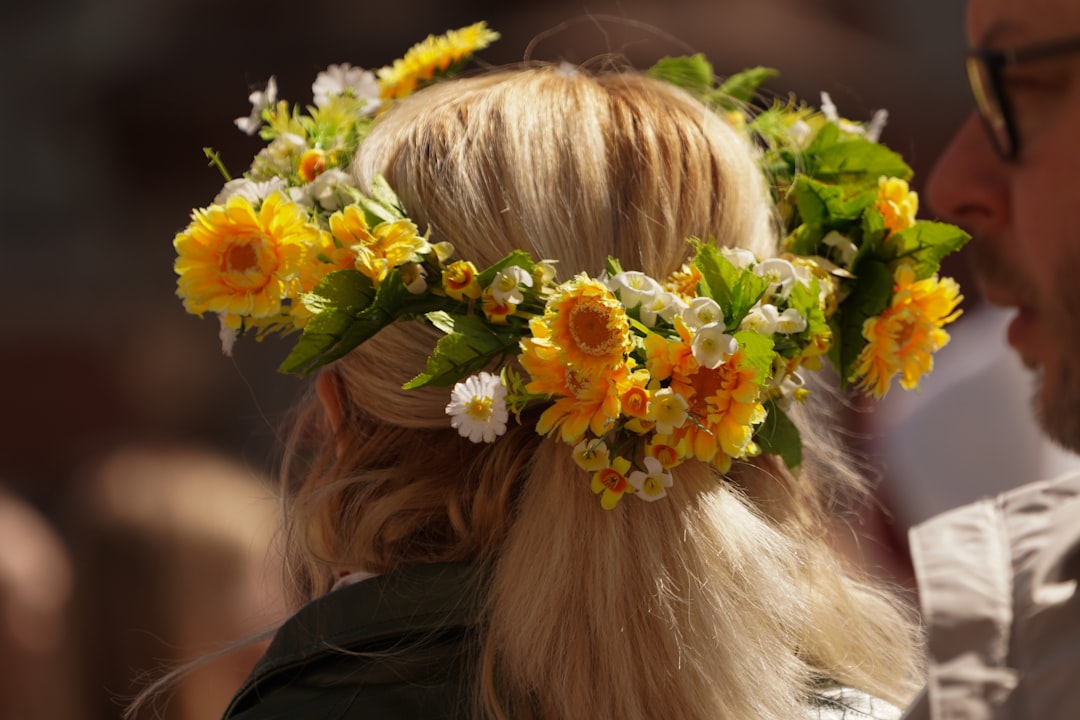
Flower crowns are not optional at Midsommar—they’re essential. Young women and girls weave elaborate crowns from fresh flowers, herbs, and greenery. The crowns are beautiful, fragrant, and serve as a visual marker of the holiday. Making a flower crown is often an activity that begins the Midsommar celebration, as families and friends gather to craft them together.
There’s a famous tradition associated with flower crowns and romantic fate: unmarried young women are supposed to pick seven different flowers (one from each neighbor’s garden, traditionally, which implies a charmingly lawless approach to private property) and place them under their pillow before sleeping on Midsommar night. In this dream, they’re supposed to see their future husband. Whether this ever actually worked is beside the point. The tradition persists because it’s charming and romantic and ties into Midsommar’s fertility themes.
Some people still practice this tradition, though in modern times it’s more often a fun activity engaged in with irony than a genuine attempt at prophetic dreaming. Still, on Midsommar night, many single Swedes go through the motions, partly out of tradition, partly out of hope, partly out of the kind of magical thinking that the long light of summer seems to encourage.
The Food: Herring, Potatoes, Strawberries, and Cream
Midsommar has a specific food tradition, one that reveals interesting things about Swedish culture. The classic Midsommar menu includes:
Gravlax and pickled herring – Several varieties of herring, prepared in different ways. The herring is essential, a connection to Sweden’s fishing heritage and long tradition of preserving food before refrigeration.
New potatoes – Small, waxy, boiled until just tender, served with fresh dill. New potatoes are a celebration of spring’s end and summer’s arrival, a vegetable that tastes fundamentally different in early summer than it does the rest of the year.
Fresh strawberries with cream – Swedish strawberries, brief and intense in flavor, served with whipped cream and sugar. This is perhaps the most iconic Midsommar dessert.
Smoked salmon and other fish – Various preparations celebrating Sweden’s abundant waters.
Meatballs and other warming foods – Because even in summer, Swedes trust that you might want warm food.
The meal is typically served as an extensive smörgåsbord, where you can graze across multiple dishes. It’s lighter than a traditional Christmas julbord but still celebratory and abundant.
Aquavit and Snaps Songs
No Midsommar celebration is complete without schnapps—typically Swedish aquavit, a caraway-flavored spirit that tastes simultaneously delicious and like drinking Christmas. Drinking aquavit comes with a specific ritual: the snaps song, or “snapsvisa.”
A snaps song is a traditional drinking song that must be sung before consuming a shot of aquavit. The songs are typically cheerful, sometimes bawdy, often referencing the food being eaten or the season being celebrated. The most famous snaps song is probably “Helan går” (The whole thing goes), which is essentially the Swedish equivalent of “Cheers!”—a rollicking celebration of communal drinking.
The protocol is strict: you don’t just drink your schnapps. You gather with others, someone leads the song (often someone designated as particularly enthusiastic), everyone sings together, and then you drink together. It’s community, it’s tradition, and it’s slightly ridiculous—all the things Swedes do best.
Even teetotalers participate in snaps songs, often making a show of drinking juice or water in place of aquavit. The point isn’t the alcohol; the point is the shared ritual.
The Midnight Sun and Summer’s Endless Light
The timing of Midsommar around the summer solstice means that in northern Sweden, the sun barely sets at all. In Stockholm, the sun doesn’t set until around 11 PM and rises again around 3 AM. In Kiruna, far in the north, the sun doesn’t set at all.
This perpetual light has a profound effect on the celebration. People dance and celebrate outside, in daylight or twilight, at times that would be considered late night in most of the world. The traditional Midsommar celebration lasts late into the night, merging into early morning, all in the presence of light.
For visitors from more southern latitudes, this experience is disorienting in a wonderful way. Your body doesn’t understand why it’s midnight when the world looks like late afternoon. Your circadian rhythm becomes confused. You find yourself getting tired around 2 AM not because it’s been a long day but because you’re genuinely exhausted, even though the sun is still shining and the world is still awake.
This light creates a sense of timelessness and abundance. The night isn’t dark; it’s just dimly golden. Time seems less linear, more cyclical. It’s intoxicating, and it goes a long way toward explaining why Swedes can be so joyful during Midsommar—they’re literally celebrating the return of light after a long darkness, and that light is so abundant it blurs the lines between day and night.
Where to Experience Authentic Midsommar
If you’re visiting Sweden during Midsommar, here are some ways to experience it authentically:
Skansen in Stockholm – This open-air museum hosts a large Midsommar celebration with traditional dancing, food, and activities. It’s somewhat touristy, but it’s genuine in its way, attracting both tourists and locals.
Dalarna region – If you can get to the rural areas, particularly towns like Rättvik or Falun, you’ll find smaller, more traditionally-oriented celebrations. This is where Midsommar culture is strongest in its most traditional forms.
With Swedish friends – The best Midsommar is one you’re invited to, at a summer cottage or garden. Many Swedes spend Midsommar in their stugans (summer cottages), and if you’re lucky enough to be invited, you’ll experience the holiday in its most authentic setting.
Parks and beaches – On Midsommar weekend, Swedes gather in parks and at beaches to dance, eat, and celebrate. Just show up with a bottle of wine and join in.
The Broader Significance
Midsommar represents something fundamental about Swedish culture: the relationship between light and darkness, the celebration of community, the importance of tradition, and the way natural cycles shape human celebration. It’s a holiday that predates Christianity—the Christian church tried to appropriate it by moving some saints’ days to align with it, but the midsummer celebration remained fundamentally pagan and seasonal.
For modern Swedes, Midsommar is a chance to step outside normal life and engage with older, deeper traditions. The flower crowns, the frog dance, the herring, the aquavit—these all connect modern Sweden to a much older past.
Experiencing Midsommar as a Visitor
If you’re visiting Sweden in June, try to time it around Midsommar. Participate in the celebrations you can access. Wear a flower crown if invited, eat the herring, sing the snaps songs (even if you don’t drink), dance around the pole, and let yourself get swept up in the peculiar joy of the midnight sun and the Swedish summer.
Midsommar is when Sweden is most itself—when the reserved exterior cracks and something wilder, more ancient, more joyful emerges. It’s worth experiencing at least once.




Leave a Reply