When you stand in front of Newgrange on a winter morning, waiting for the sunrise to penetrate deep into its stone chamber—something that won’t happen again for another 365 days—you’re experiencing something older than the Great Pyramids of Giza. That’s the thing about ancient Ireland that stops most Americans in their tracks: the monuments came first, the civilizations came after.
Before the Celts: Ireland’s Megalithic Masters
Long before the Celts arrived in Ireland, around 4000 BCE, Neolithic people were building monuments that would last longer than empires. The Brú na Bóinne complex—a UNESCO World Heritage Site in County Meath—contains some of the world’s most significant prehistoric structures, and if you only have time for one pilgrimage to ancient Ireland, this should be it.
Newgrange is the showstopper. This massive passage tomb, built around 3200 BCE, predates Stonehenge by 500 years and the Great Pyramids by nearly a millennium. It’s 85 meters in diameter, enclosed by 97 massive stones, with a central chamber accessed by a 19-meter passage lined with carved stones. But here’s what makes Newgrange genuinely magical: its builders engineered it so that the sun’s rays penetrate the inner chamber only during the winter solstice—a feat of astronomical and architectural precision that took extraordinary knowledge and labor to accomplish.
You can stand in that chamber, held your breath, and watch the sun’s light slowly illuminate the 6,000-year-old walls around you. It’s a moment that transcends tourism; it connects you directly to human ingenuity across millennia.
The Brú na Bóinne complex also includes Knowth and Dowth, equally impressive passage tombs surrounded by satellite tombs. Knowth contains two passages—one aligned to face sunrise, the other sunset—suggesting a sophisticated understanding of solar cycles. Walking through these sites feels less like visiting a museum and more like entering a conversation across time.
The Celtic Arrival: Around 500 BCE
The history gets more complicated—and more contested—when the Celts appear. The exact date of Celtic settlement in Ireland remains debated among historians. Traditional accounts suggested waves of invasions beginning around 500 BCE, but modern archaeology tells a more complex story of gradual migration, cultural mixing, and adaptation rather than dramatic conquest.
What’s clear is that by the first century CE, Ireland was thoroughly Celtic. The Celts brought iron technology, a warrior culture, and a remarkable linguistic and artistic tradition that would define Ireland for centuries. They organized themselves into túatha—small kingdoms of a few thousand people ruled by local chieftains. There was no single “Ireland” then; instead, there were dozens of competing kingdoms, a feudal patchwork of power that made the island a constant state of productive chaos.
The Druids and the Spiritual Landscape
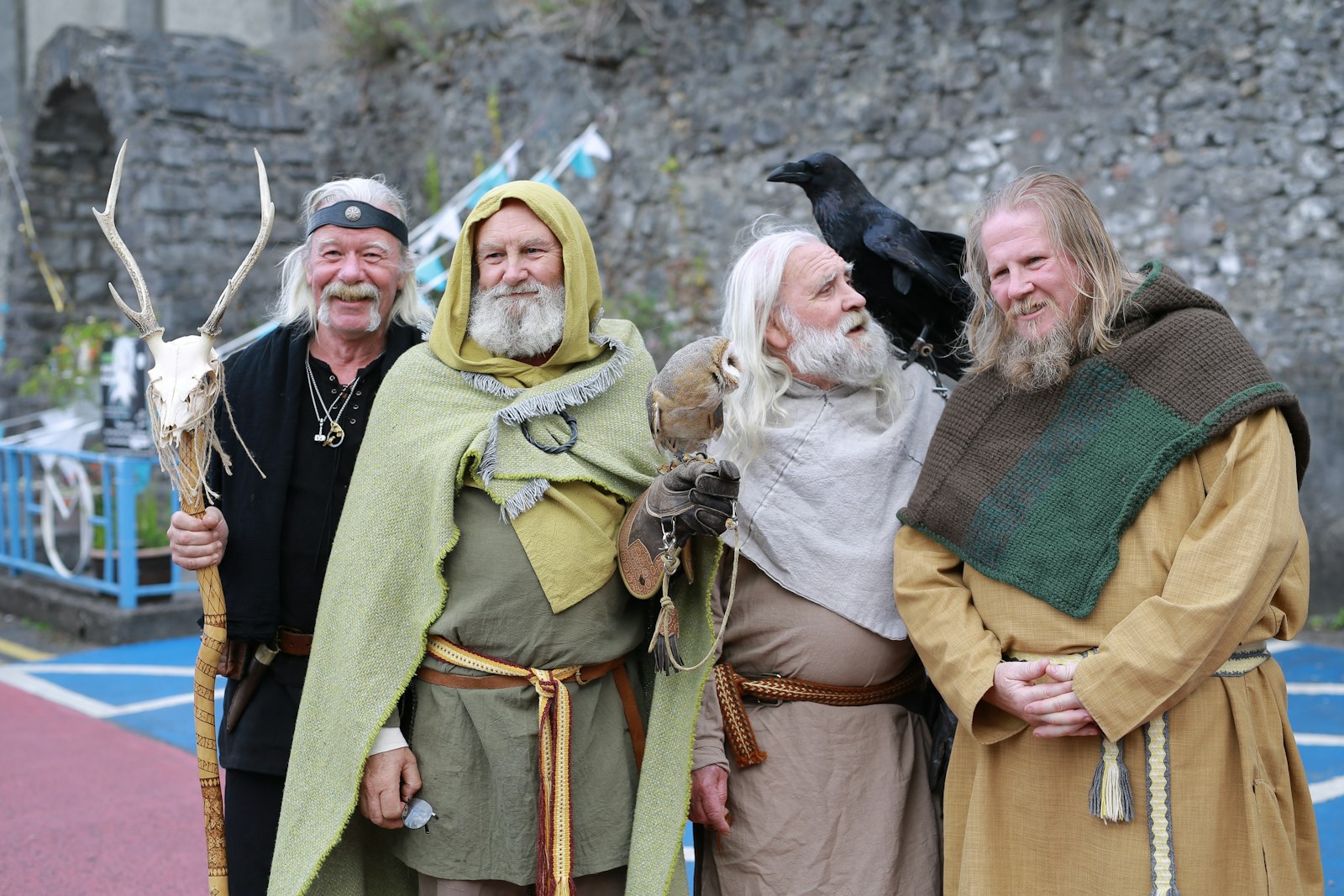
The Celts brought with them an elaborate spiritual system centered on druidic priests. Though the Druids have captured our imaginations through popular culture—conjuring images of white-robed figures in stone circles—the reality was far more sophisticated and, by Roman standards, utterly alien.
Druids weren’t just religious figures. They were philosophers, teachers, judges, and advisors to kings. They maintained oral traditions of law, science, and spiritual knowledge so complex that training to become a druid could take up to 20 years. They understood the movements of stars, the properties of plants, the subtleties of Celtic law (the Brehon Laws, which would astound medieval Europe with their sophistication).
The Druids held sacred certain natural places: wells, groves, and hills. This is why so many Irish sacred sites today sit on top of ancient hill forts where the boundary between the physical and spiritual worlds felt particularly thin.
The Hill Forts: Power and Place
For American visitors accustomed to thinking about history through buildings and cities, Irish hill forts offer something different. They’re landscape-scale monuments—huge earthworks that represent engineering projects as ambitious as any castle, created by cultures without written records or mechanical tools.
The Hill of Tara, in County Meath, was the seat of the High Kings of Ireland from around 500 BCE onwards. Standing there today, you see a landscape of earthworks—the Mound of the Hostages, the Fort of Kings, concentric rings of defensive ditches—that tells the story of power and prestige through the manipulation of land itself. Tara was never a city; it was a ceremonial and political center where major gatherings occurred. Imagine the Irish High King standing on these heights, visible for miles across the plains of Meath, and you understand how geography and symbolism combined to assert power.
On the Aran Islands, off the coast of Galway, Dún Aonghasa is even more dramatic: a massive stone fort perched on the edge of a 300-foot cliff, its outer walls still standing after 2,000 years. Built sometime between 1100 and 800 BCE, it feels simultaneously ancient and impossible—how did people build something so monumentally ambitious without modern technology? Walking along its ramparts, with the Atlantic stretching endlessly below, creates a visceral connection to those Celtic warriors who made these places home.
Stone Circles and Sacred Geometry
The stone circles scattered across Ireland—Castleruins, Drombeg, Clonagh, and dozens of others—date from the Bronze Age but were adopted and repurposed by Celtic peoples. Drombeg Stone Circle in County Cork, with its perfect 32-foot diameter, contains 17 stones arranged with remarkable precision. These circles were likely used for ritual gatherings and celestial observations, though their exact purposes remain beautifully mysterious.
Poulnabrone Dolmen, a 6,000-year-old megalithic tomb in the Burren region of County Clare, is a different structure entirely—a portal tomb where ancient peoples interred their dead. Standing beneath its massive capstone, weighing over 5 tons, you’re inside a structure built when the climate was warming and Ireland’s landscape was still being formed.
Ogham Stones: An Ancient Script
One of the most tangible connections to Celtic Ireland comes through ogham stones—standing stones carved with an ancient script that looks like a system of parallel lines and notches. Created between the 4th and 8th centuries CE, ogham served as a writing system primarily for names, many of which remain undeciphered. Scattered across the Irish landscape, particularly in the southwest, ogham stones mark ancient territories and commemorations. In museums and archaeological sites across Ireland, you’ll encounter these mysterious carved stones as concrete evidence of a literate, organized Celtic society with sophisticated systems of marking territory and commemoration.
Visiting These Worlds
For the American traveler, visiting ancient Ireland requires a shift in expectations. You won’t find reconstructed Celtic villages or theme-park approximations of hill forts (though some excellent museum exhibitions exist). Instead, you’ll stand in real places—Newgrange, Tara, Dún Aonghasa, Drombeg—and let the archaeology speak for itself.
Start at the visitor center at Brú na Bóinne, where experienced guides contextualize Newgrange, Knowth, and Dowth. Drive the back roads of the Burren in County Clare, spotting dolmens and stone circles across the limestone landscape. Take a boat to the Aran Islands to explore Dún Aonghasa. Visit Tara with a detailed guidebook that helps you parse the landscape of earthworks. Seek out local ogham stones in museums and archaeological parks.
Ancient Ireland is a landscape waiting for you to develop the patience and imagination to see it. The monuments don’t explain themselves—they can’t—but in that silence, in the physical experience of standing before structures thousands of years old, you’ll understand why the Irish have never forgotten their past. The land itself remembers.




Leave a Reply