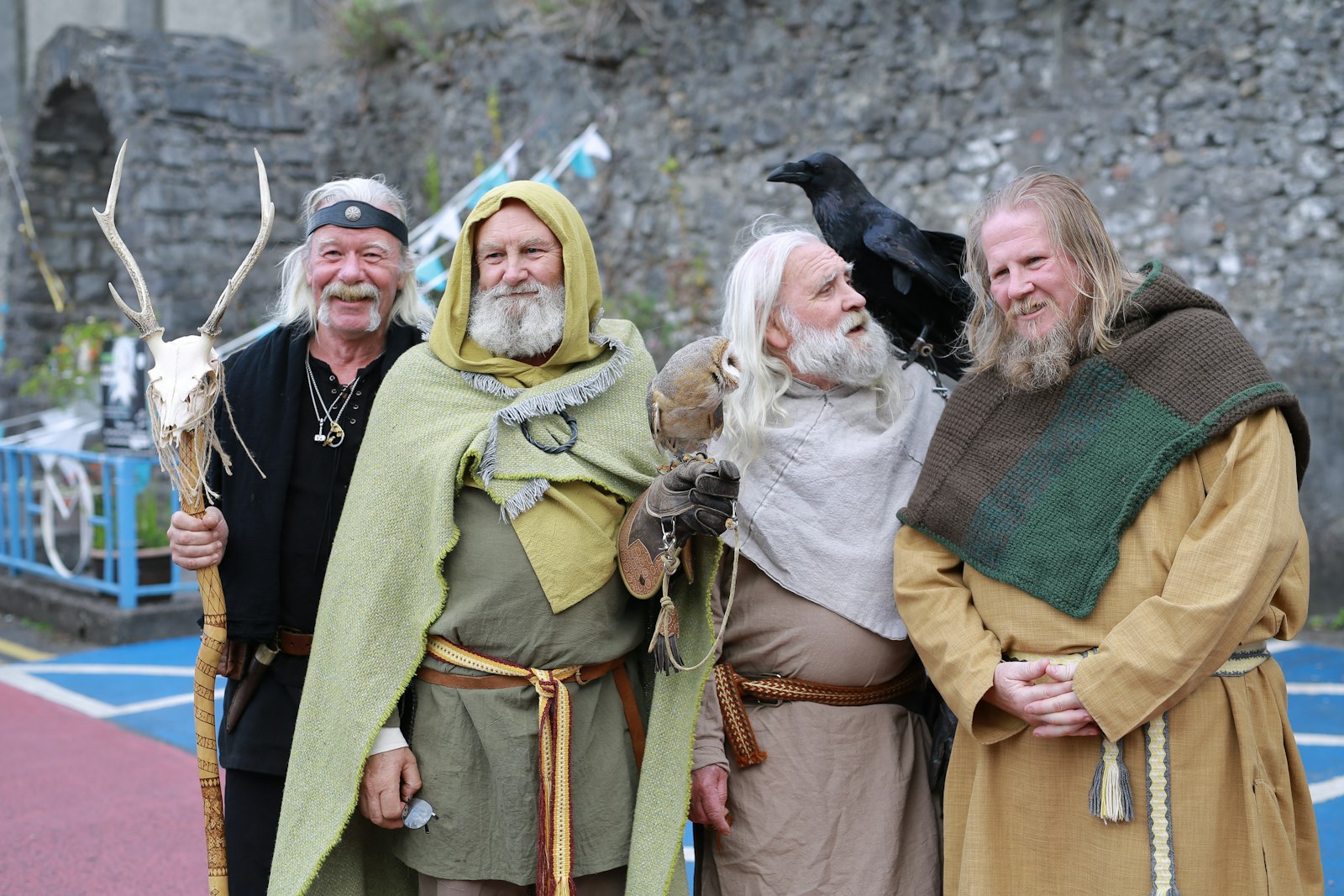
When Irish monks wrote in their manuscript margins that “Norse invasions frightened us,” they were documenting one of history’s great turning points. What most Irish chroniclers didn’t foresee was that these terrifying outsiders would fundamentally transform Ireland—particularly by creating the infrastructure of a permanent urban culture that Ireland had never quite developed before. The Vikings, despite their fearsome reputation for monastic raids, inadvertently gave Ireland a gift: cities.
The First Raids: 841 and Beyond
The Viking Age arrived in Ireland abruptly on a summer day in 841 CE when Norse longships appeared in Dublin Bay. The settlement they established wasn’t a conquest—it was a trading post designed to facilitate their expanding commercial networks across the North Atlantic. Within a few decades, Norse settlers had established a permanent foothold, creating what would become the most important port city in medieval Ireland.
Before the Vikings, “Dublin” didn’t exist. The Norsemen called their settlement Dubh Linn—the Black Pool—referring to a dark tidal pool where the Poddle River met the Liffey. The Irish called it Baile Átha Cliath (Town of the Hurdle Ford). But it was the Viking name that stuck, and Dubh Linn became Dublin, the foundation of a modern city that would one day rival London and Paris.
The Vikings weren’t unique in raiding Ireland—there had been previous raids by pirates and opportunists. But these Norsemen were different: they stayed. They intermarried with Irish women, adopted Christianity, and created a hybrid society that blended Norse maritime and commercial expertise with Irish cultural traditions. Within a century, the Norse of Dublin were as Irish as anyone else—speaking Irish, observing Irish law, and considering themselves part of the island’s complex political landscape.
Dublin’s Strategic Transformation
What made Dubh Linn so valuable? Geography. The settlement sat at a crucial junction: where the River Liffey opened to the sea, where natural harbors allowed ships to be pulled ashore, where the surrounding landscape could supply resources. The Vikings understood what Irish kingdoms had long overlooked: permanent settlements required access to maritime trade networks.
By the 10th century, Dublin had become a thriving port. Excavations at Wood Quay in the 1970s—controversial because they destroyed some medieval buildings—revealed the Viking city in extraordinary detail. Archaeologists discovered well-preserved wood and leather artifacts, household items, coins, jewelry, and the remains of Viking ships. The artifacts painted a vivid picture of a multicultural trading hub where Norse merchants purchased Irish goods (furs, wool, hides, preserved food) and sold imports (wine, luxury fabrics, metalwork) to an increasingly wealthy Irish aristocracy.
Walking Dublin’s streets today, particularly around Temple Bar and Christ Church Cathedral, you’re walking on top of a thousand years of Viking settlement. The medieval street layout of Dublin’s oldest quarter still follows the pattern established by Viking settlement plans. The names of streets recall their Viking origins: Dame Street, Copper Alley, Fish Street—the geography of commerce frozen in nomenclature.
Visiting the Viking City: Museums and Sites
Dublinia, located in the Old Synod Hall (adjacent to Christ Church Cathedral), is the essential stop for understanding Viking Dublin. The museum recreates the medieval streets with live interpreters, displaying artifacts from Wood Quay excavations, and providing detailed context about daily life, trade, and the integration of Norse settlers into Irish society. For many American visitors, Dublinia is the moment the abstract concept of “Viking Dublin” becomes real—you can hold a replica of a Viking chess piece, examine genuine medieval coins, and understand the material culture of 10th-century Dublin.
Christ Church Cathedral itself, while heavily restored in the Victorian era, contains medieval remains from the 12th century and sits on the site where the Vikings constructed wooden churches. The cathedral crypt, one of the oldest structures in Dublin, connects directly to Dublin’s Viking past. The cathedral’s existence is itself a product of Viking-Irish synthesis: built by Norse-Irish merchants who had adopted Christianity but maintained the cathedral as a symbol of their continued significance and piety.
Beyond Dublin: Viking Ireland’s Other Centers
Dublin wasn’t the only Norse city in Ireland. Waterford, at the southeastern tip of the island, had an equally dramatic origin story. Founded by Vikings in 914 CE, Waterford became an even more important port than Dublin, controlling the mouth of the River Suir and providing access to the interior of Munster.
Today, Waterford’s Viking Triangle—bounded by the rivers Suir and Barrow, with Waterford’s medieval walls—contains some of Ireland’s best-preserved medieval heritage. Reginald’s Tower, built in 1003, stands as one of the oldest stone buildings in Ireland and a magnificent symbol of Viking architectural permanence. Walking through the narrow medieval streets of Waterford’s Triangle, you can visit the Medieval Museum, housing artifacts like the Waterford Charter Roll and displays of 12th-century weaponry and trade goods.
Wexford and Limerick similarly have Viking foundations, though their medieval cores have been less preserved than Waterford’s. In Wexford, Viking settlers established another port that would play crucial roles in medieval Irish politics. In Limerick, at the junction of the River Shannon, Vikings built another fortress-port that controlled inland trade networks.
The Battle of Clontarf: Myth and Reality
The most famous conflict between Norse and Irish occurred on April 23, 1014, at Clontarf, just north of Dublin. The High King of Ireland, Brian Boru, led an Irish force against a coalition of Dublin Norse and Irish opponents. The battle’s mythology has long portrayed it as the moment when Brian Boru definitively defeated Viking power in Ireland, re-establishing Irish dominance and ending Norse expansionism.
The historical reality is more complicated. Clontarf was a significant battle, but it wasn’t the decisive blow against Viking power that legendary accounts suggest. What made it legendary, however, was that it became the origin story of Irish national resistance to foreign domination—a narrative that would be repeatedly invoked in later centuries when the Irish faced English conquest.
Brian Boru himself was a genuinely remarkable figure—one of the few High Kings of Ireland who came close to unifying the entire island under his authority. He reorganized the church, reformed the military, and used his prestige to assert power across kingdoms that had traditionally been fiercely independent. His death at Clontarf, just days after his military victory, added tragic weight to his legend. Boru became the template for the Irish national hero: a man who almost united Ireland against foreign enemies, killed at the moment of victory.
Today, the Clontarf battlefield is occupied by suburban Dublin, with only a small monument marking the site. But the cultural impact of the battle persists—it shaped how the Irish understood their relationship with outsiders and their own capacity for unity against external threats.
The Cultural Synthesis
Perhaps the most important legacy of the Viking Age in Ireland wasn’t military or political—it was cultural. The Vikings brought new skills: advanced shipbuilding, navigation techniques, and commercial organization. They introduced new architectural styles (including the rounded towers that would become iconic Irish symbols). They expanded trade networks that enriched Irish kingdoms and created a taste for luxury goods.
More profoundly, the Vikings introduced the concept of permanent, fortified urban centers. Before the Norse, Irish settlements were primarily monastic communities and rural strongholds. The Vikings demonstrated the potential of port cities as engines of wealth and power. Later Norman invaders would build on this foundation, but Dublin itself—continuously inhabited since its Viking foundation—stands as the most direct legacy of this period.
By the 12th century, the Norse of Dublin and other Irish port cities had been completely absorbed into Irish society. Their descendants remained prominent merchants and warriors, but they were Irish. The Viking Age had transformed Irish civilization, not through conquest but through the gradual integration of Norse settlers into an Irish society more resilient and adaptive than their stereotypes suggested.
When you walk Dublin’s streets, understanding that beneath your feet lie the remains of a Viking city that was thriving while Anglo-Saxon England was fragmenting and continental Europe was emerging from its Dark Ages, you grasp something crucial about Irish history: the Irish have always been at the crossroads of European currents, absorbing, adapting, and transforming outside influences into something distinctly Irish.




Leave a Reply