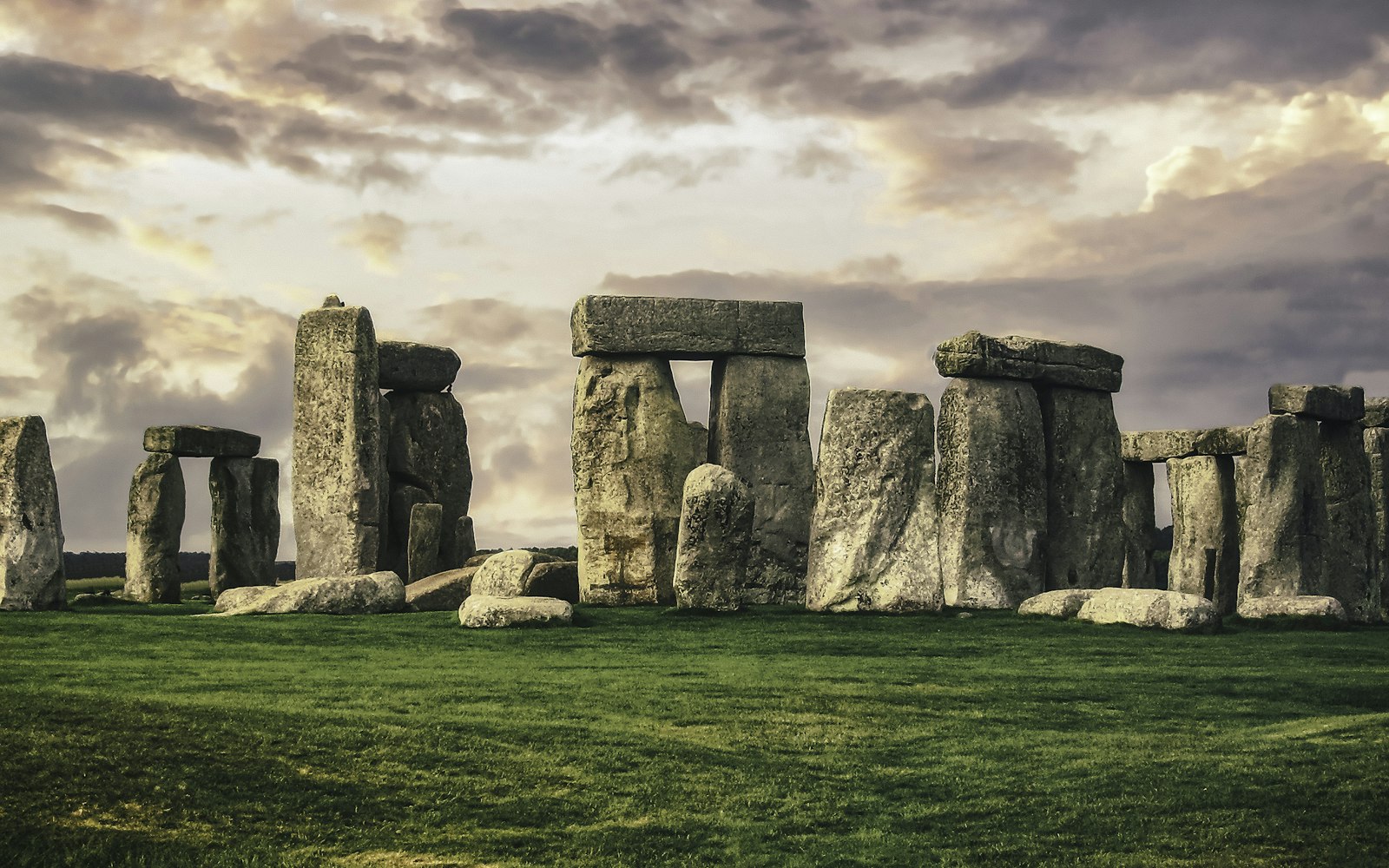
Stonehenge is perhaps the most mysterious monument in Britain. Massive stones arranged in circles, built 5,000 years ago on the Salisbury Plain, Stonehenge has captured human imagination for millennia. We don’t know exactly why the ancients built it, who built it, or how they managed the feat with prehistoric technology. That mystery—combined with the undeniable majesty of the site itself—makes Stonehenge one of the most visited archaeological sites in the world.
For American visitors, Stonehenge represents something our newer continent can’t offer: evidence of sophisticated human culture from 5,000 years ago. While Americans were building early mound societies, Britain’s Neolithic inhabitants were creating monumental architecture that required planning, engineering, and social coordination on a massive scale.
The Stones Themselves: A Puzzle in Rock
Stonehenge consists of roughly 80 stones arranged in concentric circles. The outer sarsen stones—large slabs of sandstone—were quarried from Wiltshire, about 20 miles away. The inner bluestones are smaller slabs of dolerite and rhyolite, apparently transported from the Preseli Mountains in Wales—nearly 250 miles away. How stones weighing up to 50 tons were moved across ancient Britain remains mysterious.
The stones were arranged with astronomical precision. The main axis of Stonehenge aligns with the sunrise at the summer solstice (around June 21st) and the sunset at the winter solstice (around December 21st). This isn’t accidental—it demonstrates that whoever built Stonehenge understood astronomical principles and attempted to align their monument with celestial events.
Construction began around 3100 BCE and occurred in several phases, continuing for over 1,500 years. The monument wasn’t built all at once but was gradually elaborated and modified. This suggests that Stonehenge was sufficiently important that successive generations maintained and expanded it across centuries.
Theories About Stonehenge’s Purpose
Archaeologists have proposed various explanations for Stonehenge’s purpose:
Religious or Ceremonial Site: The most widely accepted theory is that Stonehenge was a temple or ceremonial center, possibly for ancestor worship or fertility rituals. The concentration of burials near Stonehenge suggests it was a sacred burial site.
Healing Temple: Medieval legends suggested that the stones had healing properties. Archaeological evidence shows that people traveled from across Britain and Europe to Stonehenge, possibly seeking cures for illnesses.
Astronomical Observatory: The astronomical alignment suggests that Stonehenge functioned as a calendar, marking the solstices and possibly used to predict lunar eclipses. Priests or leaders with astronomical knowledge could maintain their authority by accurately predicting celestial events.
Political Monument: The sheer effort required to build Stonehenge suggests that it expressed political power. A society capable of organizing hundreds of workers, moving massive stones, and sustaining the project across generations was demonstrating its organizational sophistication.
The truth is probably that Stonehenge served multiple purposes—religious, astronomical, and political—simultaneously. Prehistoric monuments often had layers of meaning, and Stonehenge’s significance may have changed across the 1,500+ years of its construction and use.
Visiting Stonehenge: Managing Expectations
Visiting Stonehenge can be disappointing if you’re expecting to walk among the stones and experience them intimately. Modern archaeological protection requires that visitors stay behind a rope barrier, roughly 50 meters from the stones. This prevents damage but creates distance.
However, the site is still impressive. Standing on the Salisbury Plain and seeing the stones rising against the sky, you get a sense of their monumental scale and the effort required to place them. The landscape itself—open chalk downland with distant views—adds to the contemplative quality of the site.
The visitor center, built underground to minimize visual impact, provides excellent context about prehistoric Britain. Exhibits explain the construction theories, the astronomical alignment, and the artifacts discovered at the site. The reconstruction of a Neolithic village helps visitors understand how people lived during the time Stonehenge was built.
Many visitors find that seeing Stonehenge at the solstices is the most powerful experience. The summer solstice (around June 21st) draws thousands of people to watch the sunrise align with Stonehenge’s axis. It’s a genuine spiritual experience for many, though also crowded and somewhat chaotic.
For American visitors, it’s worth managing expectations: Stonehenge is a remote archaeological site, not a tourist attraction with museums and restaurants immediately adjacent. The impact comes from standing on ancient ground and contemplating the effort and meaning behind these enduring stones.
Avebury: A Larger but Less Famous Circle
If Stonehenge is Britain’s most famous prehistoric monument, Avebury is in some ways more impressive. The Avebury stone circle is larger than Stonehenge and features an exceptional advantage: you can walk among the stones.
Avebury consists of three stone circles, the largest surrounding a small English village. The outer circle is about 430 meters in diameter and originally contained nearly 100 stones. Remarkably, the village of Avebury was built within the prehistoric monument, and houses literally sit inside the ancient circles. This creates the surreal experience of walking down village streets that pass through 5,000-year-old arrangements of stone.
The atmosphere at Avebury is entirely different from Stonehenge. There’s no visitor center, no rope barriers, no sense of being at a major tourist site. Instead, you walk among the stones, and you can touch them. Placing your hand on a stone that’s stood in place for 5,000 years creates a visceral connection to the past.
Archaeologically, Avebury is fascinating. The circles are contemporary with Stonehenge, suggesting a shared Neolithic culture. But while Stonehenge appears to be a specialized religious or astronomical site, Avebury appears to have been a gathering place for communities. The village at its center suggests it remained important to people for millennia.
Walking around Avebury at sunset, the stones catching the evening light, you get a profound sense of human continuity. People have gathered at this place for 5,000 years—initially for Neolithic ceremonies, later for medieval fairs, now as a quiet place for reflection and contemplation.
Skara Brae: Neolithic Housing in Orkney
While Stonehenge and Avebury are monuments, Skara Brae in Orkney (an island group north of Scotland) offers something equally valuable: evidence of how Neolithic people actually lived. Skara Brae is a Neolithic village preserved under sand dunes, dating to around 3100-2500 BCE.
The village consists of several stone houses connected by covered passages. Each house features a central hearth (fireplace) and stone furniture—beds, shelves, and storage boxes. The fact that the houses were built of stone (because trees were scarce in Orkney) means they’ve survived 5,000 years relatively intact.
Walking through the excavated village, you see how people lived: families gathered around the fire, sleeping on stone platforms, storing possessions in stone boxes. The architecture is efficient, designed to retain heat in Orkney’s cold climate. The landscape—open, windswept, treeless—is harsh but clearly supported a community that remained here for centuries.
Skara Brae is important because it demonstrates that Neolithic Britain wasn’t primitive or backward. The people living here had sophisticated understanding of architecture, weather, and comfort. They created art, jewelry, and decorated pottery. Their society had enough surplus resources that they could build monuments like Stonehenge and Avebury.
The Orkney Islands are worth visiting for their Neolithic archaeology generally. The Ring of Brodgar, Stenness, and numerous burial mounds all attest to a culture that valued monumental architecture. The islands’ isolation from mainland Britain suggests that Orkney developed along somewhat independent lines while still maintaining connections to broader British culture.
Callanish Stones: Neolithic Mystery in the Hebrides
The Callanish Stones on the Isle of Lewis in the Outer Hebrides are another impressive Neolithic monument. Dating to around 1500 BCE (slightly later than Stonehenge), they consist of around 13 large stones arranged in a rough cross pattern, with a central circle. Unlike Stonehenge’s fame, Callanish remains relatively obscure, which means visitors can often experience them in solitude.
The stones stand on a headland overlooking Loch Roag, with the Hebridean landscape stretching away. The atmosphere is remote and contemplative. Local folklore attributes the stones to a giant woman, and they’re sometimes called a “temple of the moon” because they appear to mark lunar standstills.
The accessibility of Callanish—you can walk among the stones freely—and their remote setting make them a profound experience for many visitors. The Hebrides themselves are remote and austere, and standing among 4,500-year-old stones on these windswept islands feels genuinely liminal, as though you’re at the edge of the known world.
Barrows and Burial Mounds: Honoring the Dead
Beyond the famous stone circles, prehistoric Britain is dotted with barrows—burial mounds that contain the remains of Neolithic or Bronze Age peoples. These earthworks, sometimes covered in turf and now appearing as natural hills, actually contain stone chambers with skeletal remains and grave goods (pottery, tools, jewelry).
Notable barrows include Newgrange in Ireland (actually pre-dating Stonehenge and aligned with the winter solstice sunrise) and numerous examples across Britain. Many are accessible to visitors—you can crawl into the stone chambers and stand in burial spaces where people were interred 5,000 years ago.
These barrows are important because they show that Neolithic and Bronze Age people cared deeply about the dead, invested significant effort in burial practices, and apparently believed in an afterlife. The grave goods suggest they thought the dead would need objects in the next life. The scale of some barrows—some contain multiple chambers and required enormous labor to construct—suggests that chieftains or important people received elaborate burials.
Understanding Prehistoric Britain
The archaeological evidence from Stonehenge, Avebury, Skara Brae, and other Neolithic and Bronze Age sites shows that prehistoric Britain was far from primitive. These were sophisticated societies with:
- Planning and organization: Building monuments like Stonehenge required coordinating hundreds of workers, organizing quarrying and transportation, and maintaining effort across generations.
- Astronomical knowledge: The alignment of monuments with celestial events shows sophisticated observation of the sky.
- Artistic sensibility: Pottery, jewelry, and carved stone objects show aesthetic sense and craftsmanship.
- Social hierarchy: The resources concentrated in monumental building suggest that some people had authority to organize community labor.
- Spiritual beliefs: The monuments and burials suggest beliefs about the sacred and the afterlife.
These societies lacked writing and metals (in the early Neolithic), but they weren’t less intelligent or capable than later peoples. They adapted to their environment, created sophisticated social systems, and expressed their beliefs and values through monumental architecture.
The Summer Solstice at Stonehenge: A Pilgrimage
Many visitors make the effort to experience Stonehenge during the summer solstice sunrise (around June 21st). Thousands of people gather—New Age seekers, tourists, local people, and archaeologists—to watch the sun rise aligned with Stonehenge’s axis.
The experience is genuinely moving. As dawn approaches, the crowd quiets. As the sun rises and its first rays align with the stone arrangement, many people applaud or cheer. It’s a moment of connection—people 5,000 years ago arranged stones to capture this same moment, and here you are, participating in a ceremony that transcends millennia.
This experience reveals something important about Stonehenge: whatever its original purpose, it has become a focal point for human spiritual seeking. People continue to gather here to contemplate existence, to mark the turning of the year, to connect with something larger than themselves. In that sense, Stonehenge continues to serve a sacred function, even if we can’t fully understand its original purpose.
Stonehenge and American Visitors
For American visitors, Stonehenge offers something our own history can’t provide: tangible connection to human civilization thousands of years old. The oldest structures in America are often only centuries old. Stonehenge is 5,000 years old—standing at the boundary of recorded history.
Visiting Stonehenge means contemplating human persistence and ingenuity across vast spans of time. The people who built it had the same human minds we do, the same capacity for cooperation and creation, even without written language or modern technology. Their ability to move massive stones, align them with celestial events, and create monuments that survived 5,000 years is genuinely impressive.
Stonehenge also raises profound questions about human nature. Why do we create monuments? Why do we gather in sacred places? Why do we mark the turning of seasons? Why do we bury our dead with care and ritual? These are universal human behaviors, evident in Neolithic Britain and in modern America. Stonehenge reminds us of our continuity with our ancestors and the universality of human meaning-making.




Leave a Reply