Georgia
Your complete guide to Georgia
Quick Facts
Capital
Tbilisi
Population
3.997 million
Languages
Georgian (official) 87.6%, Azeri 6.2%, Armenian 3.9%, Russian 1.2%, other 1% (2014 est.)
Currency
laris (GEL)
Area
69,700 sq km
Government
Semi-presidential republic
About Georgia
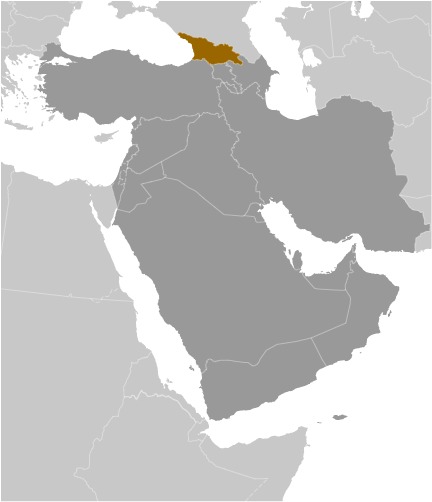
Georgia straddles the boundary between Europe and Asia in the South Caucasus, a mountainous land of ancient churches, terraced vineyards, and legendary hospitality. Its position on the historic Silk Road has given it a culture that blends Eastern and Western influences in uniquely Georgian ways.
Tbilisi, the capital, tumbles down hillsides above the Mtkvari River, its sulfur baths, Art Nouveau balconies, and modernist Bridge of Peace encapsulating the country's layered history. Beyond the capital, the cave monasteries of Vardzia, the towers of Svaneti, and the vineyards of Kakheti offer extraordinary diversity within a compact territory.
Georgia claims to be the birthplace of winemaking — archaeological evidence of grape cultivation dates back 8,000 years — and the qvevri method of fermenting wine in buried clay vessels is UNESCO-recognized. Combined with a cuisine centered on khachapuri, khinkali, and abundant fresh herbs, Georgian hospitality makes the country an emerging culinary destination.
History
Georgia's recorded history stretches to the ancient kingdoms of Colchis and Iberia. Christianity was adopted as the state religion in the fourth century, making Georgia one of the world's oldest Christian nations. The medieval Golden Age under Queen Tamar (1184–1213) saw Georgian culture, architecture, and literature flourish before Mongol invasions brought decline.
Centuries of Persian and Ottoman pressure were followed by incorporation into the Russian Empire in the early nineteenth century. A brief independence from 1918 to 1921 ended with Soviet annexation. Since regaining independence in 1991, Georgia has navigated wars in Abkhazia and South Ossetia, the 2003 Rose Revolution, and a 2008 war with Russia, all while pursuing Euro-Atlantic integration.
The region of present day Georgia contained the ancient kingdoms of Colchis and Kartli-Iberia. The area came under Roman influence in the first centuries A.D., and Christianity became the state religion in the 330s. Domination by Persians, Arabs, and Turks was followed by a Georgian golden age (11th-13th centuries) that was cut short by the Mongol invasion of 1236. Subsequently, the Ottoman and Persian empires competed for influence in the region. Georgia was absorbed into the Russian Empire in the 19th century. Independent for three years (1918-1921) following the Russian revolution, it was forcibly incorporated into the USSR in 1921 and regained its independence when the Soviet Union dissolved in 1991. Mounting public discontent over rampant corruption and ineffective government service…
CIA World Factbook
Culture & Society
Georgian culture is defined by its polyphonic singing — three-part vocal harmonies inscribed by UNESCO — its distinctive alphabet (one of only fourteen unique writing systems in the world), and its epic poetic tradition, epitomized by Shota Rustaveli's The Knight in the Panther's Skin. The supra, a traditional feast governed by a tamada (toastmaster), is the centerpiece of Georgian social life, featuring elaborate toasts, abundant wine, and dishes like satsivi and churchkhela.
Languages: Georgian (official) 87.6%, Azeri 6.2%, Armenian 3.9%, Russian 1.2%, other 1% (2014 est.)
Religions: Orthodox (official) 83.4%, Muslim 10.7%, Armenian Apostolic 2.9%, other 1.2% (includes Catholic, Jehovah's Witness, Yazidi, Protestant, Jewish), none 0.5%, unspecified/no answer 1.2% (2014 est.)
Ethnic Groups: Georgian 86.8%, Azeri 6.3%, Armenian 4.5%, other 2.3% (includes Russian, Ossetian, Yazidi, Ukrainian, Kist, Greek) (2014 est.)
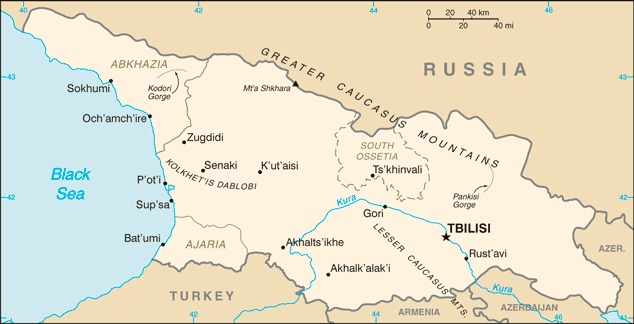
Maps
Articles About Georgia
Destinations
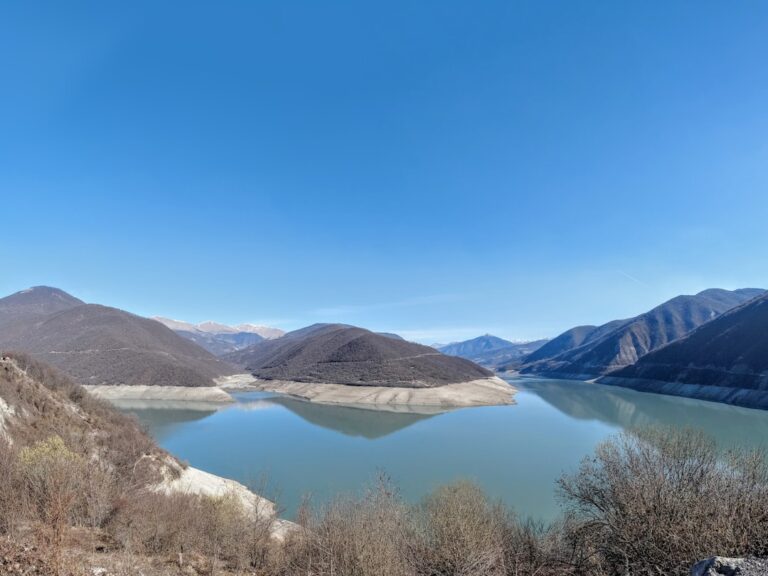
Georgia and Armenia: Where Europe Meets Asia
At the crossroads of Europe and Asia, wedged between the Greater Caucasus mountains and the borders of Turkey, Iran, and…
Travel
Georgia and Armenia: Where Europe Meets Asia
At the crossroads of Europe and Asia, wedged between the Greater Caucasus mountains and the borders of Turkey, Iran, and…