For nearly 800 years, from the Umayyad conquest of 711 AD to the fall of Granada in 1492, much of the Iberian Peninsula was under Muslim rule. The territory, known as Al-Andalus, became one of medieval Europe’s most advanced civilizations — a place where Islamic, Christian, and Jewish cultures coexisted in a complex and often fractious arrangement that nonetheless produced astonishing achievements in architecture, science, philosophy, and agriculture. Today, southern Spain is saturated with the legacy of this era, visible not only in its most famous monuments but in everyday language, food, urban planning, and the very landscape itself.
The Alhambra: A Palace of Water and Light
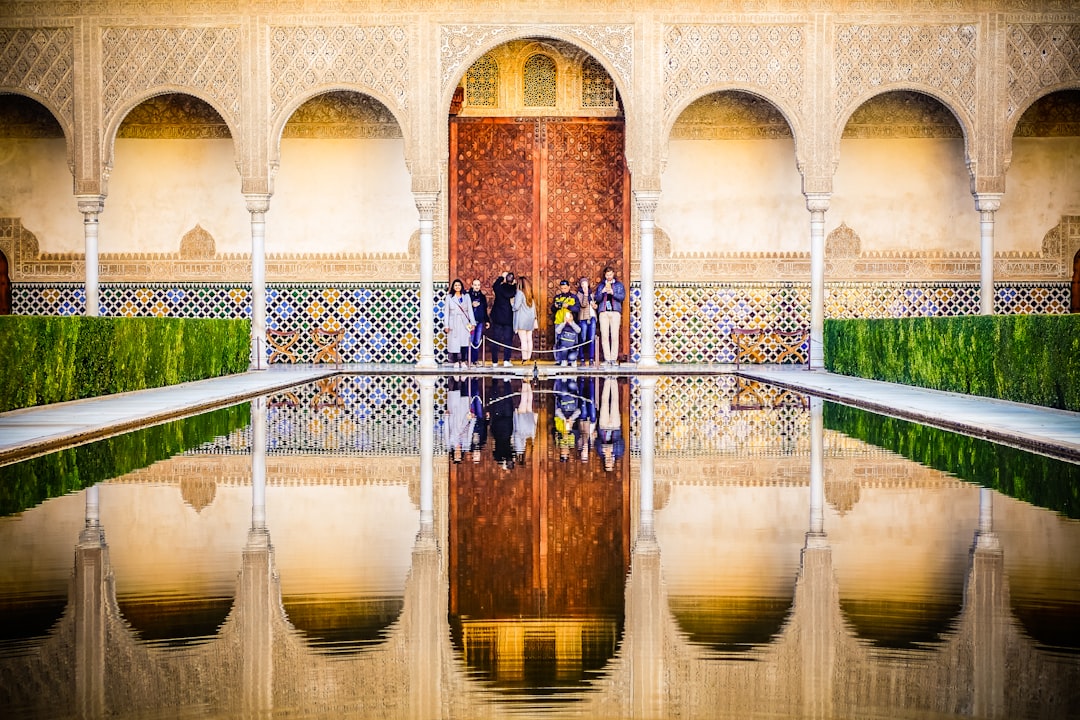
The Alhambra in Granada is the supreme achievement of Moorish architecture in Europe. Built primarily during the Nasrid dynasty in the thirteenth and fourteenth centuries, this palace-fortress complex crowns a hill overlooking the city with the snow-capped Sierra Nevada as its backdrop. The Nasrid Palaces are the emotional center — a sequence of rooms and courtyards where every surface is covered with intricate stucco carvings, geometric tile work (zellij), and Arabic calligraphy. The Court of the Lions, with its famous fountain supported by twelve marble lions, and the Court of the Myrtles, where a still reflecting pool mirrors the architecture with mathematical precision, represent the pinnacle of Islamic decorative arts in western Europe.
What makes the Alhambra transcendent rather than merely impressive is its relationship with water. Channels, fountains, and pools appear throughout, fed by an ingenious hydraulic system that carries water from the Darro River along a six-kilometer canal built in the thirteenth century. In a dry Mediterranean climate, the controlled presence of flowing water was the ultimate expression of power and paradise — the Quran’s descriptions of heaven emphasize gardens with flowing streams, and the Alhambra was designed as an earthly echo of that vision.
The Mezquita: Córdoba’s Forest of Columns
In Córdoba, the Mezquita — the Great Mosque, now officially the Cathedral of Our Lady of the Assumption — is one of the world’s most architecturally disorienting buildings. Construction began in 784 AD under Abd al-Rahman I and expanded over two centuries until it became one of the largest mosques in the Islamic world. Inside, more than 850 columns of jasper, onyx, marble, and granite support a mesmerizing double tier of red-and-white-striped horseshoe arches that create the impression of an endless stone forest. The effect is deliberately hypnotic, designed to evoke infinity.
After the Christian reconquest of Córdoba in 1236, a cathedral was inserted directly into the mosque’s center in the sixteenth century. The juxtaposition is jarring — a Renaissance nave erupting from the mosque’s rhythmic arcades — but it creates a building that is a physical record of Al-Andalus’s layered history. Charles V, who had authorized the cathedral’s construction, reportedly said upon seeing the result: “You have built here what you or anyone might have built anywhere else, but you have destroyed what was unique in the world.”
Seville’s Alcázar and Beyond
The Real Alcázar of Seville is a fascinating hybrid. Though it served as a Moorish fortress from the tenth century, much of its current form was built in the fourteenth century by the Christian king Peter I of Castile, who employed Muslim craftsmen from Granada and Toledo to create a palace in the Mudéjar style — a uniquely Iberian fusion of Islamic decorative techniques with Christian patronage. The result is indistinguishable from “authentic” Moorish work to the untrained eye, which raises interesting questions about cultural ownership and artistic identity. The Alcázar’s gardens, with their tiled fountains, orange trees, and pavilions, are among the most beautiful in Spain and have served as a filming location for Game of Thrones.
Convivencia and Cultural Fusion
The concept of convivencia — “living together” — describes the periods of relative coexistence among Muslims, Christians, and Jews in Al-Andalus. This was never a utopia; there were massacres, forced conversions, and rigid social hierarchies. But there were also remarkable periods of cultural cross-pollination. In twelfth-century Toledo, teams of scholars — Christian, Muslim, and Jewish — collaborated to translate Greek philosophical and scientific texts from Arabic into Latin, transmitting the works of Aristotle, Ptolemy, and Galen to western Europe and helping spark the intellectual revival that led to the Renaissance.
The Moorish legacy lives on in approximately 4,000 Spanish words derived from Arabic: alcalde (mayor), almohada (pillow), azúcar (sugar), naranja (orange), ojalá (“God willing”). It shaped Spain’s agricultural landscape through sophisticated irrigation systems — acequias — that transformed arid regions into productive farmland, particularly in Valencia and Murcia. The noria waterwheels still turning in some Spanish towns are direct descendants of Moorish technology. Even the tradition of decorative tile work that defines so much of Iberian and Latin American architecture traces directly to Moorish craftsmen and their geometric mastery.
To visit southern Spain without engaging with its Moorish history is to see only half of what made this region extraordinary. The architecture is magnificent, but it is merely the most visible layer of a cultural inheritance that runs deep beneath the surface of modern Spanish life.




Leave a Reply