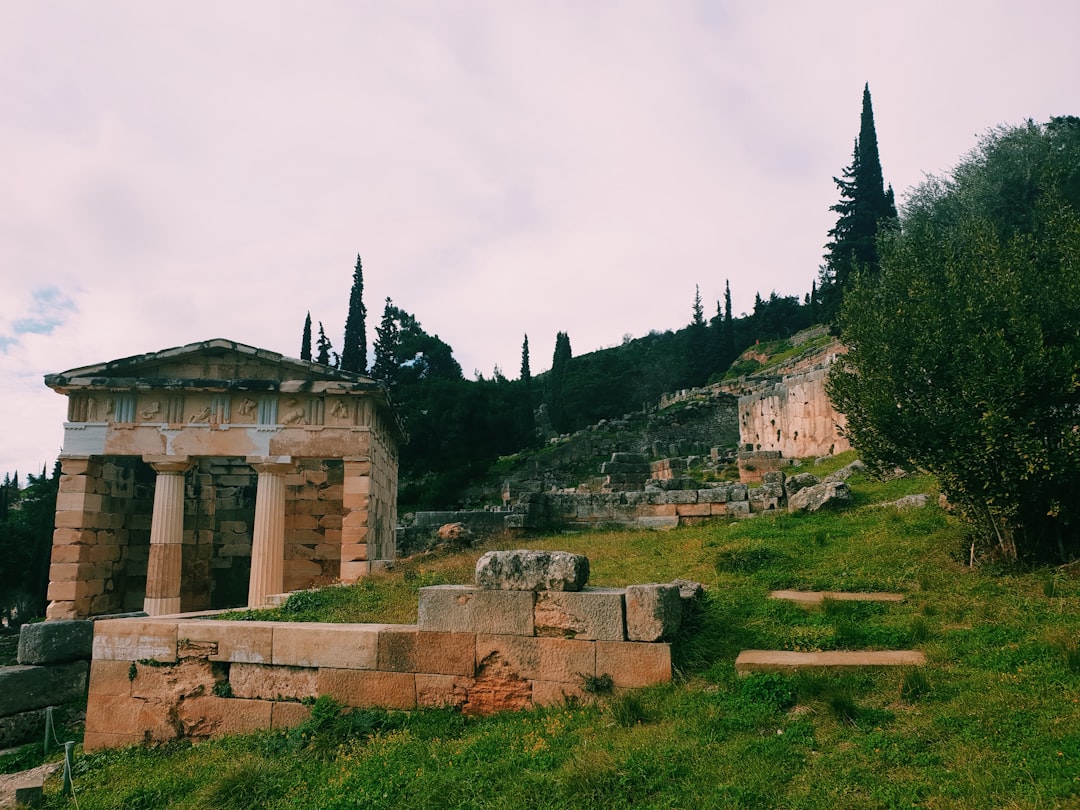
Athens gets the lion’s share of attention when it comes to ancient Greece, and rightly so — the Acropolis is one of civilization’s great monuments. But the ancient Greek world extended far beyond Athens, and some of its most powerful sites lie in the mountains and valleys of the Peloponnese and central Greece. Delphi, where the ancient world went to consult the gods. Olympia, where the Olympic Games were born. Mycenae, where the Bronze Age civilization that preceded classical Greece left massive stone ruins that the later Greeks themselves could only attribute to giants. These sites, less crowded and often more atmospheric than the Athenian landmarks, reward visitors with a deeper and more varied understanding of Greek antiquity.
Delphi: The Navel of the World
The ancient Greeks considered Delphi the center of the world — the omphalos, or navel. According to myth, Zeus released two eagles from opposite ends of the earth, and they met at Delphi. The sanctuary’s real power, however, came from the Oracle — the Pythia, a priestess of Apollo who delivered prophecies from a tripod seat over a chasm in the rock. For over a thousand years, from roughly the eighth century BC to the fourth century AD, kings, generals, and ordinary citizens traveled to Delphi to seek divine guidance on matters ranging from military campaigns to marriage decisions.
The physical setting of Delphi is extraordinary. The sanctuary clings to the steep slopes of Mount Parnassus, with the Pleistos Valley dropping away below and cliffs rising above. The Sacred Way zigzags uphill past the foundations of treasuries — small temple-like buildings where city-states stored their offerings — to the Temple of Apollo, where the Oracle sat. Higher still, a well-preserved theater seats 5,000 and offers vertiginous views over the sanctuary and valley. At the very top, a stadium that once held the Pythian Games, second only to the Olympics in prestige, stretches along a narrow terrace. The on-site museum is outstanding, housing the famous bronze Charioteer, one of the finest surviving Greek bronzes, with inlaid glass eyes that still seem to gaze into the distance with unnerving calm.
Olympia: Where the Games Began
In a lush river valley in the western Peloponnese, the sanctuary of Olympia hosted the Olympic Games every four years from 776 BC to 393 AD — over a millennium of continuous athletic competition. The site today is a sprawling ruin, but the stadium is remarkably intact: the stone starting blocks, with carved grooves for the runners’ toes, remain in place, and the track — approximately 192 meters, one stadion — is clearly defined. Standing at the starting line where the first Olympic athletes crouched is one of those rare travel moments where history collapses into the present.
The Temple of Zeus at Olympia once housed one of the Seven Wonders of the Ancient World — a 13-meter-tall chryselephantine (gold and ivory) statue of Zeus by the sculptor Pheidias. The temple’s massive column drums, toppled by earthquakes, litter the ground like enormous stone drums. Pheidias’s workshop, identified by the discovery of tools, molds, and a cup inscribed “I belong to Pheidias,” has been excavated nearby. The Archaeological Museum of Olympia is among Greece’s finest, displaying the temple’s sculptural program — the pediments depicting the chariot race of Pelops and the battle of the Lapiths and Centaurs — in a hall designed to replicate the temple’s dimensions.
Mycenae: The Bronze Age Citadel
Mycenae sits on a rocky hilltop in the northeastern Peloponnese, commanding the plain of Argos with an authority that remains palpable even in ruin. This was the capital of the Mycenaean civilization, which dominated the eastern Mediterranean from roughly 1600 to 1100 BC — the world Homer described in the Iliad and Odyssey. The Lion Gate, the main entrance to the citadel, is topped by a massive limestone relief of two lions flanking a column — the oldest monumental sculpture in Europe, dating to around 1250 BC. The Cyclopean walls, built of enormous limestone blocks weighing several tons each, were so named because later Greeks believed only the mythical Cyclopes could have moved such stones.
Inside the citadel, Heinrich Schliemann’s 1876 excavation of Grave Circle A uncovered a trove of gold artifacts including the so-called Mask of Agamemnon — a golden death mask that Schliemann (probably incorrectly) attributed to the legendary king. The mask is now in the National Archaeological Museum in Athens, but Mycenae itself retains the Treasury of Atreus (also called the Tomb of Agamemnon), a spectacular tholos tomb with a corbelled dome that was the largest enclosed space in Europe until the Roman Pantheon, built over a thousand years later.
Epidaurus: The Theater That Whispers
A short drive from Mycenae, the ancient theater of Epidaurus is the best-preserved classical Greek theater and one of the great acoustic marvels of the ancient world. Built in the fourth century BC, it seats approximately 14,000 spectators in 55 rows of limestone seats that climb the hillside in a near-perfect semicircle. Its acoustics are legendary: a coin dropped on the circular orchestra floor can be heard in the highest row. Modern acoustic studies have attributed this phenomenon to the limestone seats themselves, which filter out low-frequency background noise while reflecting the higher frequencies of human speech. The theater still hosts performances during the annual Athens-Epidaurus Festival, and seeing a Greek tragedy performed here under the stars is an unforgettable experience.
Planning a Peloponnese Road Trip
- Rent a car in Athens or Nafplio. Public transport to these sites is limited and infrequent.
- A five-day itinerary works well: Athens to Delphi (day one), Delphi to Olympia via the Rio-Antirrio Bridge (day two), Olympia to Mycenae (day three, with stops at ancient Messene or Megalopolis), Mycenae and Epidaurus (day four), return to Athens via the Corinth Canal (day five).
- The Corinth Canal, cut through solid rock in the 1890s, is worth a stop — it is only 6.3 kilometers long but slices through rock walls 90 meters high.
- Visit archaeological sites early in the morning to avoid both crowds and heat, particularly in summer when temperatures regularly exceed 35 degrees Celsius.
Ancient Greece beyond Athens reveals a civilization of extraordinary range — from the mystical pronouncements of the Delphic Oracle to the sweating athletes of Olympia, from the warrior culture of Mycenae to the refined aesthetics of Epidaurus. These sites deserve the journey.




Leave a Reply