Introduction
Portugal is a country of stunning geography—from the hillside streets of Lisbon to the sandy beaches of the Algarve, from Porto‘s riverside vistas to the quiet mountains of the interior. Getting around efficiently requires navigating trains, trams, buses, taxis, and sometimes your own two feet up steep cobblestone streets.
The good news: Portuguese transportation infrastructure is excellent and relatively affordable. The better news: most transportation workers speak some English. But having the language gives you independence, helps you negotiate better, and makes the experience infinitely more enjoyable.
In this guide, we’ll cover everything from buying tickets to understanding road signs, from navigating Lisbon‘s trams to renting a car for country drives.
Train Travel & CP (Comboios de Portugal)
Portugal’s national railway company is CP, and it’s the most extensive way to travel between cities. Understanding train vocabulary is crucial:
General Train Phrases
- Gostaria de um bilhete para… (goosh-tuh-REE-uh duh oom bee-LYET-uh PAH-ruh…) – I’d like a ticket for…
Quero ir para Porto (KEH-roo eer PAH-ruh POR-too) – I want to go to Porto
Ida e volta (EE-duh ee VOL-tuh) – Round trip
Só ida (so EE-duh) – One way
Quanto custa? (KWAN-too KOOSH-tuh?) – How much does it cost?
Qual é a próxima saída? (kwal eh uh PROK-see-muh suh-EE-duh?) – What’s the next departure?
A que horas chega em…? (uh kuh OR-ush SHEH-guh em…?) – What time does it arrive in…?
Tem uma ligação para…? (tem OO-muh lee-guh-SOWN PAH-ruh…?) – Is there a connection to…?
Quanto tempo leva? (KWAN-too TEM-poo LEH-vuh?) – How long does it take?
Que comboio é este? (kuh kohm-BOY-oo eh ES-tuh?) – What train is this?
Train Types & Classes
Alfa (AL-fuh) – High-speed train, the fastest and most expensive option
InterCidades (in-ter-see-duh-DUSH) – Inter-city trains, slower than Alfa but more affordable
Regional (ruh-zhee-uh-NAHL) – Regional trains, stop at many stations
Urbano (ur-BAH-noo) – Local/commuter trains
Primeira classe (pree-MAY-ruh KLAH-suh) – First class
Segunda classe (suh-GOON-duh KLAH-suh) – Second class
At the Station
Estação de comboios (esh-tuh-SOWN duh kohm-BOY-oosh) – Train station
Bilheteira (bee-lyuh-TAY-ruh) – Ticket office
Reserva de bilhete (ruh-ZER-vuh duh bee-LYET-uh) – Ticket reservation
Plataforma (pluh-tuh-FOR-muh) – Platform
Sala de espera (SAH-luh duh esh-PEH-ruh) – Waiting room
Bagagem (buh-gAH-zhum) – Baggage
Lugar (loo-GAR) – Seat
Comboio atrasado (kohm-BOY-oo uh-truh-ZAH-doo) – Delayed train
Cancelado (kan-suh-LAH-doo) – Canceled
Lisbon Public Transport
The Metro (Metropolitano)
Lisbon’s metro is color-coded and easy to navigate:
Metropolitano (muh-truh-puh-lee-TAH-noo) – Metro/subway
Bilhete único (bee-LYET-uh OO-nee-koo) – Single ticket
Passe diário (PAH-suh dee-AH-ree-oo) – Day pass
Passe semanal (PAH-suh suh-muh-NAHL) – Weekly pass
Estação (esh-tuh-SOWN) – Station
Saída (suh-EE-duh) – Exit
Entrada (en-TRAH-duh) – Entrance
Linha vermelha (LEEN-yuh ver-MEH-lyuh) – Red line
Linha azul (LEEN-yuh uh-ZOO) – Blue line
Linha verde (LEEN-yuh VER-duh) – Green line
Linha amarela (LEEN-yuh uh-muh-REH-luh) – Yellow line
The Tram (Elétrico)
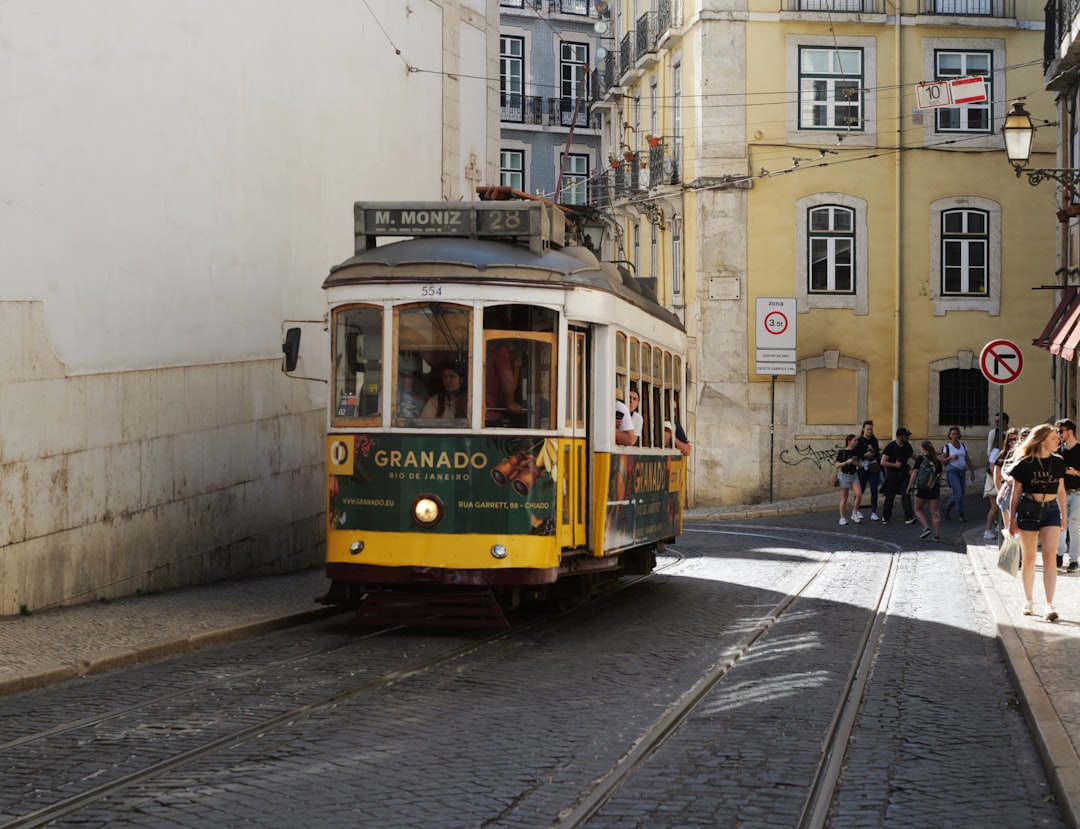
Lisbon’s iconic yellow trams are a must-ride experience:
Elétrico (eh-LEH-tree-koo) – Tram/streetcar
Elétrico 28 (eh-LEH-tree-koo VIN-tuh-OY-too) – The famous No. 28 tram that circles Lisbon’s historic center
Elétrico 15 (eh-LEH-tree-koo KEEN-zuh) – Another popular tram to Belém
Bilhete de elétrico (bee-LYET-uh duh eh-LEH-tree-koo) – Tram ticket
Próxima paragem (PROK-see-muh puh-RAH-zhum) – Next stop
Peço bilhete (PEH-soo bee-LYET-uh) – I’d like a ticket (to conductor)
The Bus (Autocarro)
Buses cover everywhere the metro and trams don’t:
Autocarro (ow-too-KAH-roo) – Bus
Qual é o número do autocarro para…? (kwal eh oo NOO-muh-roo doo ow-too-KAH-roo PAH-ruh…?) – What number bus goes to…?
Passa em…? (PAH-suh em…?) – Does it pass through…?
Quando sai o próximo? (KWAN-doo sy oo PROK-see-moo?) – When does the next one leave?
Onde é a paragem? (ON-duh eh uh puh-RAH-zhum?) – Where’s the bus stop?
Bilhete (bee-LYET-uh) – Ticket (request to driver)
Asking for Directions
One of the most crucial skills:
Onde fica…? (ON-duh FEE-kuh…?) – Where is…?
Por onde fico? (poor ON-duh FEE-koo?) – Which way do I go?
Qual é o melhor caminho para…? (kwal eh oo muh-LOR kuh-MEE-nyoo PAH-ruh…?) – What’s the best way to…?
É perto ou longe? (eh PER-too oo LON-zhuh?) – Is it near or far?
Fica a cinco minutos daqui (FEE-kuh uh SING-koo mee-NOO-toosh duh-KEE) – It’s five minutes from here
Viagem-se à direita (vee-AH-zhum-suh ah dee-RAY-tuh) – Turn right
Viagem-se à esquerda (vee-AH-zhum-suh ah esh-KER-duh) – Turn left
Continue em frente (kohn-tee-NOO-uh em FREN-tuh) – Continue straight ahead
É naquela rua (eh nuh-KEH-luh ROO-uh) – It’s on that street
Atravesse a rua (uh-truh-VES-uh uh ROO-uh) – Cross the street
Fica do outro lado da rua (FEE-kuh doo OH-troo LAH-doo duh ROO-uh) – It’s on the other side of the street
Taxi Phrases
Hailing & Getting In
Táxi! (TAK-see!) – Taxi! (to hail one)
Quer ser táxi? (ker ser TAK-see?) – Are you a taxi? (to confirm)
Está livre? (esh-TAH LEE-vruh?) – Are you free/available?
Quanto é até…? (KWAN-too eh uh-TEH…?) – How much is it to…? (ask before getting in)
Leve-me a… (LEH-vuh-muh uh…) – Take me to…
Para aqui, por favor (PAH-ruh uh-KEE, poor fuh-VOR) – To here, please
At Destination
Quanto é? (KWAN-too eh?) – How much? (at the end of the ride)
Fica com o troco (FEE-kuh kohm oo TROH-koo) – Keep the change
Pode dar-me um recibo? (POH-duh dar-muh oom ruh-SEE-boo?) – Can you give me a receipt?
Deixa-me aqui, por favor (DAY-shuh-muh uh-KEE, poor fuh-VOR) – Let me out here, please
Espere aqui um momento (esh-PEH-ruh uh-KEE oom moo-MEN-too) – Wait here a moment
Uber & Bolt
Ride-sharing apps are very popular in Portugal. The phrases are simple since the app does most of the work:
Pede um Uber (PEH-duh oom OO-ber) – Call an Uber
Pede um Bolt (PEH-duh oom bolt) – Call a Bolt
Qual é a estimativa de preço? (kwal eh uh esh-tee-muh-TEE-vuh duh PREH-soo?) – What’s the estimated price?
Chegou o motorista? (shuh-GOH oo moo-too-REE-stuh?) – Has the driver arrived?
Car Rental
At the Rental Company
Gostaria de alugar um carro (goosh-tuh-REE-uh duh uh-loo-GAR oom KAH-roo) – I’d like to rent a car
Por quantos dias? (poor KWAN-toosh DEE-ush?) – For how many days?
Qual é o preço por dia? (kwal eh oo PREH-soo poor DEE-uh?) – What’s the price per day?
Inclui seguros? (in-klew-ee suh-GOO-roosh?) – Does it include insurance?
Preciso de um carro manual ou automático? (pruh-SEE-zoo duh oom KAH-roo muh-noo-AHL oo ow-too-MAH-tee-koo?) – I need a manual or automatic car?
Qual é o combustível? (kwal eh oo kohm-boo-STEE-vel?) – What fuel type?
Há estacionamento incluído? (ah esh-tuh-see-uh-MEN-too in-KLOO-ee-doo?) – Is parking included?
Preciso de um mapa de estradas (pruh-SEE-zoo duh oom MAH-puh duh esh-TRAH-dush) – I need a road map
Road & Driving Terms
Carro/Coche (KAH-roo/KOH-shuh) – Car
Gasolina (guh-zoo-LEE-nuh) – Gasoline
Diesel (dee-ZEL) – Diesel
Estação de serviço (esh-tuh-SOWN duh ser-VEE-soo) – Gas station
Encher o depósito (en-SHER oo duh-POH-zee-too) – Fill up the tank
Quanto custa? (KWAN-too KOOSH-tuh?) – How much? (asking for fuel price)
Estacionamento (esh-tuh-see-uh-MEN-too) – Parking
Proibido estacionar (proo-EE-boo-doo esh-tuh-see-uh-NAR) – No parking
Limite de velocidade (LEE-mee-tuh duh vuh-luh-see-DAH-duh) – Speed limit
Carta de condução (KAR-tuh duh kohn-doo-SOWN) – Driver’s license
Documentos (duh-koo-MEN-toosh) – Documents
Acidente (uh-see-DEN-tuh) – Accident
Avaria (uh-vuh-REE-uh) – Breakdown
Onde fica a próxima estação de serviço? (ON-duh FEE-kuh uh PROK-see-muh esh-tuh-SOWN duh ser-VEE-soo?) – Where’s the next gas station?
Road Signs
Important signs you’ll see while driving:
Proibido (proo-EE-boo-doo) – Prohibited/No
Cuidado (kwee-DAH-doo) – Caution
Perigo (puh-REE-goo) – Danger
Construção (kohn-stroo-SOWN) – Construction
Obras (OH-brush) – Works (road construction)
Portagem (por-TAH-zhum) – Toll
Pedágio (puh-DAH-zhee-oo) – Toll (alternative word)
Centro (SEN-troo) – Center (city center)
Praia (PRAH-uh) – Beach
Airport Phrases
Arriving
Onde fica a bagagem? (ON-duh FEE-kuh uh buh-gAH-zhum?) – Where’s the baggage?
Aluguel de carros (uh-loo-GEL duh KAH-roosh) – Car rentals
Táxis (TAK-seesh) – Taxis
Transportes públicos (trans-POR-tush POO-blee-koosh) – Public transport
Informação turística (in-for-muh-SOWN too-REE-stee-kuh) – Tourist information
Departing
Qual é o portão para o voo…? (kwal eh oo por-TOWN PAH-ruh oo VOH…?) – What gate for flight…?
Quanto tempo demora a segurança? (KWAN-too TEM-poo duh-MOH-ruh uh suh-goo-RAN-suh?) – How long does security take?
Preciso de informações sobre o meu voo (pruh-SEE-zoo duh in-for-muh-SOWNSH SOH-bruh oo meh-oo VOH) – I need information about my flight
Porto & Other Cities
Ferry Travel (Across the Tagus)
Lisbon’s ferries across the Tagus River are iconic:
Ferry (FER-ee) – Ferry (yes, just use English!)
Caparica (kuh-puh-REE-kuh) – Ferry to Caparica
Barreiro (buh-RAY-roo) – Ferry to Barreiro
Almada (al-MAH-duh) – Ferry to Almada
Bilhete de ferryboat (bee-LYET-uh duh FER-ee-boat) – Ferry ticket
Quando sai o próximo ferry? (KWAN-doo sy oo PROK-see-moo FER-ee?) – When’s the next ferry?
Navigating Lisbon’s Hilly Streets
Lisbon’s topography is challenging. Important phrases:
Esta rua é muito inclinada (ES-tuh ROO-uh eh MOO-ee-too in-klee-NAH-duh) – This street is very steep
Há ascensor? (ah uh-sen-SOR?) – Is there an elevator?
Elevador de Santa Justa (uh-luh-vuh-DOR duh SAN-tuh ZHOO-stuh) – A famous lift/elevator connecting streets
Funicular (foo-nee-koo-LAR) – Funicular railway (3 in Lisbon help with steep hills)
Travesseira – Steep side street
Putting It Together
At a train station: “Gostaria de dois bilhetes para Porto, ida e volta. A que horas sai o próximo Alfa? Quanto custa?” (goosh-tuh-REE-uh duh doysh bee-LYET-ush PAH-ruh POR-too, EE-duh ee VOL-tuh. Uh kuh OR-ush sy oo PROK-see-moo AL-fuh? KWAN-too KOOSH-tuh?) – I’d like two tickets to Porto, round trip. What time does the next Alfa train leave? How much does it cost?
Asking for directions: “Desculpa, onde fica a Basílica da Estrela? É perto daqui?” (duh-SKOOL-puh, ON-duh FEE-kuh uh buh-ZEE-lee-kuh duh esh-TREH-luh? Eh PER-too duh-KEE?) – Excuse me, where is the Estrela Basilica? Is it near here?
Final Thoughts
Portugal’s transportation system is efficient, affordable, and easy to navigate once you know the vocabulary. Whether you’re taking a train to another city, catching a tram in Lisbon, or renting a car for a countryside adventure, having these phrases in your toolkit makes everything smoother.
Don’t be intimidated by the system. Portuguese people are generally helpful to travelers, and your effort to speak their language will be appreciated. Get comfortable asking for help—that’s what locals are for.
Boa viagem! (Good journey!)




Leave a Reply