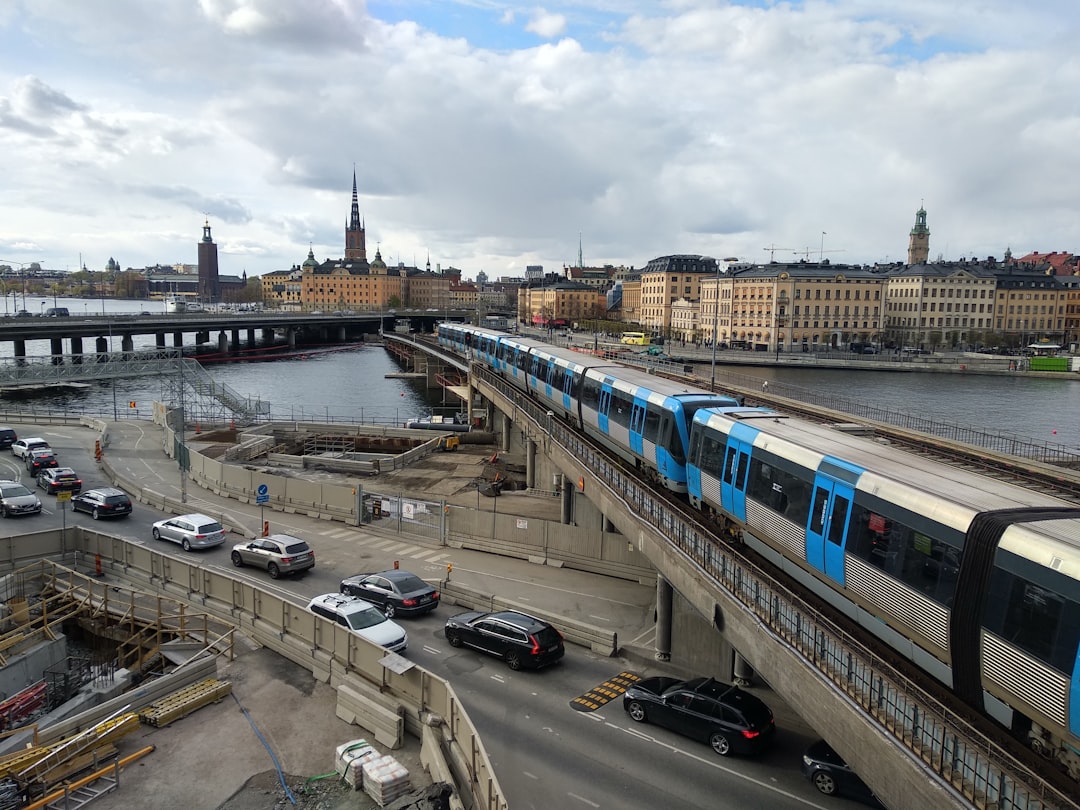
Whether you’re navigating Stockholm‘s intricate tunnelbana (subway) system, catching a train to Gothenburg, or taking a scenic archipelago boat ride, transportation vocabulary is essential for independent travel in Sweden. The good news: Sweden has world-class public transportation that’s easy to navigate, extensively English-signposted, and generally very orderly. The challenge is learning the specific terminology so you can confidently book tickets, ask directions, and understand announcements. This guide covers everything from train travel to cycling culture to the unique Stockholm card system.
Train Travel: SJ (Swedish Railways)
SJ stands for Statens Järnvägar (STAH-tens YER-nvägar) – the Swedish National Railways. This is the main rail operator in Sweden:
Jag vill åka tåg (yag vil AW-kah tawg) – I want to take the train.
En biljett till Göteborg (en bil-YET til GU-teh-borg) – A ticket to Gothenburg.
En enkel biljett (en EN-kel bil-YET) – A one-way ticket.
En tur-och-retursbiljett (en TUR-ok-reh-TUR-bil-YET) – A round-trip ticket.
Första klass (FOR-stah klas) – First class. Swedish first class is significantly more comfortable than second class and often reasonably priced.
Andra klass (AN-drah klas) – Second class.
Vilken tid går nästa tåg? (VIL-ken teed gawr NES-tah tawg) – What time is the next train?
Tåget går klockan… (TAW-get gawr KLOK-ahn) – The train leaves at… (how staff will respond)
Vilken plattform? (VIL-ken PLAT-form) – Which platform? (You might also just say “vilken spår?” – VIL-ken spawr – meaning which track)
Hur långt? (hoor LAWNG-t) – How long? (meaning duration of the journey)
Ungefär två timmar (un-yeh-FER tvaw TIM-mar) – About two hours.
Gör vi något stopp? (gur vee NAHG-ot STOP) – Do we make any stops?
Nästa station är… (NES-tah stah-SHON ehr) – The next station is…
Har vi försenad? (har vee FOR-seh-nad) – Are we delayed?
SJ trains are usually comfortable, punctual, and a pleasant way to see Sweden. Announcements are made in both Swedish and English, which is helpful.
Stockholm Tunnelbana & Public Transit System
Stockholm’s tunnelbana (literally “tunnel train”) is one of Scandinavia’s most impressive systems. The good news: it’s very English-friendly with clear signage. The essential vocabulary:
Tunnelbanan (tun-EL-bah-nan) – The subway/metro system (literally “the tunnel train”)
Tunnelbana (tun-EL-bah-nah) – Subway/metro (singular form used in general conversation)
Station (stah-SHON) – Station
Rött/Grönt/Blått linje (ret/GRUNT/BLAWT LIN-yeh) – Red/Green/Blue line
Vilken linje? (VIL-ken LIN-yeh) – Which line?
Vilket håll? (VIL-ket hawl) – Which direction?
Mot Norrmalm (mot NOR-malm) – Towards Norrmalm (a central destination)
Mot Fruängen (mot FROO-eng-en) – Towards Fruängen (a common destination on the red line)
SL-kort (ES-EL-kort) – An SL card (the transit card system). This is essential for getting around Stockholm: “Jag behöver ett SL-kort” (yag beh-HUV-er ett ES-EL-kort) – “I need an SL card.”
En dagskort (en DAHGS-kort) – A day card (good for unlimited travel one day)
En veckokort (en VEK-oh-kort) – A week card (good for one week)
Månadskort (MAH-nads-kort) – A monthly card
The SL system is extensive and covers Stockholm, surrounding areas, and connections to other cities. Stations are clean, usually have cafes, and are generally very safe, even late at night.
Asking for Directions
Even with maps, sometimes you need to ask locals:
Var är…? (var ehr) – Where is…?
Var är närmaste station? (var ehr NER-mas-teh stah-SHON) – Where’s the nearest station?
Är det långt härifrån? (ehr det LAWNG-t HER-ee-frahn) – Is it far from here?
Ungefär hundra meter (un-yeh-FER HUN-drah MEH-ter) – About a hundred meters.
Ungefär fem minuter (un-yeh-FER fem MEE-noo-ter) – About five minutes.
Till höger (til HU-yer) – To the right.
Till vänster (til VEN-ster) – To the left.
Rakt fram (rakt fram) – Straight ahead.
Vid nästa korsning (vid NES-tah KOR-ning) – At the next intersection.
Går du rätt väg? (gawr doo ret veg) – Are you going the right way?
Swedes are generally very helpful when asked for directions and will often go out of their way to ensure you understand. Don’t hesitate to ask; they appreciate it.
Taxi Phrases
Sweden has excellent taxi services, though they’re quite expensive compared to other European countries:
En taxi (en TAHK-see) – A taxi.
Kan du ringa en taxi? (kan doo RING-ah en TAHK-see) – Can you call a taxi?
Till Arlanda flygplats (til ar-LAN-dah FLYG-plats) – To Arlanda airport (Stockholm’s main airport).
Hur mycket kostar det? (hoor MYK-et KOS-tar det) – How much does it cost?
Kan du ta kortkort? (kan doo tah KORT-kort) – Can you take a card? (credit card)
Är räknaren på? (ehr REK-nah-ren paw) – Is the meter on?
Uber and other ride-sharing apps work well in Sweden and are often cheaper than traditional taxis. Many visitors opt for these instead.
Ferry & Archipelago Boats
Sweden’s archipelago is stunning, with thousands of islands and inlets accessible by boat. Here’s the relevant vocabulary:
Båt (baht) – Boat.
Färja (FER-yah) – Ferry.
En biljett för färjan (en bil-YET fur FER-yan) – A ferry ticket.
Nästa avgång? (NES-tah AHV-gawng) – When’s the next departure?
Hur långt är det? (hoor LAWNG-t ehr det) – How long does it take?
En rundtur (en RUND-tur) – A round trip/circular tour.
Östersjön (ÖS-ter-shun) – The Baltic Sea.
Skärgården (SHER-gar-den) – The archipelago (literally “the skerry garden”).
Holmen (HOL-men) – Island.
Ferries are frequent, reliable, and a wonderfully Swedish way to travel. Many Stockholm ferries offer scenic routes and are quite affordable.
Airport Phrases (Arlanda)
Stockholm’s Arlanda Airport (ARN) is one of Europe’s best-connected:
Arlanda flygplats (ar-LAN-dah FLYG-plats) – Arlanda airport.
Var är bagagehanteringen? (var ehr bah-GAH-sheh-HAN-teh-ring-en) – Where’s baggage claim?
Gate nummer… (gate num-er) – Gate number…
Vilken terminal? (VIL-ken ter-mee-NAHL) – Which terminal?
Jag saknar mitt bagage (yag SAK-nar mitt bah-GAH-sheh) – I’m missing my baggage.
Där är min väska (der ehr min VES-kah) – There’s my bag.
Arlanda has excellent English signage and English-speaking staff. You rarely need Swedish there, but knowing these phrases is helpful.
Bus Travel
Long-distance buses connect Swedish cities, and they’re significantly cheaper than trains:
Buss (bus) – Bus.
En buss till Malmö (en bus til MAL-mö) – A bus to Malmö.
Flixbus – The main long-distance coach operator in Sweden (most people just use the English name).
Hur längre sträcka? (hoor LENG-reh STRE-kah) – How long is the journey?
Är det direkt? (ehr det dee-REKT) – Is it direct?
Vart går bussen? (vart gawr BUS-sen) – Where does the bus go?
Buses in Sweden are comfortable and usually have WiFi. They’re a great budget option.
Cycling Culture
Sweden, particularly Copenhagen, is cycling-obsessed. Stockholm is increasingly bike-friendly:
Cykel (SY-kel) – Bicycle.
Jag vill hyra en cykel (yag vil HY-rah en SY-kel) – I want to rent a bike.
En cykelväg (en SY-kel-veg) – A bike path.
Var är cykelparkering? (var ehr SY-kel-par-KER-ing) – Where’s the bike parking?
Jag behöver en cykelhjälm (yag beh-HUV-er en SY-kel-YEL-m) – I need a bike helmet.
Cycling is a major form of transportation in Sweden, and cities have excellent bike infrastructure. Swedes take cycling seriously, so wearing a helmet is expected, not optional.
Winter Driving & Snow Vocabulary
If you’re renting a car and traveling in winter, you’ll encounter snow-related vocabulary:
Det snöar (det SNAW-ar) – It’s snowing.
Snö (snö) – Snow.
Is (ees) – Ice.
Vägen är glatt (VEH-gen ehr glaht) – The road is slippery.
Vinterdäck (VIN-ter-dek) – Winter tires.
Är vägen framkörd? (ehr VEH-gen FRAM-kurd) – Is the road plowed?
Vägen är blockerad (VEH-gen ehr blok-RAD) – The road is blocked.
Swedish winter driving requires winter tires, which are legally required (not just recommended). Roads are usually well-maintained, but conditions can change quickly.
General Transportation Vocabulary
Pendeltåg (PEN-del-tawg) – Commuter train (local trains connecting Stockholm to surrounding areas).
Lokaltåg (LOH-kahl-tawg) – Local train.
Långväga tåg (LAWNG-väg-ah tawg) – Long-distance train.
Omställning (om-STEL-ning) – Change/connection (when switching trains or buses).
Jag måste byta (yag MOS-teh BY-tah) – I need to change/transfer.
Angöring (AHN-gur-ing) – Docking/arrival (for boats).
Avgång (AHV-gawng) – Departure.
Ankomst (AHN-komst) – Arrival.
Försening (FOR-seh-ning) – Delay.
Avbokad (AHV-boh-kahd) – Cancelled.
Biljettkontrollör (bil-YET-kon-TROL-ur) – Ticket inspector.
Navigation Apps
Swedes use these apps for getting around, and you might hear them mentioned:
Google Maps – Works excellently in Sweden and is the go-to for most people.
SL app – For Stockholm transit specifically.
Trafikverket (TRAH-fick-VER-ket) – Swedish Transport Administration’s app for road conditions.
The Swedish Approach to Transportation
One thing you’ll notice: Swedish transportation runs on time. Swedes expect punctuality and get frustrated when things are late. The system is very orderly, and people queue properly for buses and trains. This reflects the broader Swedish cultural value of following rules and respecting public systems.
Another observation: Swedes are generally quiet on public transportation. You won’t hear the chatter and noise common on public transit in other countries. This is considered respectful. If you must talk on your phone on the train, speak quietly—loud phone conversations are frowned upon.
Getting around Sweden is genuinely one of the best parts of visiting. The public transportation system is efficient, clean, and extensive. Armed with these phrases, you’ll navigate it with confidence and maybe even start understanding the Swedish appreciation for orderly, punctual, well-designed systems. Lycka till med din resa! (Good luck with your trip!)




Leave a Reply