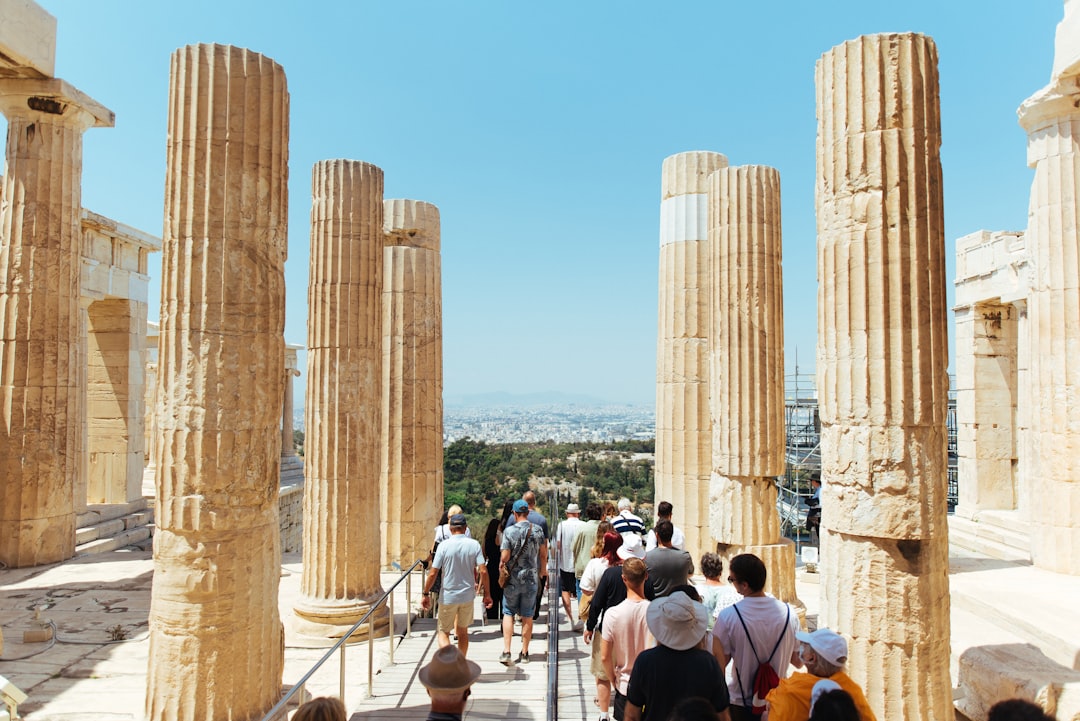
When you stand atop the Acropolis and gaze at the Parthenon, you’re looking at one of the most revolutionary structures ever built—not because of its architecture, though that’s breathtaking, but because of what it represented. This temple was the physical manifestation of a startling idea: that ordinary citizens could govern themselves. Before you explore those sun-bleached ruins, let’s talk about what ancient Athens actually was, because the reality is messier, more human, and far more interesting than the marble statues suggest.
The Athens That Wasn’t All White Marble
First, let’s shatter a romantic myth: the ancient Greeks didn’t adore pristine white marble. Shocking, I know. The Parthenon that you see today looks like it was freshly scrubbed by an obsessive custodian, but that’s a lie told by time. When it was new, around 430 BCE, it blazed with color. The metopes were painted in deep reds, blues, and golds. The sculptures gleamed with bright pigments. Wealthy Athenians wore brilliantly dyed clothing. The agora bustled with merchants selling purple dyes, red ochre, and vibrant fabrics.
This matters because understanding the visual reality of ancient Athens helps you understand the people. They weren’t austere philosophers contemplating abstract ideals in silence. They were vivid, passionate, competitive, loud. They loved color, spectacle, and rhetoric—the art of persuasion. When you visit the Acropolis Museum today, look for the reconstructed sculptures with their original paint colors. It’s like putting on glasses and seeing the ancient world clearly for the first time.
Democracy: A Radical and Deeply Flawed Experiment
Athens invented democracy around 510 BCE under Cleisthenes, and it’s the ancestor of your own government (if you live in a democracy). But here’s the uncomfortable truth: Athenian democracy was democratic only for a tiny slice of the population.
Imagine Athens in its heyday, around 430 BCE. The city-state had roughly 300,000 people. Of these, only about 60,000 were free male citizens—and you had to be born to citizen parents to count. That’s about 20% of the population. The other 80%? Women, slaves (perhaps 100,000 of them), resident foreigners (metics), and children had no vote whatsoever.
Among the 60,000 male citizens, perhaps 30,000 regularly attended the Assembly on the Pnyx hill, just west of the Acropolis. This wasn’t a representative democracy like modern systems. It was direct democracy—they voted on everything themselves. On the day you’re visiting, if there had been an Assembly meeting 2,400 years ago, you would have stood on the stone steps carved into that hillside, and heard proposals debated in real time. You would have voted by a show of hands—or later, by ostrakon (pottery shards), which is where the word “ostracism” comes from. If you really annoyed people, they could banish you for ten years simply by writing your name on a piece of pottery. Democracy could be brutal.
Walk to the Agora (the ancient marketplace and civic center) and you’re walking through the heart of Athenian democracy. Here, in the open air, political discussions happened daily. The Council met at the Bouleuterion (though you’ll only see modest remains). Courts convened in the open. The Stoa Poikile, the painted colonnade, was where Zeno the Stoic would later walk and philosophize (hence the word “Stoic”). Standing in that emptiness now, try to imagine the noise: merchants haggling, politicians debating, philosophers arguing, the smell of food and animal dung and human sweat. This was where ideas that shaped the world were born.
Philosophers in the Agora: Where Ideas Became Living Things
Socrates (469-399 BCE) never wrote anything down. He didn’t establish a school. Instead, he wandered the Agora and other public spaces, accosting people—often wealthy, important men—and asking them questions. “What is justice?” “What is courage?” His method, now called the Socratic method, was to make people realize they didn’t actually understand what they thought they understood. Unsurprisingly, important people found this irritating. When you visit the Agora, you’re walking where Socrates walked, making people uncomfortable and questioning their assumptions.
Plato (428-348 BCE), Socrates’ most famous student, eventually moved to the edge of Athens and founded the Academy around 387 BCE, a school that would last nearly 900 years. It was less a formal institution than a gathering place for talented young men interested in philosophy and mathematics. Plato wrote down Socrates’ ideas and expanded on them, creating a philosophical system that influenced Western thought for millennia. Today, the Academy’s site is largely buried under modern Athens, but you can visit the small archaeological museum there.
Aristotle (384-322 BCE) was born in Macedonia but moved to Athens as a young man, studying at Plato’s Academy. Later, he started his own school, the Lyceum, near the Agora. He was phenomenally productive, writing on logic, physics, biology, ethics, politics, poetry, and more. Unlike Plato, Aristotle was an empiricist—he believed in observing the world carefully. He supposedly walked while he taught, which is why his school was called the Peripatetic school (from the Greek word “to walk”).
These weren’t men in ivory towers. They were walking through the same streets you’ll walk through. They were embedded in Athenian politics and culture. Socrates died because he was sentenced to death for corrupting youth and impiety during a moment when Athens was traumatized by military defeat. Plato was allegedly captured and sold into slavery at one point. Aristotle had to flee Athens when anti-Macedonian sentiment surged, precisely because his student Alexander the Great was conquering the world on Macedonia’s behalf. Philosophy wasn’t abstract—it was entangled with life, politics, and danger.
The Golden Age Under Pericles: Building a Dream (and Going Broke)
In the 440s and 430s BCE, Athens was at its zenith. The city had defeated the invading Persian Empire at Marathon (490 BCE) and Salamis (480 BCE), establishing itself as the dominant Greek power. The statesman Pericles convinced the Assembly to launch an audacious building program: rebuild the temples destroyed by the Persians, but bigger, better, more magnificent.
The crown jewel was the Parthenon, begun in 447 BCE. This wasn’t just a temple—it was a statement. Iktinos and Kallikrates designed it with extraordinary mathematical precision, using subtle optical illusions (the columns curve slightly to appear straight to the eye). Inside, Phidias created a massive gold and ivory statue of Athena, goddess of wisdom. The exterior sculptures were works of genius, telling the story of Athena’s triumph and the victory of order over chaos.
The Parthenon cost a fortune. Pericles funded it partly from the tribute that allied city-states paid to Athens for “protection”—money that was essentially imperial taxation. This was controversial even then. His rival, Thucydides (not the historian, but a politician), publicly complained about the expense. But Pericles was brilliant at rhetoric. He convinced Athenians that this wasn’t waste—it was immortality. It was proof of their greatness. It was a jobs program. Artists, sculptors, laborers, quarrymen, transport workers all benefited.
When you walk around the Parthenon today, you can still see the foundation marks, the drainage systems, the precision of the construction. The building stands on the highest point of the Acropolis, visible from anywhere in the city. It’s propaganda made stone, and it’s monumentally effective even 2,400 years later.
The Peloponnesian War: When Democracy Destroys Itself
But here’s the dark side of Athenian greatness: prosperity bred arrogance. In 431 BCE, Athens and its allies went to war with Sparta and its allies. The Peloponnesian War would last twenty-seven years and would ultimately destroy the Athenian empire.
The war turned Athenians against themselves. The demagogue Alcibiades convinced the Assembly to launch a massive invasion of Sicily in 415 BCE. It was a disaster—the Athenian fleet was destroyed, and the city lost tens of thousands of young men. Alcibiades, fearing prosecution, defected to Sparta. Paranoia gripped Athens. In 399 BCE, in the paranoid atmosphere of defeat and humiliation, Socrates was tried for corrupting youth and impiety. He was convicted and executed by drinking hemlock, a poisonous herb.
By 404 BCE, Athens surrendered. The Long Walls that connected the city to its port were dismantled. The Athenian empire was finished. The city would never again be as dominant, though it remained a cultural and intellectual center.
When you visit the Acropolis Museum, you’ll see fragments of this story in pottery, sculpture, and inscriptions. You’ll see the pride and the tragedy intermingled. You’ll understand that Athens didn’t spring forth fully formed as a perfect democracy. It was a real society with all the flaws, corruption, and violence that real societies have.
Sites to Visit
The Acropolis: Walk up in the early morning before crowds arrive. The views over Athens are extraordinary, and you’ll feel the significance of this sacred space.
The Acropolis Museum: This modern museum is world-class. Don’t miss the section showing original paint colors on sculptures. The view of the Parthenon from the top floor is stunning.
The Agora: Walk through the remains of the marketplace. The Temple of Hephaestus (one of the best-preserved Greek temples) stands here, looking almost untouched by time.
The Pnyx: Hike up this hill and stand where Athenian democrats stood. Imagine the Assembly gathered, debating, voting. The views of the Acropolis from here are magical, especially at sunset.
The National Archaeological Museum: Houses the largest collection of ancient Greek art in the world. The bronze sculptures are particularly stunning—these are originals that survived because they sank in the sea and were preserved.
Parting Thoughts
Ancient Athens gave the world democracy, philosophy, tragic drama, and some of the most enduring art and architecture ever created. But it also enslaved hundreds of thousands, excluded women completely, and went to war with itself. It was brilliant and flawed, noble and brutal. Understanding both sides of that contradiction is what makes ancient history real, and what makes visiting Athens a genuine journey into understanding human civilization in all its complexity.
The marble may not be white, but the questions the Athenians asked—about justice, courage, the good life, how we should govern ourselves—are still brilliant, still urgent, still demanding answers. You’ll find those questions everywhere in the ruins.




Leave a Reply