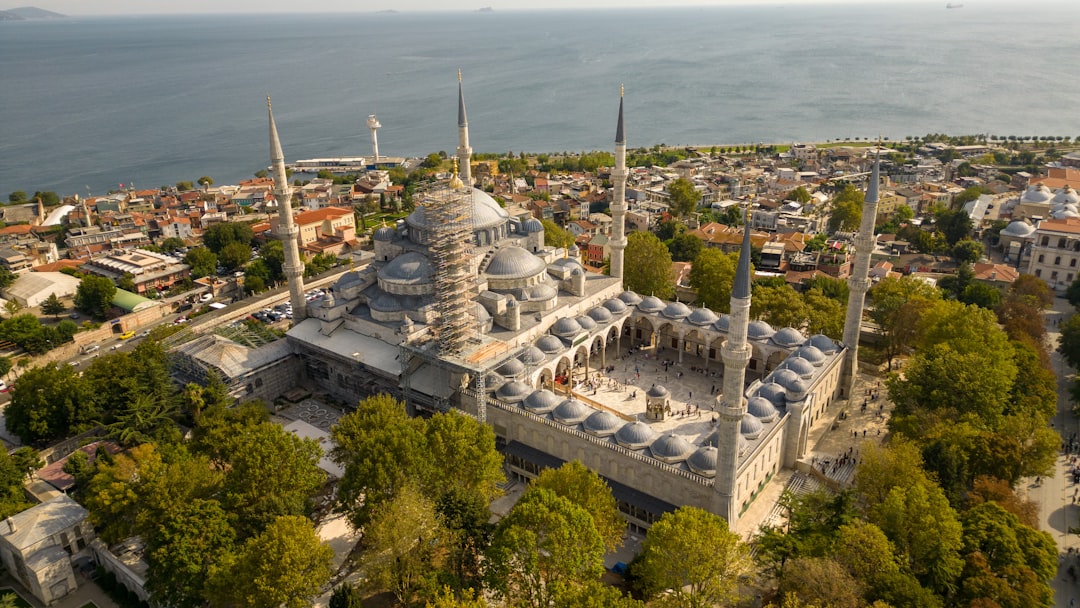
Most people have heard of the Roman Empire and think it ended around 500 CE, when the Western Empire fell to Germanic invasions. But here’s what most people don’t know: the Roman Empire continued for another thousand years in the East. It was called the Byzantine Empire (named after the ancient Greek colony of Byzantium on which Constantinople was built), and it was arguably more “Roman” than anything that came before it. For ten centuries, from roughly 330 to 1453, an unbroken tradition of Greek-speaking, Orthodox Christian civilization preserved Roman law, Roman administration, and Roman military strategy while transforming into something entirely new: Byzantium.
Constantine’s Vision: The Foundation of a New Rome
In 306 CE, Constantine became emperor of Rome. He faced a crisis: the empire was too large to govern from Rome. The frontiers were under constant pressure. The administrative systems were breaking down. Constantine made a radical decision: he would build a new capital at the eastern edge of the empire, in a strategic location that controlled the crucial passage between Europe and Asia.
He chose Byzantium, a Greek city on the Bosporus, and renamed it Constantinople (the City of Constantine) in 330 CE. The city’s location was genius: it was easily defended, sitting on a peninsula surrounded by water on three sides. It controlled maritime trade between the Mediterranean and the Black Sea. It was far enough east to be central to the empire’s richest provinces. And it was in territory that was already thoroughly Hellenized (Greek in language and culture).
Constantine also made another revolutionary decision: he adopted Christianity. Whether from genuine faith or political calculation (Christianity was increasingly popular among the empire’s subjects), Constantine converted, and he did so at a time when Christianity was still a persecuted minority religion. He legalized Christianity throughout the empire in 313 CE and began to build churches. In Constantinople, he built the Church of the Holy Apostles, one of the greatest structures of the ancient world.
Constantine’s empire was still “Roman”—Latin was the official language, Roman law was paramount, Roman administrative structures held. But it was also increasingly becoming something else: Orthodox Christian and Greek.
The Glory of Justinian and Theodora
For a thousand years, Byzantium had many great rulers, but none more significant than Justinian I, who reigned from 527 to 565 CE. Justinian had an extraordinary ambition: he wanted to reconquer the lost western half of the empire and restore Rome to its former greatness.
Justinian married Theodora, a woman of remarkable intelligence and political acumen who had come from a theater family (and in the Byzantine court, theater was considered a disreputable profession). Theodora was something extraordinary for the sixth century: she had influence and authority equal to the emperor. When riots threatened to overthrow Justinian in 532 (the Nika Riots), it was Theodora who urged him to stand firm. “Purple makes a fine burial shroud,” she told him, meaning she’d rather die as an empress than live as an exile. Justinian took her advice, and his armies crushed the rebellion.
Justinian’s greatest achievement was the Hagia Sophia, the Church of Holy Wisdom. The dome of the Hagia Sophia is 31 meters (102 feet) in diameter and rises 56 meters (184 feet) from the ground. When it was built in 537 CE, it was unlike anything ever constructed. The dome appeared to float in the air, supported by a sophisticated engineering system of vaults and arches. It was the largest interior space ever built in the ancient world. Contemporary observers said it was as if the dome was suspended from heaven by a golden chain.
Justinian also commissioned Procopius to write the comprehensive legal code called the Justinian Code (or Corpus Juris Civilis), which systematized all Roman law. This code would become the foundation of law in most of Europe and is still studied in law schools today.
But Justinian’s attempt to reconquer the West was ultimately too expensive and too ambitious. He fought wars with the Persians on the eastern frontier, religious wars against various Christian heresies, and military campaigns in North Africa, Italy, and Spain. By the time he died, the empire was bankrupt and exhausted. The gains in the West would soon be lost to new invaders.
The Transformation: From Rome to Orthodox Christendom
After Justinian, the Byzantine Empire contracted. It lost territory to Arab invaders, Persian invaders, and Slavic peoples. By the early seventh century, it was a much smaller realm, centered on the Balkans, Anatolia (modern Turkey), and the Mediterranean islands. Latin fell out of use; Greek became the sole official language. The army reorganized around a “themes” system—military districts that combined civil and military administration.
But this was also a period of profound spiritual and intellectual development. The Orthodox Church became the center of Byzantine identity. Byzantine theology—the way Christians understood God, salvation, and the human condition—developed sophisticated philosophical frameworks. The veneration of icons (holy images) became central to Byzantine spirituality, even as it sparked fierce theological controversies.
Monasteries became centers of learning. Byzantine monks copied ancient texts, preserving the works of Plato, Aristotle, and the Church Fathers. While Western Europe descended into the chaos of the early medieval period, Byzantium maintained an unbroken tradition of learning, urban life, and complex administration.
The Iconoclasm Controversy: Religion and Politics Intertwined
From 726 to 843 CE, Byzantium was convulsed by the Iconoclastic Controversy. This was a religious dispute: some argued that the veneration of icons (images of saints and holy figures) was idolatry and violated the commandment against graven images. Others argued that icons were legitimate aids to devotion and theological teaching.
But this wasn’t purely a theological debate. It was a political struggle between emperors and the Church, between the military and the monastic establishment, between Greek and Syrian factions within the empire. Emperors who favored iconoclasm (the destruction of icons) saw them as a threat to imperial authority and military morale. The Church defended icons as essential to Orthodox practice.
The controversy tore the empire apart for over a century. Icons were destroyed, churches were desecrated, monks were persecuted. Families were divided. The dispute was eventually resolved in favor of icons, and the Second Council of Nicaea in 787 officially restored their veneration. But the wound had been deep.
This controversy illustrates something essential about Byzantium: it was a civilization where theology and politics were inseparable. Religious questions weren’t abstract philosophical exercises; they had immediate political consequences and involved the state in the most personal aspects of faith.
The Great Schism: Breaking with Rome
For centuries, the Byzantine Church maintained an uneasy relationship with the Roman Church in the West. Both claimed apostolic authority. Both saw themselves as the true heir of apostolic Christianity. But they developed different liturgies, different traditions, different theological emphases.
In 1054, the tension reached a breaking point. The Byzantine Patriarch of Constantinople and the Roman Pope exchanged excommunications. This event, called the Great Schism, split Christianity into Eastern Orthodox and Roman Catholic branches. This split would shape European history for the next thousand years. Eastern Christianity developed along Greek and Byzantine lines, spreading into Russia, the Balkans, and the Middle East. Western Christianity developed along Roman and Germanic lines, spreading into Western Europe.
Ironically, 1054 was no one’s intended breaking point. They thought they were engaging in a temporary dispute that would be resolved. The schism was formalized only in retrospect, a realization that the split was permanent.
The Crusaders’ Betrayal: The Sack of Constantinople
By the twelfth century, Byzantium was weakening. The Seljuk Turks had conquered most of Anatolia. The empire had lost territory to Norman invaders in the south and Serbian kingdoms in the north. The emperors called for help from the West.
In 1095, Pope Urban II called for a Crusade to reclaim the Holy Land from Muslim rule. The First Crusade, launched in 1096, was partly intended to help Byzantium, but it was also a Western power play. The crusaders were mostly French and Norman knights with their own agendas.
The Fourth Crusade (1204) was a catastrophe for Byzantium. The Crusaders, funded by Venetian merchants, were supposed to sail to Egypt. Instead, they were diverted to Constantinople itself. In a shameful act of betrayal, the Christian crusaders attacked the capital of Eastern Christianity, sacked it, and established a Latin Empire, a puppet state ruled by Westerners.
For fifty-seven years, Constantinople was under Latin rule. The great churches were desecrated, artworks were stolen, the population was brutalized. Byzantine nobles retreated to smaller kingdoms in exile. When the Byzantines eventually reclaimed Constantinople in 1261, it was weakened and never fully recovered.
The sack of Constantinople in 1204 was one of history’s great turning points. It shattered forever the unity of the Christian world and left Byzantium too weakened to resist the rising Ottoman threat that would eventually destroy it.
The Final Days: 1453 and the Fall
In 1453, over two hundred years after the Fourth Crusade, Constantinople fell to the Ottoman Empire. The last Byzantine Emperor, Constantine XI Palaeologus, died fighting on the walls. The city that had been the capital of a great empire for over a thousand years passed under Islamic rule.
But even as Constantinople fell, Byzantine scholars fled westward, bringing with them thousands of precious manuscripts. They fled to the Italian Renaissance, to Venice, to Rome, to Athens. The texts they brought—lost works of ancient Greek and Roman authors—helped ignite the Renaissance. In this way, Byzantium’s intellectual legacy passed directly into the modern world.
Why Byzantium Matters
Byzantium is often overlooked in Western history, partly because it’s not “Western” (it was Greek and Orthodox, not Latin and Catholic), partly because it fell to Islamic conquest, and partly because medieval history is less popular than ancient history. But Byzantium’s achievements were extraordinary.
Byzantine architects built the greatest churches of the medieval world. Byzantine theologians developed profound spiritual philosophies. Byzantine administrators created sophisticated bureaucratic systems. Byzantine artists created stunning mosaics and icons that influenced art for centuries. Byzantine scholars preserved the works of antiquity.
Most importantly, Byzantium was the link between the ancient world and the modern world. It maintained the legacy of Rome and Greece while transforming that legacy into something new. When you look at Orthodox Christianity today—whether in Greece, Serbia, Bulgaria, Russia, or elsewhere—you’re looking at a direct descendant of Byzantine civilization.
Sites to Visit
The Hagia Sophia in Istanbul: The greatest Byzantine building that survives. Though now a mosque (and during my knowledge cutoff, it had been converted back to a mosque), it remains one of the most spiritually powerful structures ever built. The engineering, the scale, the light streaming through the dome—it’s breathtaking.
Byzantine Museum in Athens: Contains excellent mosaics, icons, and artifacts from the Byzantine period in Greece.
Mystras: A medieval Byzantine city in the Peloponnese, partially preserved, with Byzantine churches and monasteries. Walking the ruins, you can feel the continuity of Byzantine civilization into the later medieval period.
The Meteora: A complex of monasteries built on towering rock pillars in Thessaly. These monasteries preserved Byzantine Orthodox tradition and learning through centuries. Several are still active today.
Parting Thoughts
Byzantium was a civilization that lasted longer than Rome itself. It preserved the legacy of the ancient world while creating something entirely new. It was a place where theology and politics were woven together, where Greek and Roman traditions merged into Orthodox Christianity, where great art and literature flourished even as the empire contracted and faced invaders.
When the Ottoman conquest ended Byzantium, it ended one of history’s great civilizations. But it also released Byzantine learning and art into the Renaissance, shaping the modern world. The Hagia Sophia still stands, still inspiring awe, still reminding us of what human genius and vision can create when supported by centuries of tradition and imperial wealth.
Understanding Byzantium is understanding a thousand years of human history that most Westerners barely know about—and that’s a tragedy, because Byzantium’s story is one of the most compelling in all of history.




Leave a Reply