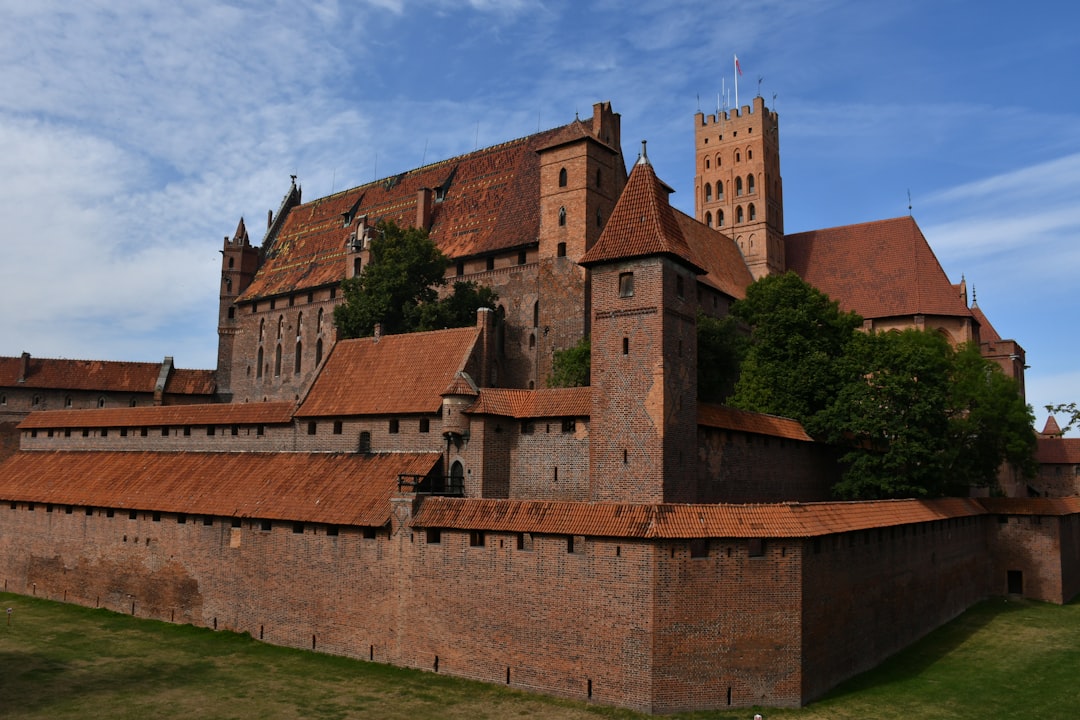
In medieval Europe, there was a special kind of military institution: the crusading order. These were monastic organizations of warriors dedicated to Christian military campaigns. The Knights Templar fought in the Holy Land. The Knights Hospitaller held Mediterranean islands. And in the Baltic region, one of the most powerful crusading orders controlled a vast territory: the Teutonic Knights. For more than two centuries, these German warrior-monks fought, conquered, and built one of the most impressive fortress complexes in medieval Europe. Their conflict with Poland and Lithuania shaped the entire region and produced one of the greatest medieval battles ever fought.
Today, visitors can see the castles the Teutonic Knights built—massive brick structures that still dominate the Polish landscape. These castles aren’t just historical artifacts; they’re monuments to an entire epoch of medieval warfare, crusading ideology, and the fierce competition for power in Northern Europe.
The Order Arrives in the Baltic: A Crusade in the North
The Teutonic Knights were founded in 1191 during the Crusades as a military-religious order dedicated to fighting for Christendom. By the early 13th century, they had repositioned themselves in the Baltic region, where Christian Poles, Bohemians, and German rulers were attempting to conquer and Christianize the lands of the pagan Prussians and Lithuanians.
The story goes that a Polish duke invited the Teutonic Knights to help him conquer the pagan Prussian tribes that were raiding Polish territories. The Knights saw an opportunity. Here was a land they could conquer, Christianize, and rule themselves. Here was a frontier where crusading activity could continue. The Baltic became their new Holy Land.
From the early 13th century onward, the Teutonic Order launched a series of crusades against the Prussians. These weren’t campaigns of a few years. They took more than fifty years of constant warfare to fully conquer the Prussian lands. The Knights built castles as they advanced, establishing strongpoints to consolidate their control. These castles served multiple purposes: they were military garrisons, administrative centers, and symbols of Christian conquest over pagan territories.
The Prussians fought fiercely for their independence. They were skilled warriors who knew the forested terrain. But they were facing an enemy with superior organization, better weapons, and the ability to bring reinforcements from Germany. Over the decades, Prussian resistance was crushed. By the mid-13th century, the Teutonic Knights controlled Prussia. They had established their own state, with the Grand Master as the supreme ruler.
Building an Empire: The Teutonic State
What the Teutonic Knights created was not just a military presence but a state. They governed a territory that eventually stretched from the Vistula River in the west to the Neman River in the east, and from the Baltic coast in the north to the borders of Mazovia and Lithuania in the south. They established cities, ports, and trade networks. They created an administrative system. They recruited German settlers to populate their lands.
The heart of their power was their network of castles. These weren’t the small, isolated fortifications of earlier medieval periods. These were impressive structures, often rectangular in shape, made of brick (stone was less available in the flat Baltic region). They had thick walls, defensive towers, and complexes of buildings inside the walls housing garrisons, administrative offices, and supplies. The largest of these castles was a marvel of medieval military architecture.
Malbork Castle (called Marienburg by the Germans) was constructed starting in 1274 and expanded over nearly two centuries. It became the largest castle in medieval Europe and the residence of the Grand Master of the Teutonic Order. The castle covers an enormous area—the outer walls enclosed multiple courtyards and buildings. At its height, it could house a garrison of hundreds and served as the administrative center for the entire Order’s Baltic operations.
Walking through Malbork today—it was partially destroyed in World War II but extensively restored—you encounter the scale of the Teutonic ambition. The castle is so large and so complex that you can easily get lost exploring it. You see the Grand Master’s quarters, the vast dining hall where the order’s elite dined, the defensive towers, the fortification walls. You understand that this wasn’t just a fortress; it was a seat of power for an organization that controlled an entire region.
Other major Teutonic castles included Marienmburg (Malbork’s sister fortress), Konigsberg (which became the capital of East Prussia), and numerous smaller strongpoints throughout the conquered territories. Each castle was connected to others through a system of roads and communication networks that allowed the Order to maintain control over its far-flung territories.
The Growing Conflict with Poland-Lithuania
As the Teutonic Order grew more powerful, the neighboring Polish and Lithuanian rulers grew increasingly alarmed. The Knights were expanding their control and posing a threat to Polish and Lithuanian interests. The situation was complicated by religious differences—the pagan Lithuanians especially were seen as a threat by the Christian powers—but increasingly, the conflict became about territorial control and power rather than about crusading ideology.
By the 14th century, Poland and Lithuania, traditionally rivals, began to recognize their common interest in opposing Teutonic expansion. This was a crucial turning point. The union of Poland and Lithuania—formalized in the 15th and 16th centuries—was partly a response to the Teutonic threat. In an era when large powerful states were the norm, Poland and Lithuania understood that they needed to unite to counter the Knights’ power.
The conflict simmered for decades, with periodic military campaigns and peace treaties. The Teutonic Order was formidable, but Polish and Lithuanian forces were now becoming more organized and more numerous. The great powers of Europe—and increasingly, popular opinion even in German territories—were questioning whether the Teutonic crusade was legitimate.
The Battle of Grunwald: The Turning Point
By 1410, the tension had reached a breaking point. The Polish King Władysław II Jagiello, who had married the Lithuanian Grand Duchess Jadwiga, united Polish and Lithuanian forces and prepared to confront the Teutonic Order once and for all.
On July 15, 1410, the armies met near the village of Grunwald (called Tannenberg by the Germans). The Polish-Lithuanian force was enormous—estimates suggest 40,000 to 50,000 troops. The Teutonic Knights fielded perhaps 20,000 warriors, but these were among the most skilled and heavily armored troops in medieval Europe. The Knights were confident. They had defeated larger Polish forces before.
The battle raged all day. It was chaotic, brutal, and at times the issue was in doubt. But the Polish-Lithuanian forces, fighting on home territory with superior numbers and morale, gradually pushed back the Knights’ lines. By evening, the Teutonic Order had suffered a catastrophic defeat. The Grand Master himself was killed. Thousands of Knights and soldiers lay dead on the field.
Grunwald—or Tannenberg as Germans call it—was one of the decisive battles of medieval Europe. It proved that the Teutonic Order, despite its military skill and heavy armor, could be defeated. It proved that a unified Poland-Lithuania was capable of fielding forces that could match European powers. It was, in many ways, the moment when Eastern Europe shifted from passive frontier territories to active participants in European power politics.
The Decline of the Teutonic Order
After Grunwald, the Teutonic Order never recovered its dominance. They continued to rule their Baltic territories for another century, but they were increasingly hemmed in and challenged. The Peace of Thorn (1466), following another war, forced the Knights to cede their western Prussian territories to Poland. The Order’s remaining lands became a vassal state to Poland.
More significantly, the Teutonic Order’s legitimacy as a crusading force was increasingly questioned. The crusading ideal was losing its appeal. European Christianity was more unified, and the notion of endless crusades against pagans who had already been baptized seemed increasingly outdated. The Order became essentially a Baltic merchant and military power without the crusading mission that had originally defined it.
By the 16th century, when the Reformation swept through Northern Europe, the Teutonic Order found itself in crisis. In 1525, the last Grand Master of the Teutonic Order in Prussia converted to Protestantism and secularized the Order’s lands, creating the Duchy of Prussia. The last remnants of the Order were dissolved.
But for more than two centuries—from the early 13th century to the early 16th century—the Teutonic Knights had dominated the Baltic. They had built some of the most impressive castles of medieval Europe. They had shaped the political history of Poland, Lithuania, and the Baltic region.
Visiting the Teutonic Castle Landscape
Today, travelers interested in this history can visit a landscape shaped by Teutonic military ambition. Malbork Castle remains the most impressive—it’s so large and architecturally significant that it’s now a UNESCO World Heritage Site. The castle’s complex of walls, towers, and buildings has been extensively restored and now functions as a museum. You can walk through the Grand Master’s quarters, visit the castle’s chapel, explore the defensive towers, and stand on the walls looking out over the Nogat River.
Walking through Malbork, you encounter medieval military architecture at its finest. You see the sophistication of Teutonic fortifications and understand why this castle was so impressive to contemporary observers. The castle’s size and complexity are still awe-inspiring, even in an age of modern fortifications.
Other Teutonic castles are scattered throughout northern Poland and the Baltic region. Kwidzyn, Gniew, Bytów—each is a brick fortress that tells the story of Teutonic expansion and control. Some are partially ruined, some restored, but all preserve the memory of this military order and its impact on the region.
The site of the Battle of Grunwald, near the village of the same name, has been preserved as a memorial. There’s a monument and a museum telling the story of the battle. Standing at Grunwald, you can imagine the armies assembling on the same ground where one of medieval Europe’s most important battles was fought.
In Kraków, the National Museum has exhibits on the Teutonic Order and the conflict between the Knights and Polish-Lithuanian forces. You can see artifacts, weapons, and artwork from this period, helping you understand the material culture of medieval warfare and crusading.
Understanding the Teutonic Legacy
The Teutonic Knights represent a fascinating and complex period in European history. They were simultaneously crusaders motivated by religious ideals and ruthless military conquerors. They brought Christianity and European civilization to the Baltic region, but they also conquered peoples who had their own cultures and beliefs. They built impressive structures and organized an efficient state, but they did so through military force and domination.
The Knights’ conflict with Poland and Lithuania is important because it demonstrates that Eastern Europe was not simply a passive frontier waiting to be civilized by Western powers. Poland and Lithuania had their own powerful rulers, their own ambitious goals, and their own ability to fight and win against even formidable enemies. The defeat of the Teutonic Knights at Grunwald showed that Eastern European states could match—and defeat—Western military powers.
The castles that remain from the Teutonic period are striking monuments. They remind visitors of a moment when a military-religious order attempted to carve out its own realm in medieval Europe. That attempt ultimately failed, but the castles, especially Malbork, remain as testimony to the scale of that ambition and the sophistication of medieval military architecture.
Today, the Teutonic Knights are a historical curiosity, their crusading mission long obsolete, their state dissolved centuries ago. But their castles endure, drawing visitors from around the world who come to see these remarkable structures and learn about this chapter of European history. In those brick walls and towers, the ambitions and conflicts of medieval Europe are still visible, still powerful, still capable of speaking to anyone who stands before them.




Leave a Reply