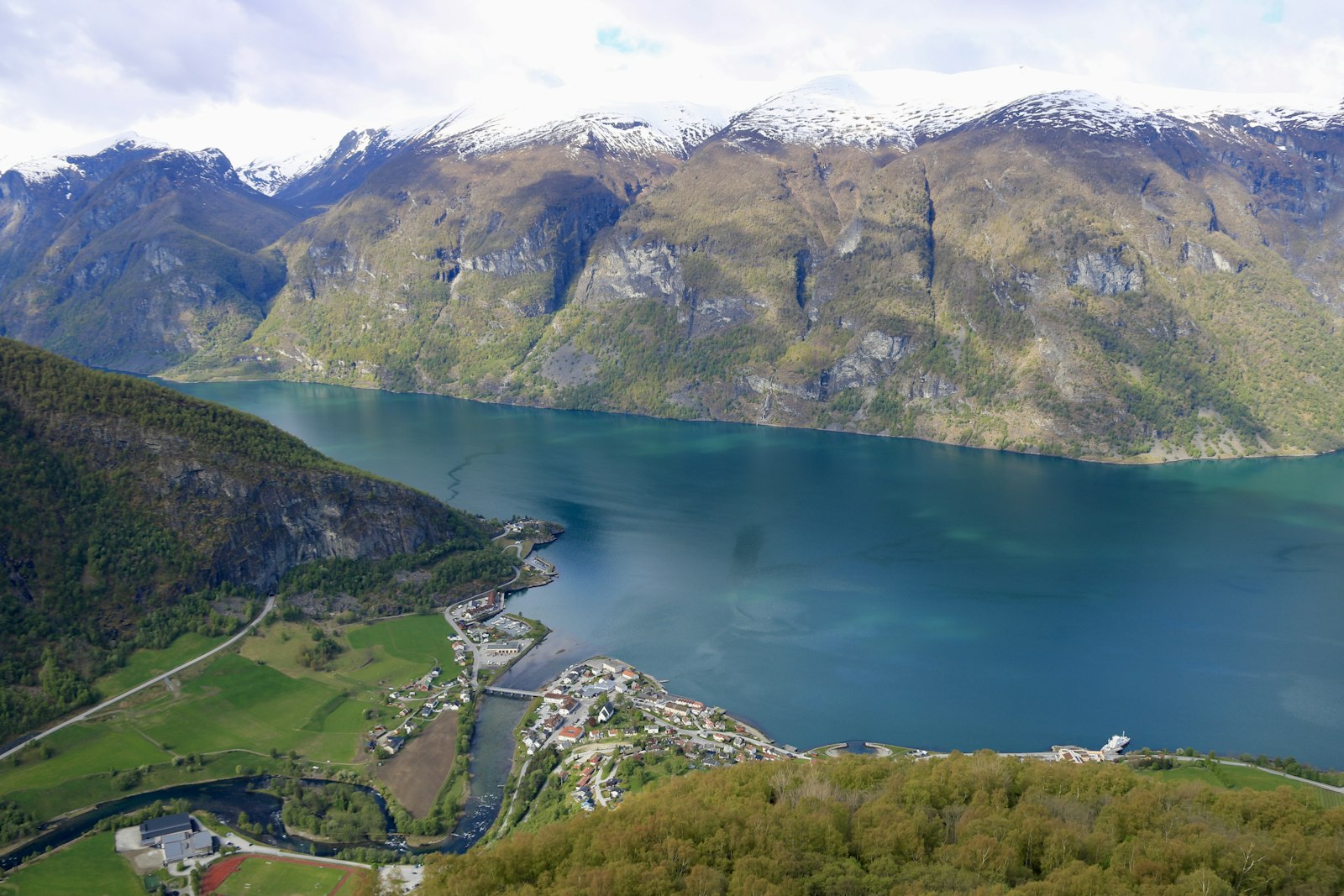
Aurland is one of those places that makes you question how a single small village can be so ridiculously beautiful. Nestled on the Aurlandsfjorden, a dramatic branch of the massive Sognefjord, this tiny Norwegian village sits at the intersection of everything that makes western Norway spectacular—steep mountains rising directly from fjord water, waterfalls cascading down impossible slopes, and the kind of scenery that makes professional photographers weep because even their best work doesn’t do it justice.
The village itself (population: approximately 300 people) is small enough that you can walk the main village in 15 minutes, but the surrounding region offers enough adventure to keep you occupied for a week. This is fjord life at its most authentic and dramatic—not commercialized, not overwhelmed with cruise ships, just genuinely stunning Norwegian nature and a handful of visitors who’ve discovered one of Scandinavia’s best-kept secrets.
1. Stegastein Viewpoint: The View That Makes You Understand Perspective
Stegastein might be the single most dramatic viewpoint in all of Scandinavia, and the hike to reach it is perfect—challenging enough to feel like accomplishment, not so hard that non-athletes can’t do it.
The Stegastein viewpoint is accessed by a hiking trail that climbs steeply from near Aurland. The trail ascends roughly 500 meters over 3-4 kilometers, taking about 1-1.5 hours depending on pace. The real reward isn’t the hike itself (though it’s beautiful)—it’s the viewpoint at the top.
Stegastein is a dramatic cantilevered platform suspended 650 meters above the Aurlandsfjorden. When you step out onto it, you’re essentially standing on thin air with the fjord dramatically far below and the surrounding mountains stretching across your entire visual field. The scale is genuinely disorienting—the mountains look simultaneously close and impossibly distant. The fjord water far below reflects the sky and cliffs, creating a mirror effect that doubles the sense of scale.
The structure itself was designed by architect Carl-Viggo Hølmebakk and completed in 2006. It’s not aggressive or architectural—it sits gently into the landscape while delivering one of the most profound perspective shifts available in hiking. Many visitors report that Stegastein changes their understanding of scale and their relationship to mountains.
Come early (sunrise starts are ideal) or late afternoon (sunset) for best light and the possibility of solitude. The weather needs to be decent—in fog or heavy clouds, the view disappears (though even then the experience is worth it).
2. Aurlandsfjorden: Kayaking and Boat Exploration
The fjord itself is the landscape, and the best way to experience it is from the water. Kayaking in Aurlandsfjorden offers perspective on the mountains, waterfalls, and fjord ecosystem that you simply can’t get from shore.
Several operators in Aurland offer kayaking experiences, from 2-hour guided tours to full-day adventures. The water is generally calm (fjords are protected from ocean swells), making this accessible to people without paddling experience. You’re paddling beneath mountains, past waterfalls, with genuine solitude available if you go early or mid-week.
The fjord contains several famous waterfalls (including Vetleflossen and others) that become accessible by kayak. The water itself is incredibly clear and blue-green, and if you’re lucky, you might see seals or occasionally dolphins.
Kayaking isn’t just about the paddling—it’s about perspective. From sea level on the water, the mountains appear even more dramatic than they do from hiking trails. The scale of everything becomes visceral.
Boat tours are also available if kayaking doesn’t appeal. Guided fjord cruises show you similar scenery from a larger vessel with less personal exertion.
3. Flåm Railway: One of the World’s Greatest Train Journeys
The Flåm Railway isn’t actually in Aurland, but it’s within easy reach (about 20 minutes from Aurland to Flåm village by car), and it’s one of those journeys you simply cannot miss if you’re in the region.
The Flåm Railway climbs from the village of Flåm (at near sea level) to Myrdal (867 meters) in approximately 20 kilometers and 55 minutes. It’s a cog railway specifically designed to climb steep mountain terrain, and the journey involves tunnels, switchbacks, and continuous dramatic views.
The experience is unique because you’re descending (if traveling down) or ascending (if traveling up) through the landscape at train speed—fast enough to cover distance meaningfully, slow enough to absorb scenery. The engineering is impressive (the line has gradients of up to 55 degrees in places), but mostly you’re focused on the landscape unfolding around you.
Most visitors do this as a day trip: taking the train up to Myrdal, then continuing on another scenic railway (the Oslo-Bergen line) or hiking back down (the walk is considered one of Norway’s best day hikes). The full experience takes 4-5 hours but repays every minute.
The railway is popular but genuinely remarkable enough that tourists are worth putting up with. Try to go in shoulder seasons (May-June or September) when it’s less crowded.
4. Hiking: Multiple Options from Beginner to Serious
Beyond Stegastein, Aurland has excellent hiking territory. Trails range from easy valley walks to serious mountain hikes.
Easy Walks: The valley floor around Aurland is farmland that’s been cultivated for centuries. Gentle walks through pastoral scenery (surprising given how dramatic the mountains around it are) connect villages and offer perspective on how Norwegians have carved life from mountain fjord territory.
Moderate Hikes: The Stegastein hike (mentioned above) represents good moderate difficulty. There are also hikes to various viewpoints, mountain passes, and destinations. The Aurland Tourist Office has maps and descriptions.
Serious Alpine Hiking: Trails extending into the surrounding mountains get progressively more serious, eventually transitioning into proper mountaineering territory. For experienced hikers comfortable with navigation and basic scrambling, these offer genuine Alpine experiences.
The beauty of hiking from Aurland is that you’re constantly ascending toward the ridgelines above the fjord, so views continuously improve as you gain elevation. The landscape transitions from inhabited valley to wild mountains, and the sense of solitude increases proportionally.
5. Waterfalls and Waterfall Hikes
Aurland sits at the base of some of Norway’s most dramatic waterfalls. Waterfalls are numerous and powerful, especially in early summer when snowmelt is at peak.
Vetleflossen: This is one of the most photographed waterfalls in Norway—a thin ribbon of water cascading hundreds of meters down an impossible vertical slope. There’s a short hike to view it, and the experience of standing beneath something that grand is worth the minor effort.
Other Waterfalls: Numerous others exist throughout the valley. Some have formal trails; others require scrambling or kayak access. The sheer number of waterfalls is striking—water literally falls from the sky on all sides.
Waterfall hikes in early summer can be powerful experiences. The volume of water, the sound, the spray, and the raw force of it all creates an almost primal experience. By late summer, some waterfalls diminish to trickles, so timing matters if you want full power.
6. The Villages: Authentic Norwegian Architecture and Culture
Aurland itself is charming but tiny. However, nearby villages (Flåm, Undredal, and others) preserve traditional Norwegian architecture and lifestyle. These villages aren’t museums—they’re genuine communities where people live and work.
Undredal: A particularly remote village (only 50 people) accessible by a steep, narrow road or by hiking. It has a small medieval church, traditional goat cheese production, and a genuine sense of being off the beaten path despite being accessible by vehicle.
Flåm: More developed than Aurland, with hotels, restaurants, and the railway station. It preserves traditional architecture but with modern amenities.
These villages serve as living museums of Norwegian mountain culture. The architecture—dark wood, traditional designs, positioning on slopes—reflects centuries of adaptation to mountain fjord life. Walking through them reminds you that this landscape shaped specific ways of living and building.
7. Mountain Biking and Sports
For adrenaline seekers, Aurland offers mountain biking, rock climbing, and other adventure sports. The mountains have excellent trails for biking, and the proximity of fjord and mountains creates unique settings for various outdoor activities.
Several sports operators in the region offer guided experiences, instruction, and equipment. The particular combination of dramatic scenery with accessible terrain makes this an excellent location for learning new skills in beautiful surroundings.
8. Simply Living Fjord Life for a Few Days
Sometimes the best thing to do is the least organized thing. Come to Aurland, rent a cabin (several guesthouses and small accommodations exist), shop at the tiny local store, eat at the guesthouse restaurant, wake up to fjord views, and spend days hiking, kayaking, and absorbing the landscape.
There’s a particular magic to staying put in beautiful places. Instead of moving hotel to hotel, you settle into a village and let the landscape become familiar. The mountains change with light. The weather creates different atmospheres. The slower pace lets you notice details.
This is genuine Nordic immersion—simple living in beautiful surroundings, the Norwegian concept of “friluftsliv” (open-air living), which emphasizes life spent in nature and connection with landscape.
Planning Your Visit
Getting There: Aurland is accessed by driving or taking the Flåm Railway from other parts of Norway. It’s not on any major highway—you need to intend to come here. Driving from Bergen takes about 4-5 hours. This remoteness is actually an advantage—it keeps crowds manageable.
When to Visit:
- June-August: Peak season, warmest weather, all attractions fully open. Most crowded.
- May and September: Shoulder seasons, excellent weather, fewer crowds. Good value for accommodation.
- Winter: Dramatic, remote, and cold. Some roads might be impassable. For experienced winter travelers only.
How Long: 3-4 days minimum to not feel rushed. 5-7 days is ideal, allowing time for multiple hikes and genuine immersion in the landscape.
Accommodation: Limited but adequate options. Guesthouses, small hotels, and cabins. Book ahead in summer. Off-season, you’ll have more options and better prices.
Physical Requirements: Most activities require reasonable fitness. You don’t need mountaineering experience, but comfort with hiking and physical activity is necessary for the area’s best experiences.
Weather: Fjord weather is notoriously changeable. It can be sunny and 20°C one day and rainy and 8°C the next. Pack layers and rain protection regardless of season.
Cost: Norway is expensive. Expect to pay 15-25 USD for simple meals, 100+ USD for accommodation. This is generally 30-40% more expensive than continental Europe but less than major Scandinavian cities.
Why Aurland Matters
Aurland doesn’t have famous museums, famous restaurants, or famous cultural attractions. It matters because it’s one of Earth’s genuinely beautiful places in its raw, uncommercialized state. You’re not visiting a packaged experience—you’re visiting actual mountains, actual fjords, actual Norwegian villages.
The Stegastein viewpoint changes how you understand perspective. The Flåm Railway reconnects you with the romance of travel. The kayaking puts you in an environment untouched by modern infrastructure. The hiking challenges your body while the landscape challenges your sense of scale.
This is the kind of place where your best vacation photos won’t actually convey the experience—they’ll just remind you that you witnessed something genuinely exceptional that photography can’t fully capture.
Come here. It’s worth the journey.




Leave a Reply