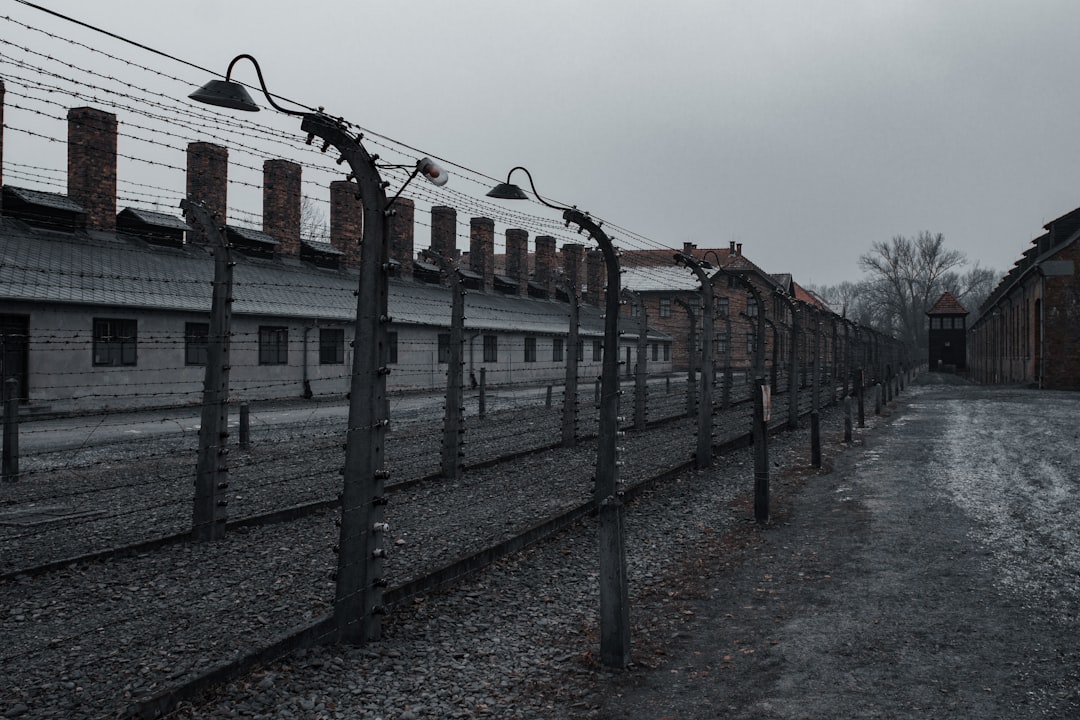
Some places demand that we change how we walk, how we speak, how we think. Auschwitz-Birkenau is such a place. It is not a pleasant place to visit. It is not designed to entertain or comfort. Instead, it is a call to bear witness—to stand in the presence of evil and remember those who suffered there, and by remembering, to affirm that such horrors must never happen again.
If you are planning to visit Auschwitz, you should know that it will affect you. It is meant to. What happened there was so vast, so systematically cruel, that no visit can fully encompass it. But standing in that place, walking those grounds, breathing that history—it changes something within you. It makes the Holocaust real in a way that reading about it never quite can.
The Horror Takes Shape: Auschwitz 1940-1945
Auschwitz began not as a death camp but as a prison for Polish political prisoners. In May 1940, the Nazis established Konzentrationslager Auschwitz in a Polish military barracks near the town of Oswiecim (which they called Auschwitz). At first, it held Polish resistance fighters and intellectuals, Soviet prisoners of war, and common criminals. It was brutal—the purpose was to break prisoners through work, starvation, and torture—but it was not yet the death factory it would become.
That changed in 1941-1942. As Nazi Germany pushed deeper into Soviet territory and committed itself to the “Final Solution”—the deliberate, systematic extermination of European Jewry—Auschwitz was transformed. A second, much larger camp was built a few kilometers away at Birkenau (Auschwitz II). Then, in early 1942, the gas chambers began operation.
What followed was an industrial-scale horror that remains almost incomprehensible nearly eight decades later. Between 1942 and 1945, approximately 1.1 million people were murdered at Auschwitz-Birkenau. About 90 percent were Jews. The rest were Roma, Soviet prisoners of war, Polish intelligentsia, political prisoners, and others deemed “undesirable” by Nazi ideology. By the end of the war, Auschwitz had become the largest cemetery in human history.
The mechanics of murder at Auschwitz reveal the systematic nature of the crime. Trains arrived regularly—sometimes multiple times a day—carrying Jews from across Nazi-occupied Europe. Families crowded into cattle cars, sometimes fifty or sixty people crammed into a space meant for livestock, without food, water, or sanitation. The journey could last days. Many died en route.
When the trains arrived at the Birkenau platform, the deportees were ordered to leave their belongings on the platform—possessions they would never see again. Then came the selection process. SS doctors—most infamously Josef Mengele—examined the arriving prisoners. The strong and able-bodied men and some women were sent left, destined for the labor camps where they would work until they died from overwork and starvation. The elderly, the sick, the disabled, and especially the children—the vast majority—were sent right. Those sent right walked directly to the gas chambers. Most were dead within thirty minutes.
The gas chambers themselves were presented to victims as shower facilities. They were told to undress because they needed to be disinfected. They were herded into sealed rooms and told to bathe. Then Zyklon B cyanide pellets were poured through vents in the ceiling. Death came quickly but not instantly—it was still suffering. The corpses were then taken to crematoria that burned day and night, the smoke rising constantly from Auschwitz, visible from miles away.
This happened not once but thousands upon thousands of times. The Nazi regime kept meticulous records. They knew exactly how many people they were killing. It was, in their eyes, administrative work. Bureaucracy applied to mass murder.
What Visitors Encounter at Auschwitz Today
The Auschwitz complex today consists of three main areas: Auschwitz I (the original camp), Auschwitz II-Birkenau (the main death camp), and Auschwitz III-Monowitz (the labor camp). Most visitors see Auschwitz I and Birkenau, and most do so on an organized tour, which is highly recommended—the guides are historians who can contextualize what you’re seeing and ensure you visit in proper sequence.
Auschwitz I, the original camp, is smaller and more accessible. Here you see the barbed-wire fences, the brick buildings where prisoners were held, the watchtowers. You see the cells where inmates lived—sometimes a dozen people crammed into a small room designed for one. You see Block 11, the prison within the prison, where torture and interrogation took place. You see the courtyard where random prisoners were selected for execution.
One of the most emotionally overwhelming experiences at Auschwitz I is seeing the personal belongings of victims. There are enormous glass cases containing shoes—thousands of shoes—taken from murdered Jews. There is a room filled with human hair, also thousands of kilos of it, shaved from prisoners’ heads. There are photographs of victims, faces of real people who had names and families and futures. There are eyeglasses, artificial limbs, even children’s clothing. Each display represents not statistics but human lives stolen.
The gas chamber at Auschwitz I is a lower priority in the visitor route, as it was used less extensively than those at Birkenau. But many visitors feel compelled to go there—to stand in the place where thousands died, to try to grasp, even incompletely, what happened in that room.
Auschwitz II-Birkenau, the main death camp, is a vast, haunting space. The sheer scale of it is almost incomprehensible. Row after row of prisoner barracks, most now just the stone foundations and chimneys remaining, stretch across what is essentially flat, open land. The barracks themselves—when still standing—were completely inadequate: five-tiered bunks with straw, no proper ventilation, no sanitation. Thousands of people died of disease and starvation alone, even before considering those murdered in the gas chambers.
At Birkenau, you can see the notorious ramp where trains arrived and where the selection process happened. You can stand exactly where victims took their last steps. You can see the ruins of the gas chambers and crematoria, which the Nazis partially destroyed in late 1944 in an attempt to hide the evidence of their crimes.
There is also a memorial at Birkenau—a stone structure erected in 1967 with inscriptions in multiple languages, acknowledging the victims. Visitors often leave flowers there, tributes of remembrance.
Before You Go: What You Should Know
A visit to Auschwitz is not a typical historical site visit. It is an experience, a confrontation with human evil on a scale that is difficult to process. Here are some practical and emotional things to know:
Physical preparation: Auschwitz-Birkenau involves significant walking—often three to four hours or more. The sites are outdoors, and the weather can be harsh. Wear comfortable walking shoes and appropriate clothing for the season. Bring water.
Emotional preparation: Most visitors find the experience deeply moving and often traumatic. That’s normal. Some people find it helps to learn the history beforehand through books or documentaries, so they’re not experiencing it completely fresh. Others prefer to approach with an open heart. There’s no right way to do this.
Guided tours: The official Auschwitz Museum provides guided tours in multiple languages. These tours are truly worthwhile. The guides are knowledgeable and respectful. They provide context and ensure you understand what you’re seeing and why. Tours are three and a half hours and cost around 90 PLN (roughly $23 USD). Advance booking is recommended, especially in high season.
Respectful behavior: Photography is restricted in certain areas, particularly at the memorials. Maintain quiet respect throughout the site. Conversations should be hushed. Treat this as sacred ground, because it is—it’s a cemetery on a monumental scale.
Time needed: Three to four hours is a reasonable minimum, but some people spend a full day. There’s no rush. Move at your own pace. Sit when you need to. Take breaks. Some people need to leave early—that’s also okay and understandable.
Why Every Generation Must Make This Journey
The Holocaust is not just history. It is a warning encoded in the ashes of Auschwitz, written in the memories of survivors, inscribed in the architecture of evil. It happened in one of Europe’s most cultured, educated societies—Nazi Germany was the nation of Goethe and Schiller, of scientific advancement and philosophical tradition. That civilization chose to industrialize murder. That is a lesson every generation needs to absorb.
By visiting Auschwitz, you participate in an act of remembrance that the victims would have wanted. Elie Wiesel, who survived Auschwitz and spent his life bearing witness, said: “To forget would be not only dangerous but offensive; to forget the dead would be akin to killing them a second time.” When you visit Auschwitz, you ensure that the victims are not forgotten. You bear witness. You keep the dead alive in memory.
There is also something important about standing in the place where it happened. Reading about Auschwitz is one thing. Standing in the barracks, walking the selection ramp, confronting the scale of the camp—it creates a visceral understanding that no book can quite achieve. You understand, in your bones, that this happened. It was real. These were real people. This was real suffering.
The Survivors and Their Legacy
Auschwitz was liberated by Soviet forces on January 27, 1945. About 7,000 prisoners were freed—most were so close to death from starvation and disease that many died in the weeks after liberation despite medical care. Tens of thousands had been evacuated on death marches by the retreating Germans in the preceding weeks.
Many survivors came forward to tell their stories. Survivors like Primo Levi, Viktor Frankl, Elie Wiesel, and Auschwitz prisoner 16681, who was a woman named Ruth Elias. Their testimonies are available at the museum and elsewhere. Reading or listening to survivor stories before or after visiting Auschwitz provides crucial human connection—these stories remind us that the victims had voices, personalities, hopes, and fears.
Standing in the Presence of History
A visit to Auschwitz-Birkenau is, ultimately, an act of compassion. You go there for the victims. You go there to say: I know what happened to you. I remember. I will not allow this to be forgotten or minimized. I will ensure that the world knows that you lived, that you mattered, that your deaths mean something.
When you leave Auschwitz, you leave changed. You carry something of that place with you. The responsibility to remember. The determination that such horrors must never happen again. The sobering knowledge that evil is real and must be actively resisted.
Auschwitz is difficult to visit. But it is essential. It is one of those places that reminds us what we are capable of—both in terms of cruelty and in terms of the refusal to accept that cruelty. By visiting, by bearing witness, you honor the memory of those who died there and affirm the imperative to build a world where such camps need never exist again.




Leave a Reply