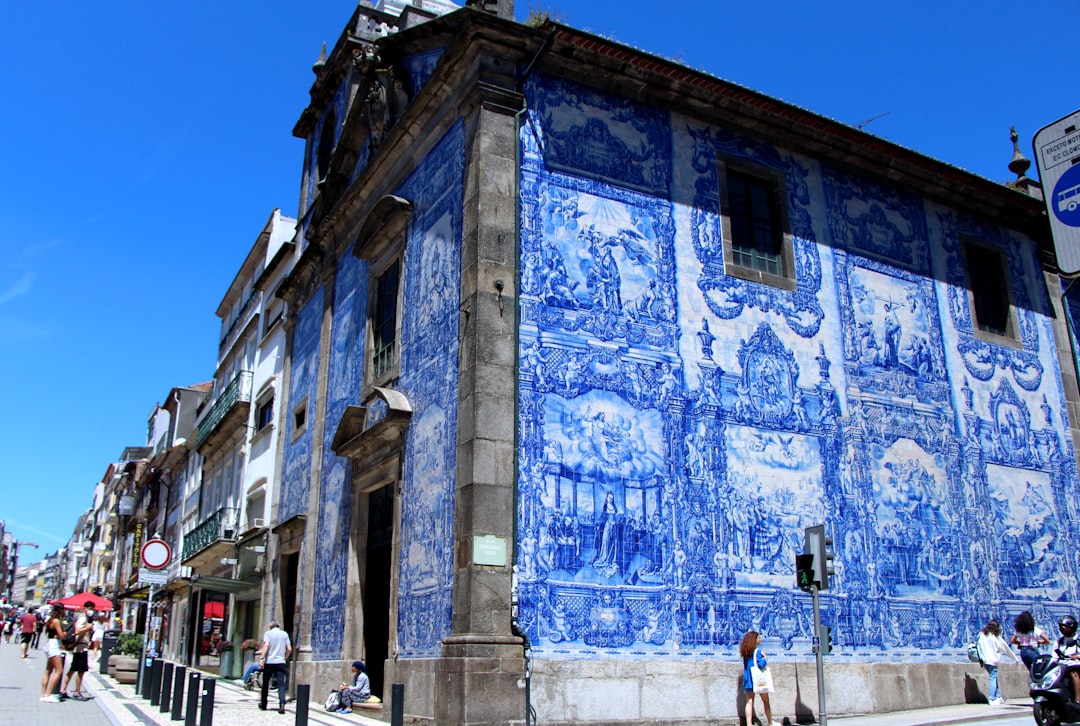
Walk through any Portuguese city—Lisbon, Porto, Covilhã, even small coastal towns—and you’ll be struck by color. Not the muted earth tones you might expect in a European country, but vibrant blues, yellows, greens, and intricate geometric patterns covering the walls of buildings, churches, palaces, and train stations. These are azulejos, Portuguese hand-painted tiles, and they’re far more than decoration. They’re a written history of the country, a visual encyclopedia of its cultural and artistic evolution, and a living tradition that continues to define Portugal’s aesthetic identity.
The azulejo tells the story of how Portugal became Portuguese: invasion and resistance, cultural fusion and synthesis, religious fervor and artistic innovation. Understanding azulejos means understanding how Portugal absorbed influences from its Moorish occupiers, became a Christian kingdom, built a maritime empire, and eventually developed a visual language entirely its own. It’s a story written in tiles, literally and figuratively, and it’s one of the most beautiful stories in European art history.
The Moorish Origins
The story of the azulejo begins not in Portugal but in the broader Islamic world. The word “azulejo” itself likely derives from the Arabic “al-zulaij” (small polished stone). The technique of creating glazed and painted tiles developed in the Islamic world, where religious restrictions on figurative representation in religious spaces led to the development of increasingly sophisticated geometric patterns.
When the Moors occupied large parts of Portugal beginning in the 8th century, they brought this tile-making tradition with them. For nearly 800 years, the Iberian Peninsula was a space of cultural synthesis and conflict, where Christian, Islamic, and Jewish communities coexisted and influenced one another. In the realm of art and architecture, this meant that Portuguese Christian kingdoms were exposed to Islamic aesthetics, techniques, and design principles.
When these kingdoms eventually reconquered Portuguese territory (the Reconquista was completed in 1297), they didn’t reject the beautiful things they encountered. Instead, they synthesized them. They kept the techniques, the love of color, the geometric sensibilities, and began developing their own version—one that would eventually become distinctly Portuguese.
The earliest surviving Portuguese azulejos date from the 15th century. These tiles show clear Islamic influences in their geometric patterns but increasingly begin to incorporate Portuguese symbols, Christian iconography, and a developing sense of local identity. They’re evidence of cultural integration at the artistic level, proof that conquest wasn’t the whole story. There was also exchange, learning, and the creation of something genuinely new.
The Evolution: From Geometry to Narrative
Early azulejos were primarily geometric, following Islamic design principles. But as the centuries progressed, Portuguese tile makers began to expand their visual vocabulary. By the 16th century, azulejos were beginning to tell stories.
This shift reflects broader changes in European art during the Renaissance. As narrative art became more important in Christian Europe, Portuguese artisans adapted their tile tradition to include figurative scenes. You began to see tiles depicting biblical scenes, religious narratives, historical events, and eventually scenes of daily life.
The technique evolved alongside the aesthetics. Early geometric tiles were relatively simple to produce once the design was established. Narrative tiles required more skill, more careful hand-painting, more understanding of perspective and composition. Portuguese tile makers rose to the challenge. They developed the skill to render complex scenes in miniature, to capture movement and emotion on a small ceramic surface.
By the 17th century, Portuguese azulejos were some of the most sophisticated tile work in Europe. They could be abstract and geometrically pure, or they could tell an elaborate visual story. They could decorate a simple kitchen or cover the walls of a royal palace. They were simultaneously folk art and high art, accessible and sophisticated.
The Golden Age: 17th and 18th Centuries
If there’s a “golden age” of Portuguese azulejos, it’s roughly the 17th and 18th centuries. This is when Portuguese tiles achieved their greatest sophistication and spread throughout the country. It’s also when the tile tradition became deeply embedded in Portuguese identity.
Several factors contributed to this explosion of tile work. First, Portugal was wealthy from its maritime empire. Money meant patronage, and patronage meant artistic flourishing. Second, tiles are incredibly practical—they’re durable, waterproof, easy to clean, perfect for kitchens and bathrooms. As living standards improved and people decorated their homes more elaborately, tiles were there to fill that need. Third, the Portuguese tile makers themselves had achieved a level of mastery that made their work sought after throughout Europe and in Portugal’s colonies around the world.
During this period, the iconography of azulejos became deeply embedded in Portuguese culture. You see tiles commemorating royal events, tiles depicting saints and martyrs, tiles showing scenes from classical literature adapted into Portuguese versions, tiles showing the everyday life of the period. There are tiles of ships and exotic animals brought back from the colonies. There are tiles of elegant gentlemen and fashionable ladies. There are tiles of gardens and mythological scenes.
The color palette deepens during this period. While early tiles were often limited to blues and whites, 18th-century tiles add yellows, greens, browns, and more vibrant blues. The technical skill increases too. The tiles become larger, more ambitious in scope, more nuanced in their design and execution.
The Great Tile Locations
To truly appreciate Portuguese azulejos, you need to visit the places where they’re still in situ, covering walls and floors as they were intended to be seen.
São Bento Train Station in Porto is perhaps the most famous single location of tile work in Portugal. The main hall is completely covered in massive azulejo panels depicting historical scenes from Portuguese history. The scale is overwhelming. The panels are meticulously detailed, featuring hundreds of figures, horses, ships, and architectural elements. Walking into São Bento is like stepping into a history book written in tiles. The emotional impact of seeing this much beautiful, historically significant artwork in one place is difficult to overstate.
The National Tile Museum (Museu Nacional do Azulejo) in Lisbon is absolutely essential. Located in the former Convent of Santa Apolónia, the museum has one of the world’s most comprehensive collections of Portuguese azulejos, arranged chronologically and thematically. You can trace the entire evolution of the art form from medieval Islamic-influenced tiles to contemporary work. The museum also has a lovely café in the convent gardens where you can sit and absorb what you’ve seen.
Churches throughout the country are often completely or partially covered in azulejos. The Basilica of the Star in Lisbon, the Church of Clérigos in Porto, the Chapel of Bones in Faro—all feature significant azulejo work. Many smaller churches throughout the country have their interiors lined with tiles, some famous, many not, all beautiful.
Palaces and noble homes throughout Portugal showcase azulejos. The Palace of Queluz near Lisbon has particularly magnificent tile work. The Palace of Pena in Sintra features tiles prominently. Even private homes and aristocratic residences, where possible to visit, display beautiful azulejos.
Quinta dos Azulejos (Tile Estate) near Lisbon is a museum dedicated entirely to tiles, with beautiful gardens that feature tile work and a museum showcasing both historical and contemporary Portuguese tiles.
The Theft Problem and the Fight to Preserve
Here’s something many tourists don’t realize: Portuguese azulejos are being stolen. Not by casual souvenir hunters, but by organized theft rings that target historically significant tiles.
Beautiful 17th and 18th-century tiles are valuable. They’re valuable artistically, historically, and literally on the art market. Criminals have discovered they can carefully remove tiles from older buildings and sell them to collectors or to wealthy individuals decorating homes or restaurants. This theft has become a serious problem in Portugal, particularly in Lisbon and Porto.
The Portuguese government has responded by increasing surveillance, implementing protective measures, and raising awareness. Some of the most historically significant tile locations now have security measures that weren’t necessary even a decade ago. This is particularly heartbreaking because it means that some of Portugal’s cultural heritage has to be protected as if it were in danger of war—because, in a sense, it is.
As a traveler, you can help protect this heritage by not buying any tiles that seem to have been recently removed from buildings (which is illegal) and by supporting legitimate museums and collections. If you want to take home Portuguese tile work, buy modern reproductions from contemporary tile makers, which is both legal and supportive of the living tradition.
Modern Artists Keeping the Tradition Alive
The 20th century saw a decline in traditional azulejo production. Industrial methods replaced hand-painting. The tradition seemed, for a moment, in danger of becoming purely historical.
But Portugal is a country that doesn’t let its traditions die easily. Starting in the mid-20th century and continuing through the present, contemporary Portuguese artists have been revitalizing and reinterpreting the azulejo tradition.
Artists like Maria de Lourdes da Silva de Castro and more contemporary creators have proven that azulejos aren’t a dead art form. They’ve created new designs that respect traditional techniques while bringing contemporary sensibilities. Some are abstract, some are figurative, some are overtly political (particularly tiles created during and immediately after the 1974 Carnation Revolution, which used tiles as a medium for expressing democratic ideals).
You can see contemporary azulejos throughout Portugal. Some buildings in Lisbon have recently been decorated with new tile panels that feel both traditional and modern. Artists are working with municipalities to add color and history to neighborhoods. The tradition is alive, evolving, and still capable of producing work that moves viewers.
Azulejo Workshops and Making Your Own
Several places throughout Portugal allow tourists to try their hand at tile painting. These workshops typically last a few hours and teach you the basics of traditional azulejo technique.
The experience is more difficult than you might expect. Creating a recognizable design on a ceramic tile requires patience, a steady hand, and an understanding of how colors and proportions work. But it’s also incredibly rewarding. You come away with genuine respect for the centuries of tile makers who did this work by profession, often creating hundreds of tiles in a year.
Most workshops will fire your tile in their kiln and mail it to you, so you can take home a genuine Portuguese tile that you created yourself. It’s a perfect souvenir—personal, handmade, connected to the living tradition rather than just its history.
The Visual Identity of Portugal
Standing back and looking at the bigger picture, azulejos have fundamentally shaped how Portugal looks and how Portugal understands itself. In most European countries, architectural beauty is created through stone carving, through architectural proportions, through the play of light and shadow on classical forms.
Portugal is different. The azulejo gave Portugal a tradition where beauty is created through color, pattern, and narrative. Portuguese buildings aren’t primarily beautiful because of their classical proportions (though many are) but because of their surfaces—the intricate, beautiful surfaces that tell stories and create visual delight.
This has consequences for how Portuguese people relate to beauty, decoration, and public space. There’s a sense in Portuguese culture that public and private spaces should be beautiful, that color is not something to be embarrassed about, that visual storytelling is an important form of communication.
Walk through a Portuguese neighborhood and you’ll see this aesthetic sensibility everywhere. Even modest buildings are painted in bright colors. Small tiles decorate unexpected corners. Public spaces are given visual attention. It’s not chaotic—it’s deeply organized by centuries of aesthetic tradition. But it’s alive in a way that many European cities, with their somber stone facades, are not.
Visiting Azulejos as a Traveler
If you want to really see and understand Portuguese azulejos:
Start at the National Tile Museum in Lisbon. It gives you the historical context and the eye to see what you’re looking at in other locations.
Visit São Bento Station in Porto. This single location is an education in Portuguese art history.
Walk slowly through the old neighborhoods—Alfama in Lisbon, Ribeira in Porto, the medieval towns in the interior. Look up. Look at corners and walls and building edges. You’ll see azulejos everywhere, each one with its own story.
Visit churches and religious buildings when possible. Tiles in religious buildings often represent some of the finest and most ambitious work.
Consider visiting an azulejo workshop and trying to create one yourself. Understanding the physical difficulty of the craft deepens your appreciation for those who do it professionally.
Pay attention to contemporary tiles as you see them. Portugal’s tile tradition isn’t in a museum—it’s alive, still being created, still evolving.
The azulejo is proof that beauty doesn’t have to be complicated to be profound. It’s proof that something practical—a waterproof surface for a wall—can become art. It’s proof that cultural traditions can survive centuries of change, can evolve and transform, can stay relevant and alive. Most of all, it’s proof that Portugal is a country that has always understood that beauty matters, that the spaces where we live and move through the world should be filled with color, pattern, story, and art.
That understanding is written in tiles, quite literally, across every corner of this remarkable country.




Leave a Reply