France in 1940 was the world’s most powerful military force—or so everyone thought. The French Army was larger than Germany’s, better equipped in many ways, and backed by British naval supremacy. Then, in six weeks, it collapsed. German armies poured across the border, swept aside French defenses, and by June, France had surrendered. The occupation that followed would last four years and fundamentally transform French society, psychology, and culture. For travelers interested in understanding modern France, World War II is inescapable—the scars and memories remain visible across the landscape.
The Fall of France: How the Mighty Collapsed
The story of France’s defeat in 1940 is one of history’s great reversals. The French military strategy was built around the Maginot Line, a series of massive fortifications along the German border designed to be impenetrable. But the Maginot Line had a fatal flaw: it didn’t extend to the Belgian border, which was left relatively open. French and British strategists believed the Ardennes forest was impassable to modern armies. They were catastrophically wrong.
On May 10, 1940, German armies attacked. Rather than attacking the Maginot Line directly, they poured through Belgium and then through the Ardennes. Within days, German tanks had swept around the French defenses and were racing toward the English Channel. The coordinated air power (the Luftwaffe) combined with mobile warfare (Blitzkrieg) overwhelmed the static defenses the French had built.
The French Army was shattered. Within weeks, 1.5 million soldiers were taken prisoner. The French government fled Paris and eventually surrendered on June 22, 1940. Many French people never forgave the government for capitulating so quickly. There had been no invasion, no occupation of Paris—just a military defeat that turned into political collapse.
Vichy France: The Uncomfortable Compromise
What followed the armistice wasn’t simple occupation. The Germans allowed France to retain nominal independence under a new government established in the spa town of Vichy, far from German control. The Vichy government, led by Marshal Philippe Pétain (who had been a hero in World War I), made a crucial calculation: since the British still fought on, and since the Germans seemed invincible, the best strategy was collaboration—cooperating with the Germans in hopes of preserving what remained of France’s sovereignty and French lives.
This logic was understandable but morally catastrophic. Vichy collaborated in Nazi racial policies. It passed antisemitic laws, turned over French Jews to the Germans for deportation, and provided material support to the German war effort. Vichy France also established a totalitarian state, suppressing dissent and freedom. The regime became associated with collaboration, authoritarianism, and complicity in genocide.
The Vichy phenomenon remains controversial in modern France. Some argue that Vichy was a pragmatic choice in impossible circumstances. Others see it as cowardly collaboration and a betrayal of French values. The truth is probably complex—Vichy was both genuine French government policy and a French invention that magnified Nazi racism. Understanding this moral ambiguity is important for understanding how ordinary people in occupied countries behaved during the Holocaust.
Daily Life Under Occupation
For four years, France was occupied by German troops. The northern half of the country was under direct German military rule. The southern half nominally belonged to Vichy. Everywhere, rationing was severe. Black markets flourished. German soldiers were everywhere, and French people had to navigate the strange mixture of coexistence and hostility that defined occupation.
What daily life was like varied by region and by circumstance. In Paris, German soldiers drank in cafés, attended concerts, and treated the city as a conquered prize. For some French people, working for or accommodating the occupiers was survival. For others, accommodation was complicity and collaboration. For still others, any accommodation felt like betrayal of France itself.
Food was scarce. Young people were drafted for labor service in Germany. Families were separated. The constant surveillance created paranoia—neighbors might be informers, so you watched what you said. Jewish families went underground or fled. Resistance activists planned and plotted. Meanwhile, most people tried to simply endure, to keep their families alive, to maintain some sense of dignity and French identity in a country no longer under French control.
The Resistance: From Myth to Reality
After 1940, resistance to Nazi occupation developed, but it took time. In the first years, resistance was limited, disorganized, and dangerous. There were attacks on German soldiers, sabotage of supplies, the distribution of underground newspapers. The Germans responded with brutal repression—hostages were shot, resistance fighters were executed, entire villages were razed if they harbored resistants.
The myth of the Resistance—that France rose up spontaneously against occupation—is largely false. Resistance was marginal, difficult, and dangerous. Most French people didn’t actively resist and didn’t actively collaborate—they tried to survive. But the Resistance that did exist was heroic. Men and women risked everything to gather intelligence, help escaped prisoners, and plan for liberation.
Charles de Gaulle, a general who escaped to London in 1940, became the symbolic leader of the Free French. “I have never believed that the French people were defeated,” he declared, making the case that France could and should continue fighting through its external forces. For years, the Free French were essentially exiles, fighting with the British and later the Americans, waiting for the moment when they could return home.
The Resistance and Free French weren’t always well coordinated until later in the war. But by 1944, as liberation approached, the Resistance networks were increasingly important to the war effort and would play a crucial role in the immediate aftermath of D-Day.
D-Day: The Beaches of Normandy
On June 6, 1944, the Allies launched Operation Overlord—the invasion of Normandy. It was the largest amphibious assault in history. Nearly 160,000 soldiers from the United States, Britain, and Canada landed on five beaches code-named Utah, Omaha, Gold, Juno, and Sword. The invasion was preceded by weeks of bombing and deception operations designed to convince the Germans that the invasion would come elsewhere (at Pas-de-Calais, further north).
The landings themselves were chaotic, bloody, and in many cases successful. At Omaha Beach, where American troops landed, casualties were especially high. Soldiers climbing off landing craft into water and then up a steep beach toward fortified German positions faced devastating machine-gun fire. Thousands were killed in the first hours of fighting. Yet the landings held. By day’s end, the Allies had established a foothold in Normandy.
What followed was a grueling campaign to break out of Normandy and expand the beachhead. For weeks, American, British, and Canadian armies fought against German defenders in terrain that favored the defenders. German forces, even late in the war, were still formidable. The Norman bocage—a landscape of dense hedgerows, small fields, and dense vegetation—made movement difficult and fighting bitter. Thousands more were killed in the weeks after D-Day.
But the sheer weight of American and British resources gradually pushed German forces back. By late July, the breakout from Normandy succeeded. By mid-August, German forces in Normandy were encircled and destroyed. The road to Paris was opening.
The Liberation of Paris
After weeks of fighting in the Norman countryside, American and French forces fought toward Paris. The city itself was liberated on August 25, 1944. The entry was chaotic—Paris erupted in celebration, but there was also confusion, revenge killings, and the grim business of sorting out who had collaborated and who had resisted.
De Gaulle entered Paris in triumph, cementing his position as the leader of liberated France. He became the face of French resistance and French renewal. The image of him walking down the Champs-Élysées with crowds celebrating is one of the most iconic images of the war. It suggested that France had never truly accepted German rule, that the nation’s spirit had remained unbroken.
This narrative is partly myth-making, but it was important. France needed to feel that it had resisted, that it was being liberated rather than conquered. The alternative—accepting that France had been conquered, occupied, and partially collaborated—was too psychologically damaging. So the story of France as a nation of resistance, led by de Gaulle, became the official narrative.
The Beaches Today: Sites of Pilgrimage
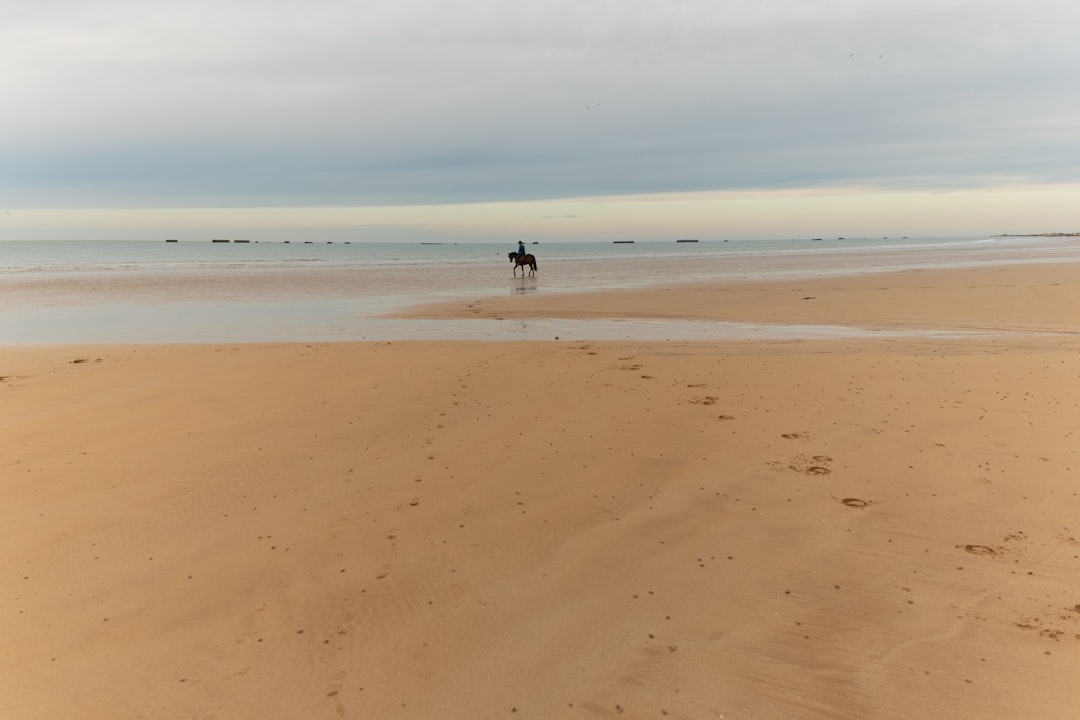
If you visit Normandy today, you’re visiting sacred ground for millions of Americans, Canadians, and British people. The beaches are now peaceful, lined with hotels and seaside towns. But underneath that contemporary facade, the ghosts of 1944 are everywhere.
Omaha Beach remains the most visited, the most photographed. The beach itself is long and sandy, with the cliffs rising behind. Looking at it now, you can understand why the soldiers who landed here thought they were going to die. Some did. Standing on the beach, imagining being in an open landing craft, approaching this defended position—it creates a visceral understanding of what those soldiers faced.
Utah Beach, further west, was less costly for American forces, but the terrain behind the beach was difficult and the surrounding areas were heavily defended. The fighting that followed the beach landings was brutal and continued for weeks.
Pointe du Hoc, between Utah and Omaha, is where Army Rangers were tasked with scaling cliffs and destroying German gun positions. The cliffs are dramatic and visible, and the difficulty of the task becomes clear when you see the terrain. They accomplished their mission, though at great cost.
The American Cemetery at Colleville-sur-Mer is perhaps the most moving site in Normandy. Row upon row of white crosses and Stars of David stretch across a gently rolling hill overlooking Omaha Beach. Nearly 10,000 American servicemen are buried there. Walking among the graves, reading the names and ages (many were teenagers and early twenty-somethings), the human cost of the war becomes almost unbearably clear.
The Mémorial de Caen, a museum dedicated to the history of D-Day and the Normandy campaign, provides context, artifacts, and personal stories that help visitors understand what happened. It’s thorough and well-designed, and it presents multiple perspectives—German, French, American, British, Canadian—on the invasion and its aftermath.
The Dark Side: Oradour-sur-Glane
Not all of Normandy’s World War II history is about D-Day and heroic military campaigns. On June 10, 1944, just four days after D-Day, an SS division entered the village of Oradour-sur-Glane (not far from Limoges, south of Normandy) and massacred the entire population—642 people, including 247 children. The exact reason for the massacre remains disputed, but it was a reprisal killing, and it was total and systematic.
Today, Oradour-sur-Glane is a memorial and museum. The ruins of the village are preserved exactly as they were left after the massacre. Walking through the destroyed buildings, seeing the bullet-scarred church where villagers were herded and burned, understanding that this was a French community that had nothing to do with the Resistance and was destroyed for that reason—it’s one of the most haunting experiences in France. It’s a reminder that the brutality of Nazi occupation wasn’t abstract. It was local, personal, and devastating.
The Mémorial de la Shoah
In Paris, in the Latin Quarter, the Mémorial de la Shoah (Shoah Memorial) documents and commemorates the Holocaust and the deportation of French Jews. Over 75,000 Jews were deported from France to Auschwitz and other death camps. Most were killed. The memorial documents these losses through exhibits, artifacts, and personal testimony.
Visiting the memorial, you encounter the reality of France’s role in the Holocaust—not just as a conquered nation where the Nazis acted, but as a French state (Vichy) that cooperated in the deportation of Jews. It’s difficult history to confront, but it’s essential. The memorial makes clear that this wasn’t something that happened to France, but something France participated in.
The Psychological Legacy
France’s experience in World War II was different from other occupied nations. Being conquered by Germany was a profound shock to French self-image. France had been a dominant European power. The idea that it could be defeated so quickly and completely was psychologically devastating.
This trauma shaped postwar France. It contributed to de Gaulle’s determination to establish France as an independent power, not subordinate to either the Americans or the Soviets. It contributed to France’s sometimes prickly relationship with the United States. It contributed to France’s emphasis on cultural independence and national identity—the idea that France must resist homogenization and maintain its unique character.
The Holocaust, and France’s partial collaboration with Nazi racial policies, also created a specific moral wound. In the postwar period, France struggled with the question of collaboration and Vichy. This wasn’t resolved cleanly. Many collaborators were never punished. The Vichy government was officially dissolved, but the psychological legacy remained.
Visiting the Sites
If you visit Normandy, make the pilgrimage to the beaches and memorials. If you visit Paris, spend time at the Conciergerie (where resistance fighters and others were imprisoned during the occupation), the Mémorial de la Shoah, and the Musée de l’Armée (the Army Museum at Les Invalides), which has excellent exhibits on the occupation and liberation.
Reading about these events, seeing the sites where they occurred, understanding the personal stories behind the grand historical narratives—it transforms how you experience France. Normandy isn’t just a beautiful coastline. Paris isn’t just a beautiful city. They’re places where millions of people experienced one of history’s greatest catastrophes, and where they subsequently rebuilt themselves and their nation.
The World War II history of France is complicated, sometimes shameful, sometimes heroic, always human. It’s a reminder that history isn’t abstract—it’s about real people facing impossible choices, sometimes failing, sometimes rising to the occasion, always struggling to survive and maintain dignity in the face of overwhelming tragedy. That complexity, and that human reality, is what makes these sites matter.




Leave a Reply