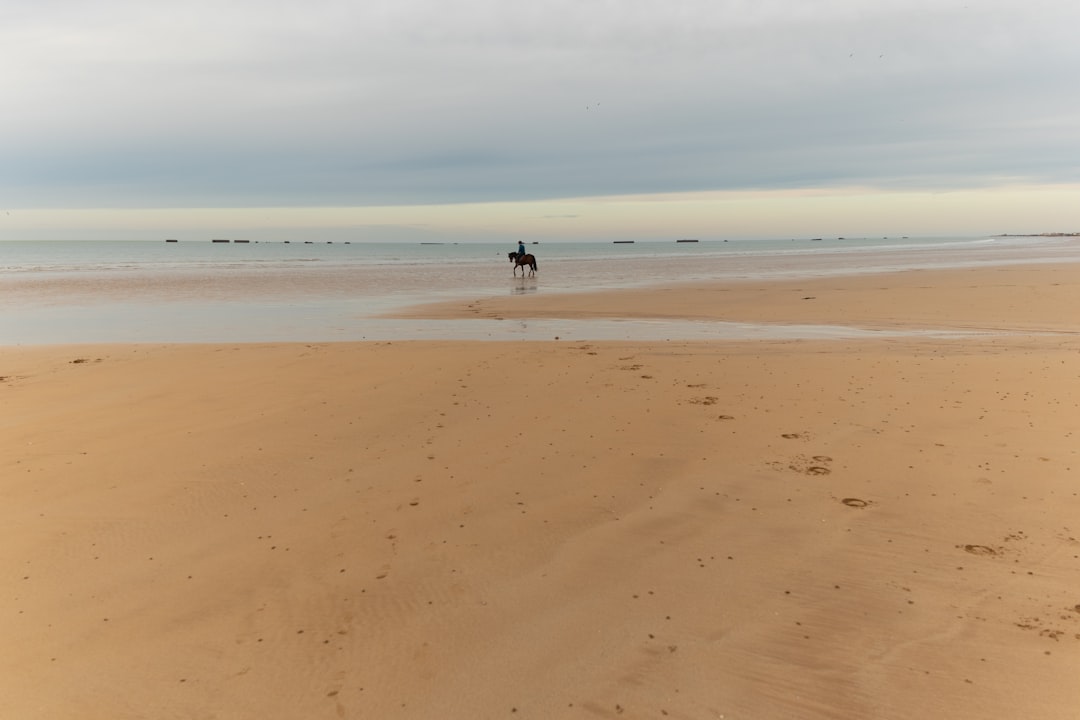
On June 6, 1944, more than 156,000 Allied troops landed on five beaches along an 80-kilometer stretch of Normandy’s coast in the largest amphibious military operation in history. The beaches were given codenames — Utah, Omaha, Gold, Juno, and Sword — and what happened on them over the course of that single day changed the trajectory of the Second World War and, with it, the future of Europe. Visiting these beaches today is a profoundly moving experience, but it demands a certain intentionality: these are not tourist attractions but hallowed ground.
Omaha Beach and the American Cemetery
Omaha Beach, between Vierville-sur-Mer and Colleville-sur-Mer, saw the heaviest fighting on D-Day. The first wave of American troops — mostly from the 1st and 29th Infantry Divisions — faced withering fire from well-fortified German positions on the bluffs above the beach. By day’s end, approximately 2,400 Americans had been killed or wounded on this single stretch of sand. Today, the beach is wide, peaceful, and often windswept, with low-tide expanses that make the distance from waterline to bluff — the killing ground — viscerally apparent.
Above the eastern end of Omaha Beach, the Normandy American Cemetery and Memorial at Colleville-sur-Mer contains 9,387 white marble headstones aligned in perfect rows on a manicured clifftop lawn. The precision of the layout is itself a statement — order imposed on chaos, dignity restored to sacrifice. A semicircular memorial garden at the center includes a bronze statue called “The Spirit of American Youth Rising from the Waves.” The visitor center, opened in 2007, provides excellent context without sensationalizing. Stand at the edge of the cemetery looking down at the beach below, and the geography of the battle becomes heartbreakingly clear.
Pointe du Hoc
Between Omaha and Utah beaches, the clifftop promontory of Pointe du Hoc was assaulted by 225 U.S. Army Rangers who scaled the 30-meter cliffs using rope ladders and grappling hooks under intense fire. Their mission was to destroy a battery of heavy guns believed to be positioned there. The guns had been moved inland, but the Rangers found and disabled them. Only 90 of the original 225 Rangers were still able to fight by the end of the two-day battle. Today, the site is preserved exactly as it was — the landscape is pockmarked with enormous bomb craters, and the concrete bunkers remain shattered and tilted at angles. It is the most raw and unreconstructed of all the D-Day sites.
Utah Beach and Sainte-Mère-Église
Utah Beach, the westernmost landing zone, was relatively lightly defended and saw far fewer casualties than Omaha — about 200 killed and wounded against approximately 23,000 troops landed. The Utah Beach Museum, built around a former German bunker, tells the story effectively. Nearby Sainte-Mère-Église was one of the first towns liberated by American paratroopers of the 82nd and 101st Airborne Divisions, who dropped in the early hours of June 6. A parachute mannequin hanging from the church steeple commemorates Private John Steele, whose parachute caught on the spire, leaving him dangling and playing dead while the battle raged below.
The British and Canadian Beaches
Gold, Juno, and Sword beaches, assaulted by British and Canadian forces, receive somewhat less international attention than the American beaches but are equally significant. At Arromanches-les-Bains on Gold Beach, the remains of the Mulberry artificial harbor — a prefabricated port towed across the English Channel and assembled in place — are still visible at low tide, their massive concrete caissons a monument to engineering audacity. The Arromanches 360 cinema shows immersive archival footage on nine screens.
Juno Beach, where Canadian forces landed, has an excellent museum — the Juno Beach Centre — built and operated by Canadian veterans and their descendants. Sword Beach, the easternmost landing zone, was the responsibility of the British 3rd Infantry Division and saw fierce fighting around the resort town of Ouistreham, where a museum in a former German battery tells the story.
How to Visit Respectfully
- Allow at least two full days. Rushing between sites cheapens the experience and prevents real engagement with each location’s significance.
- Read before you go. At minimum, understand the basic plan and timeline of the invasion. Antony Beevor’s “D-Day: The Battle for Normandy” is an excellent starting point.
- Speak quietly at cemeteries and memorial sites. Selfies with headstones are inappropriate.
- Visit in the off-season if possible. The beaches in November, with grey skies and cold wind, evoke the conditions of the invasion far more powerfully than a sunny July afternoon.
- Remember that this is not exclusively an American story. British, Canadian, Free French, Polish, Norwegian, and other Allied forces all played essential roles.
The D-Day beaches are among Europe’s most sacred secular spaces. They ask something of visitors — not just attention, but a willingness to sit with the weight of what happened here, to let the landscape speak before reaching for a camera. Give them that respect, and they will repay it with an experience that stays with you permanently.




Leave a Reply