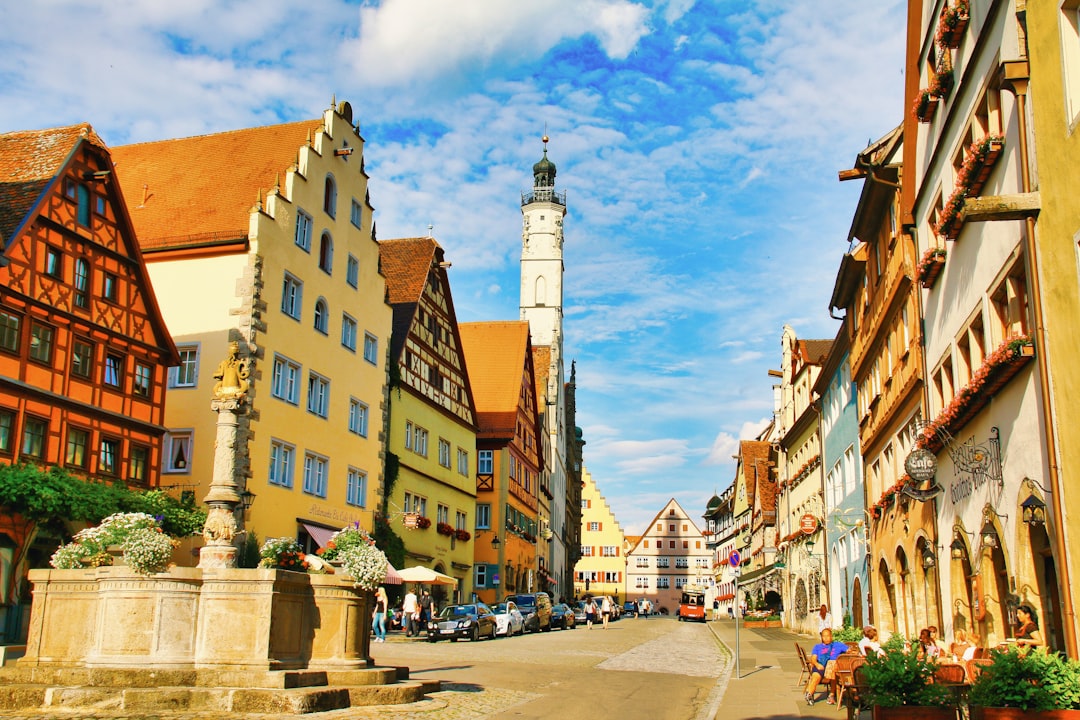
Medieval Europe lives on in a surprising number of towns that have survived centuries of war, modernization, and urban development with their historic cores remarkably intact. Walking through their narrow cobblestone streets, past half-timbered houses and stone ramparts, is the closest thing to time travel that tourism offers. These are not museum recreations but living communities where medieval architecture remains the fabric of daily life — where people buy groceries in buildings that were old before Columbus sailed, and children play in squares where markets have operated since the twelfth century.
Carcassonne, France
The fortified city of Carcassonne in southern France is medieval military architecture at its most spectacular. The Cité, perched on a hill above the River Aude, is enclosed by a double ring of walls studded with 52 towers, making it the largest fortified city in Europe. Though the outer walls date to the thirteenth century and the inner ones incorporate Roman foundations from the third century, much of what visitors see today is the result of an ambitious nineteenth-century restoration by Eugène Viollet-le-Duc, who added the distinctive conical slate roofs that give Carcassonne its fairy-tale silhouette. Critics accused him of over-restoration, but the result is undeniably dramatic. Visit early in the morning or after the day-trippers leave to experience the Cité without crowds, when the limestone walls glow amber in the fading light.
Rothenburg ob der Tauber, Germany
Rothenburg ob der Tauber in Bavaria is perhaps the archetypal German medieval town — so perfectly preserved that it served as a model for the village in the Disney film Pinocchio. Its complete circuit of fourteenth-century walls, with covered walkways and watchtowers, can be walked in about an hour. The Plönlein, a tiny triangular square where two streets diverge beneath half-timbered houses flanked by tower gates, is one of Germany’s most photographed scenes. The town’s survival is partly due to an American assistant secretary of war, John J. McCloy, who had visited before the war and ordered that it be spared during the Allied advance in 1945 — though not before some damage was inflicted. The Medieval Crime Museum offers a fascinating and sometimes disturbing collection of judicial instruments and punishment devices.
San Gimignano, Italy
Known as the “Medieval Manhattan” for its skyline of fourteen surviving tower houses — there were originally 72 — San Gimignano in Tuscany preserves a unique feature of Italian medieval urban life. Wealthy families built towers as both defensive structures and status symbols; the taller the tower, the more powerful the family. The tallest surviving tower, the Torre Grossa at 54 meters, can be climbed for panoramic views of the surrounding Tuscan countryside. The town’s compact historic center, a UNESCO World Heritage Site since 1990, also contains the Collegiate Church with its extraordinary fourteenth-century frescoes and the Palazzo Comunale. The local Vernaccia di San Gimignano, a crisp white wine, has been produced here since at least 1276, when Dante mentioned it in the Divine Comedy.
Český Krumlov, Czech Republic
Wrapped in a dramatic horseshoe bend of the Vltava River in southern Bohemia, Český Krumlov is dominated by its enormous castle — the second-largest in the Czech Republic after Prague Castle. The town’s medieval and Renaissance core is so intact that the entire center was designated a UNESCO World Heritage Site in 1992. The castle’s Baroque theater, one of the best-preserved in Europe, still contains original eighteenth-century stage machinery and painted scenery. Below the castle, the town’s lanes wind past pastel-colored Gothic and Renaissance houses to small squares with outdoor cafés. In summer, the Vltava provides a different perspective entirely — renting a canoe or inner tube and floating through the town is a popular and slightly surreal way to experience medieval architecture.
Mdina, Malta
Malta’s former capital, known as the “Silent City,” sits on a hilltop in the center of the island behind Arab-Norman walls. With a permanent population of fewer than 300 people, Mdina genuinely earns its nickname — the narrow streets are often deserted, and cars are restricted. The city’s architectural layers reflect Malta’s complex history: Arab foundations, Norman churches, and Baroque palaces coexist within walls that date partly to the ninth century. The view from the bastions across the island to the Mediterranean is magnificent, and the small but excellent Cathedral of St. Paul, built on the site where the apostle Paul supposedly lived after being shipwrecked on Malta in 60 AD, contains fine Mattia Preti paintings.
Tallinn and Óbidos
Tallinn’s Old Town, one of the best-preserved medieval cities in northern Europe, retains most of its thirteenth-century walls and towers. The distinction between the upper town (Toompea), where the nobility lived, and the lower town, home to merchants and craftsmen, remains physically visible in the limestone cliff that separates them. Meanwhile, Óbidos in Portugal is a whitewashed jewel enclosed entirely by crenellated walls that visitors can walk atop. Given to queens of Portugal as wedding gifts for centuries, Óbidos maintains a character that is intimate rather than grand — its population is only about 3,000, and it can be explored in a leisurely afternoon, ideally with a cup of ginjinha, the local cherry liqueur, served in a chocolate cup.
What makes these towns special is not merely their age but their continuity. They are not archaeological sites or open-air museums but places where the medieval built environment remains functional, lived-in, and loved. They remind us that the past is not always behind us — sometimes it is the ground beneath our feet and the walls around us.




Leave a Reply