Andorra
Your complete guide to Andorra
Quick Facts
Capital
Andorra la Vella
Population
77,000
Languages
Catalan (official), French, Castilian, Portuguese
Currency
euros (EUR)
Area
468 sq km
Government
Parliamentary democracy (since March 1993) that retains its chiefs of state in the form of a co-principality; the two princes are the President of France and Bishop of Seu d'Urgell, Spain
About Andorra
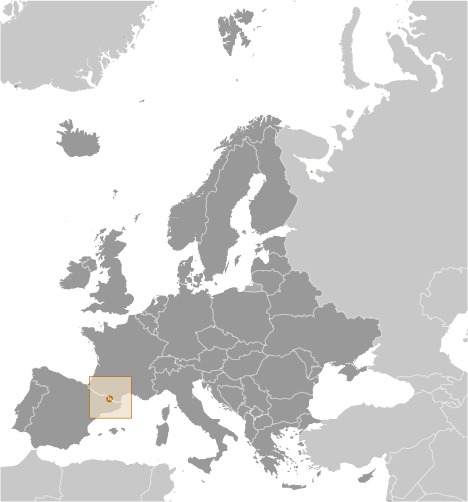
Tucked high in the eastern Pyrenees between France and Spain, Andorra is one of Europe's smallest sovereign states — yet it draws millions of visitors each year to its ski slopes, duty-free shops, and dramatic mountain scenery. At an average elevation of over 1,900 meters, it is the highest inhabited country in Europe.
Despite its diminutive size, Andorra has developed a prosperous modern economy built on tourism, banking, and retail. The capital, Andorra la Vella, sits at 1,023 meters and buzzes with shoppers and skiers depending on the season. Beyond the commercial center, stone Romanesque churches and hiking trails through glacial valleys reveal the principality's quieter soul.
Andorra's unique political arrangement — a parliamentary co-principality under the joint sovereignty of the French president and the Bishop of Urgell — dates back to a medieval charter of 1278, making it one of Europe's most unusual constitutional curiosities.
History
Legend attributes Andorra's founding to Charlemagne, who supposedly granted the valleys a charter in gratitude for local guides during his campaign against the Moors. The documented history begins with a ninth-century charter, and the co-principality was formalized in 1278 through the Pareatge, a feudal agreement between the Count of Foix and the Bishop of Urgell.
For centuries Andorra remained an isolated pastoral society of shepherds and farmers. Modernization accelerated only after World War II, when duty-free commerce and winter tourism transformed the economy. A formal constitution was adopted in 1993, establishing Andorra as a parliamentary democracy while preserving the ceremonial co-princes.
The landlocked Principality of Andorra is one of the smallest states in Europe, nestled high in the Pyrenees between the French and Spanish borders. For 715 years, from 1278 to 1993, Andorrans lived under a unique coprincipality, ruled by French and Spanish leaders (from 1607 onward, the French chief of state and the Bishop of Urgell). In 1993, this feudal system was modified with the introduction of a modern constitution; the co-princes remained as titular heads of state, but the government transformed into a parliamentary democracy. Andorra has become a popular tourist destination visited by approximately 8 million people each year drawn by the winter sports, summer climate, and duty-free shopping. Andorra has also become a wealthy international commercial center because of its mature b…
CIA World Factbook
Culture & Society
Andorran culture draws from both Catalan and broader Pyrenean traditions. Catalan is the sole official language, and festivals like the Festa Major feature sardana circle dances, gegants (giant puppets), and communal feasts. Traditional cuisine centers on hearty mountain fare — trinxat (cabbage and potato cake), escudella stew, and cured meats — while the Romanesque churches of Sant Joan de Caselles and Santa Coloma testify to a deep medieval heritage.
Languages: Catalan (official), French, Castilian, Portuguese
Religions: Roman Catholic (predominant)
Ethnic Groups: Andorran 48.8%, Spanish 25.1%, Portuguese 12%, French 4.4%, other 9.7% (2017 est.)
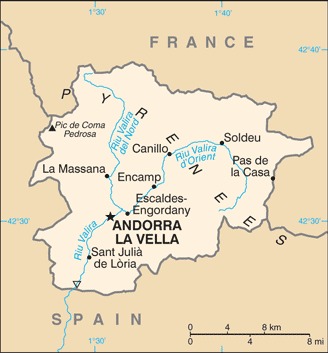
Maps
Articles About Andorra
Destinations
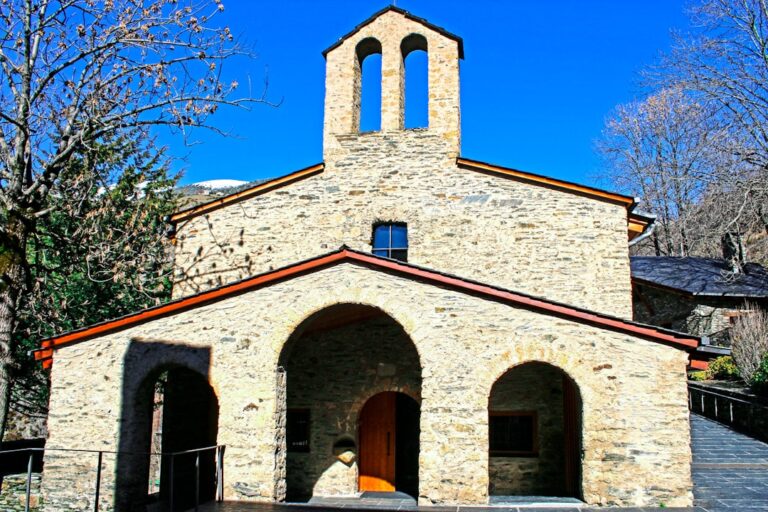
Europe's Forgotten Microstates: Andorra, San Marino, and Liechtenstein
Tucked between Europe's larger nations lie a handful of tiny sovereign states that most travelers overlook entirely.
Travel
Europe's Forgotten Microstates: Andorra, San Marino, and Liechtenstein
Tucked between Europe's larger nations lie a handful of tiny sovereign states that most travelers overlook entirely.