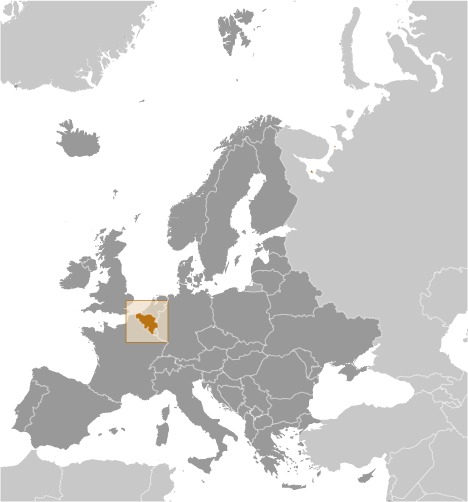
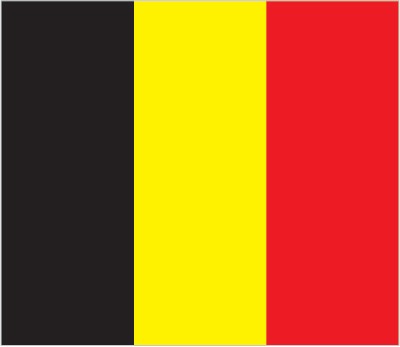
Belgium
Your complete guide to Belgium
Quick Facts
Capital
Brussels
Population
11,720,716
Languages
Dutch (official) 60%, French (official) 40%, German (official) less than 1%
Currency
euros (EUR)
Area
30,528 sq km
Government
Federal parliamentary democracy under a constitutional monarchy
About Belgium
Belgium straddles the cultural frontier between Germanic and Romance Europe, a compact kingdom whose three official languages — Dutch, French, and German — reflect a complex federal identity. Despite persistent linguistic tensions, the country has forged a shared culture around beer, chocolate, comic strips, and surrealist art.
As the de facto capital of the European Union and host to NATO headquarters, Brussels carries an outsized international significance. Beyond the capital, the medieval cloth halls of Flanders, the forested Ardennes, and the Art Nouveau streetscapes of Brussels itself reward exploration at every turn.
Belgium's culinary reputation is world-class: it produces over 1,500 varieties of beer, invented the praline, and perfected the twice-fried chip. Combined with a rich artistic heritage spanning Van Eyck, Bruegel, Magritte, and Hergé, the country offers a density of cultural riches matched by few nations its size.
History
Belgium's territory has been a crossroads and battleground for centuries. Ruled successively by Burgundy, Spain, Austria, and France, the region gained independence from the Netherlands in 1830 after a liberal revolution. The new kingdom quickly industrialized — Wallonia became one of the world's first industrial regions — and acquired the vast Congo Free State under King Leopold II, a colonial episode marked by horrific exploitation.
Belgium suffered devastating occupation in both World Wars, with the Ypres Salient and the Battle of the Bulge leaving deep scars. Postwar recovery brought European integration, and Belgium became a founding member of the EEC. Internally, the country has evolved into a complex federal state to manage its Dutch-speaking, French-speaking, and German-speaking communities.
Belgium became independent from the Netherlands in 1830; it was occupied by Germany during World Wars I and II. The country prospered in the past half century as a modern, technologically advanced European state and member of NATO and the EU. In recent years, political divisions between the Dutch-speaking Flemish of the north and the French-speaking Walloons of the south have led to constitutional amendments granting these regions formal recognition and autonomy. The capital city of Brussels is home to numerous international organizations including the EU and NATO.
CIA World Factbook
Culture & Society
Belgian culture thrives on creative contrasts: Flemish masters hang in the same mental gallery as surrealist provocateurs, and monastic Trappist breweries coexist with Michelin-starred innovation. The country's comic-strip tradition — home to Tintin, the Smurfs, and Lucky Luke — is celebrated in dedicated museums and murals across Brussels. Carnival traditions, particularly the UNESCO-listed Carnival of Binche with its gilles and wax masks, reveal deep-rooted folk customs.
Languages: Dutch (official) 60%, French (official) 40%, German (official) less than 1%
Religions: Roman Catholic 50%, Protestant and other Christian 2.5%, Muslim 5%, Jewish 0.4%, Buddhist 0.3%, atheist 9.2%, none 32.6% (2009 est.)
Ethnic Groups: Belgian 75.2%, Italian 4.1%, Moroccan 3.7%, French 2.4%, Turkish 2%, Dutch 2%, other 10.6% (2012 est.)
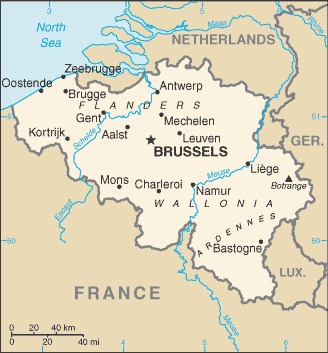
Maps
Articles About Belgium
History
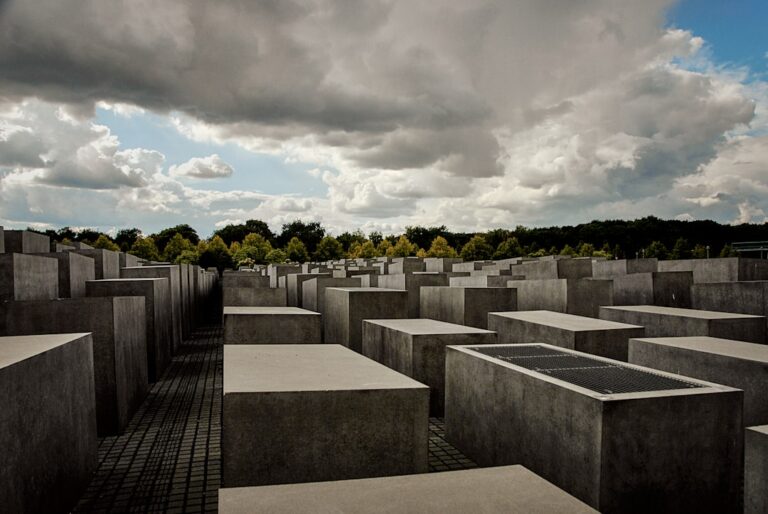
Europe’s Most Haunting World War I Battlefields
The First World War killed approximately 20 million people — soldiers and civilians — between 1914 and 1918, and wounded…
Destinations
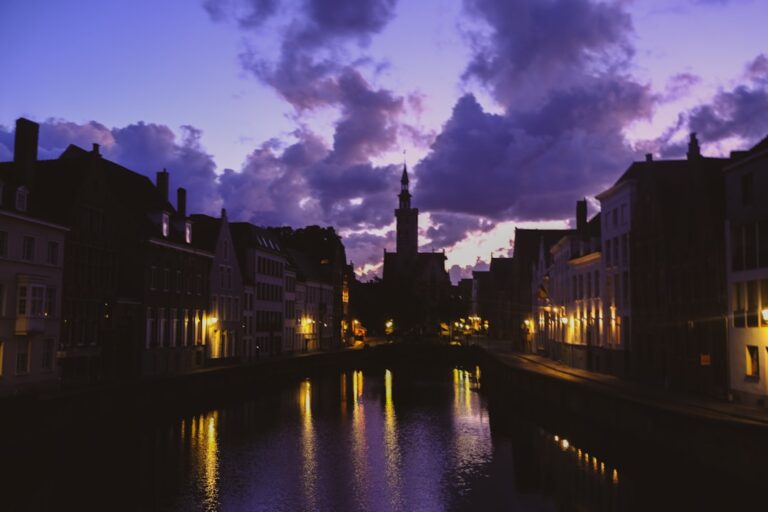
A Weekend in Bruges: Beyond the Chocolate Shops
Bruges has a reputation problem.
Travel
A Weekend in Bruges: Beyond the Chocolate Shops
Bruges has a reputation problem.