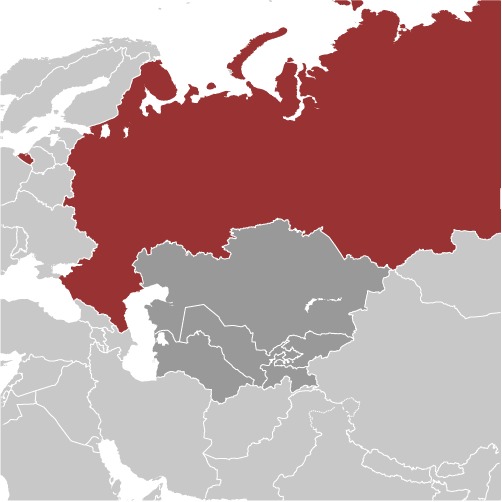
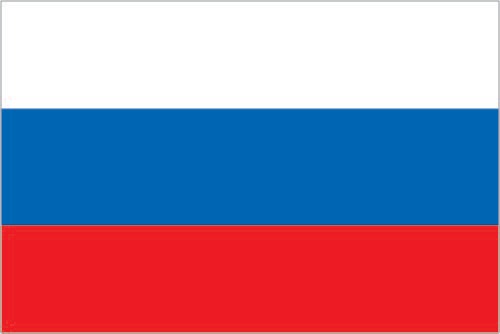
Russia
Your complete guide to Russia
Quick Facts
Capital
Moscow
Population
141,722,205
Languages
Russian (official) 85.7%, Tatar 3.2%, Chechen 1%, other 10.1% (2010 est.)
Currency
Russian rubles (RUB)
Area
17,098,242 sq km
Government
Semi-presidential federation
About Russia
Russia is the world's largest country by area, spanning eleven time zones from the Baltic exclave of Kaliningrad to the Pacific coast. Its European portion — west of the Ural Mountains — contains the majority of its population and the cultural centers of Moscow and Saint Petersburg.
Moscow, the capital, is a city of imposing scale: the Kremlin, Red Square, and the domed cathedrals speak to centuries of imperial and Soviet power, while a vibrant contemporary scene of restaurants, galleries, and nightlife pulses beneath the monumental facades. Saint Petersburg, Peter the Great's 'Window to Europe,' is a Baroque and Neoclassical masterpiece built on canals and islands.
Russia's cultural contributions — in literature, music, ballet, and science — are immense. Tolstoy, Dostoevsky, Chekhov, Tchaikovsky, and Stravinsky are just a few names in a tradition that has profoundly shaped world culture.
History
Russia's European history begins with the medieval state of Kievan Rus', followed by centuries of Mongol domination and the rise of the Grand Duchy of Moscow. The Russian Empire, expanding from the sixteenth century under Ivan the Terrible and then dramatically under Peter the Great and Catherine the Great, became one of the world's great powers.
The Russian Revolution of 1917 ended the Romanov dynasty and established the Soviet Union, which industrialized rapidly, defeated Nazi Germany at enormous cost in World War II, and became a nuclear superpower during the Cold War. The Soviet collapse in 1991 created the Russian Federation, which has since navigated economic upheaval, political centralization, and renewed geopolitical tensions with the West.
Founded in the 12th century, the Principality of Muscovy was able to emerge from over 200 years of Mongol domination (13th-15th centuries) and to gradually conquer and absorb surrounding principalities. In the early 17th century, a new ROMANOV Dynasty continued this policy of expansion across Siberia to the Pacific. Under PETER I (ruled 1682-1725), hegemony was extended to the Baltic Sea and the country was renamed the Russian Empire. During the 19th century, more territorial acquisitions were made in Europe and Asia. Defeat in the Russo-Japanese War of 1904-05 contributed to the Revolution of 1905, which resulted in the formation of a parliament and other reforms. Devastating defeats and food shortages in World War I led to widespread rioting in the major cities of the Russian Empire and …
CIA World Factbook
Culture & Society
Russian culture is defined by its depth and intensity. The literary tradition — Pushkin, Gogol, Tolstoy, Dostoevsky, Chekhov, Bulgakov — is one of the world's richest. Russian classical music (Tchaikovsky, Rachmaninoff, Shostakovich) and ballet (the Bolshoi, the Mariinsky) set global standards. The cuisine, built on rye bread, soups (borscht, shchi), dumplings (pelmeni), and preserves, reflects the country's continental extremes, while the banya (steam bath) and vodka traditions are deeply embedded in social life.
Languages: Russian (official) 85.7%, Tatar 3.2%, Chechen 1%, other 10.1% (2010 est.)
Religions: Russian Orthodox 15-20%, Muslim 10-15%, other Christian 2% (2006 est.)
Ethnic Groups: Russian 77.7%, Tatar 3.7%, Ukrainian 1.4%, Bashkir 1.1%, Chuvash 1%, Chechen 1%, other 10.2%, unspecified 3.9% (2010 est.)
Maps
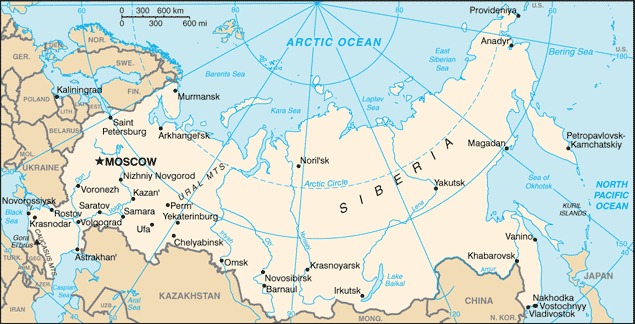
Articles About Russia
Articles
We're still writing about Russia. Check back soon or browse the category archive.