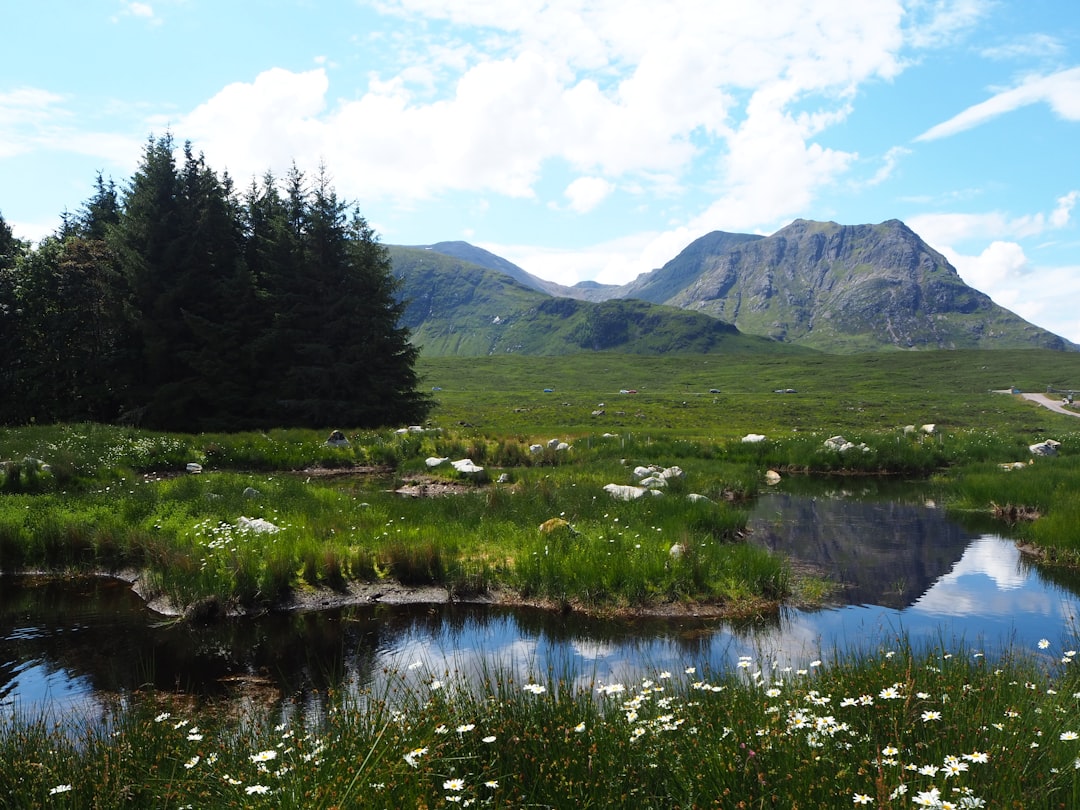
The Scottish Highlands are one of the last great wild landscapes in Western Europe—a vast expanse of heather-covered mountains, dark lochs, and empty glens where the human population thins to almost nothing and the red deer outnumber the people. The common assumption is that visiting requires a hefty budget: luxury lodges, private whisky tours, guided hikes. It does not. Scotland has some of the most generous public access laws in Europe, a network of free or nearly free accommodation in the hills, and a landscape that charges nothing for admission. Here is how to experience the Highlands without emptying your wallet.
The NC500: Scotland’s Answer to Route 66
The North Coast 500 is a roughly five-hundred-mile loop around the northern Highlands, starting and ending in Inverness. It traces a route through some of the most dramatic scenery in Britain—the towering sea stacks of Duncansby Head, the white sand beaches of Durness and Achmelvich, the lunar landscape of Knockan Crag, and the impossibly steep single-track roads of the Bealach na Bà pass above Applecross. The route can be driven in five days at a brisk pace, but a week or more allows for proper exploration.
Car rental from Inverness starts at around thirty to forty pounds per day if booked in advance. Fuel costs are higher in the Highlands—expect to pay ten to fifteen percent more per litre than in the central belt—but the distances between stops are not enormous. Budget around one hundred and fifty pounds for fuel for the full loop. The real savings come from where you sleep.
Wild Camping and Bothies
Scotland’s Land Reform Act of 2003 enshrined the right to roam and, crucially, the right to wild camp. You can pitch a tent almost anywhere on unenclosed land, provided you follow the Scottish Outdoor Access Code: camp in small numbers, move on after two or three nights, leave no trace, and avoid enclosed farmland or the immediate vicinity of buildings. This means that some of the most spectacular campsites in Europe—a loch shore backed by mountains, a clifftop overlooking the Atlantic, a hidden glen with a waterfall—are completely free.
Even more remarkable are the bothies. These are remote, unlocked shelters—usually old stone cottages or shepherds’ huts—maintained by the Mountain Bothies Association. They are free to use, first come, first served. There are no bookings, no wardens, and no facilities beyond four walls, a roof, and sometimes a fireplace. You bring your own sleeping bag, stove, food, and water. The bothy book, left inside for visitors to record their stays, often makes for the most atmospheric reading you will find anywhere. Shenavall in Fisherfield, Corrour on Loch Ossian, and Glencoul in Sutherland are among the finest, though reaching any of them requires a decent hike.
Glen Coe and the Isle of Skye
Glen Coe, about two hours north of Glasgow, is the Highlands distilled to their essence. The valley is a deep U-shaped glacial trough flanked by brooding peaks—the Three Sisters, Buachaille Etive Mòr, Bidean nam Bian—and its history is as dark as its weather. The 1692 massacre, in which government soldiers murdered their MacDonald hosts in the dead of winter, haunts the place still. Walk the valley floor on the easy trail from the visitor centre, or tackle the Aonach Eagach ridge if you have a head for heights and scrambling experience. The ridge is exposed and serious, but the views from the top are among the finest in Scotland.
The Isle of Skye, reached by a road bridge from Kyle of Lochalsh, concentrates an absurd amount of dramatic scenery onto a single island. The Quiraing, a landslip landscape of pinnacles and plateaus on the Trotternish peninsula, offers a circular walk of about seven kilometres that feels like hiking on another planet. The Old Man of Storr, a fifty-metre basalt pillar visible from miles away, is a shorter but steeper hike. The Fairy Pools near Glenbrittle—a series of crystal-clear pools and waterfalls below the Black Cuillin ridge—are free to visit, though the car park now charges a few pounds.
Whisky on a Budget
A distillery tour is essential Highland culture, and many are surprisingly affordable. Clynelish in Brora, Glenmorangie in Tain, and Dalmore in Alness all sit along or near the NC500 route and offer standard tours in the ten-to-fifteen-pound range, including a tasting. The trick is to avoid the premium VIP experience tours and stick to the standard offerings, which are informative and include perfectly good drams. For the best budget option, visit the Scotch Whisky Experience in Edinburgh before heading north—it provides an excellent grounding in regional styles so you know which distilleries suit your palate.
Budget Accommodation Beyond Camping
- Youth hostels run by SYHA (Scottish Youth Hostels Association) offer beds from around twenty to thirty pounds per night in locations including Glen Coe, Skye, Torridon, and Inverness.
- Inverness makes a practical and affordable base. Budget B&Bs on the east side of the River Ness start around fifty to sixty pounds for a double room with breakfast.
- The Cairngorms National Park, south of Inverness, has a good concentration of affordable guesthouses and self-catering cottages, plus Britain’s highest funicular railway and excellent mountain biking at Glenmore Forest.
- Midges (tiny biting flies) are ferocious from June to September, especially near standing water in still weather. A head net and DEET-based repellent are not optional—they are survival equipment.



Leave a Reply