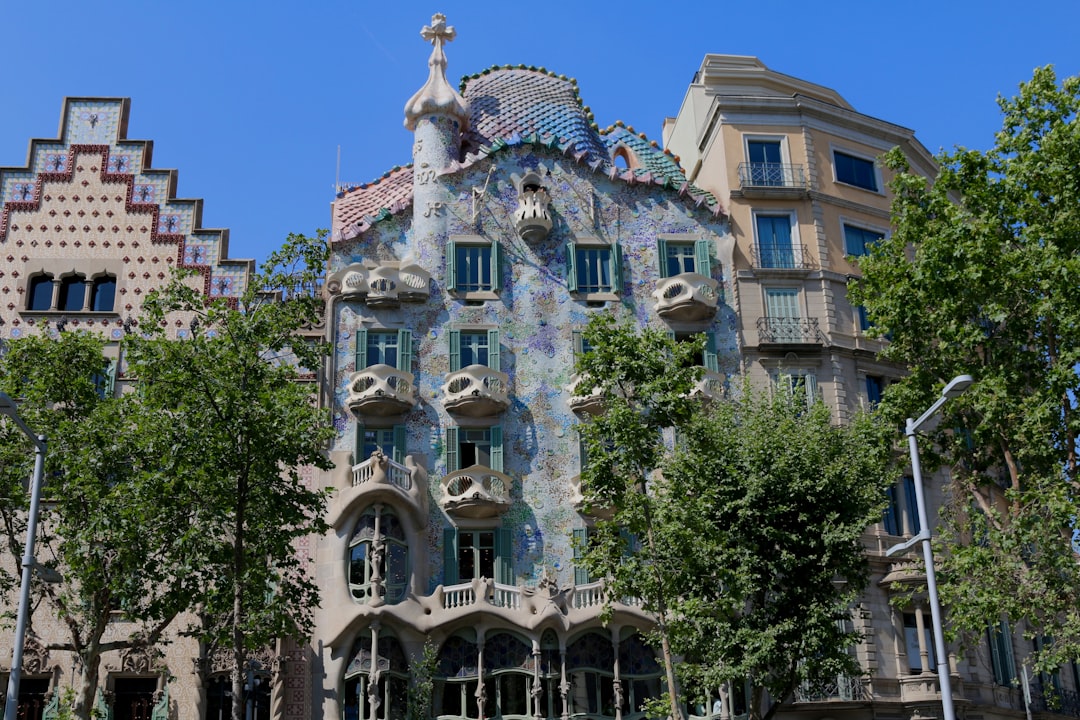
Barcelona is a city of extraordinary density: Gothic quarters, Moderniste mansions, industrial waterfronts, Olympic venues. But if there’s one person who defines Barcelona’s visual identity to the world, it’s Antoni Gaudí. Walk through Barcelona and you can’t avoid his work—the sinuous curves of Casa Batlló, the organic geometry of Park Güell, the incomplete spires of the Sagrada Família rising above the city. Gaudí didn’t just design buildings; he created a vocabulary of form that has become synonymous with Barcelona itself.
Gaudí wasn’t unique—Modernisme was a broader movement—but he was the genius at its center. To understand his work is to understand a specific moment in Barcelona’s history: the late 19th century when the city was exploding in wealth, when Catalan nationalism was reasserting itself, and when an architect could emerge who would create something that had never been seen before.
Barcelona Ascendant: The Rise of a City
To understand Gaudí, you have to understand Barcelona in the 1880s. The city was booming. Spanish industry was growing. Barcelona especially was becoming a manufacturing center—textiles, metalwork, chemicals. Wealthy industrialists were getting richer. The city expanded beyond its medieval walls. A new district called the Eixample (Expansion) was laid out on a grid, but with a new kind of elegance: wide boulevards, regular blocks, space for grand architecture.
This was Barcelona’s Gilded Age. Wealthy families wanted to display their status through their homes. They wanted the latest in modern design. They didn’t want the staid, traditional Spanish architecture of palaces and cathedrals. They wanted something new, something that announced: we’re modern, we’re cultured, we’re forward-looking.
At the same time, there was a cultural and political movement called Catalanism—a reassertion of Catalan identity, language, and culture against Madrid-centered Spanish nationalism. Catalan culture had been suppressed for centuries (especially after the Catalan-Aragonese state was absorbed into Spain). By the late 1800s, Catalan intellectuals, artists, and industrialists were reviving Catalan language, Catalan traditions, Catalan pride.
Modernisme, the architectural and artistic movement that emerged in this context, was partly Barcelona’s Gilded Age consumption and partly Catalan cultural assertion. It drew on international influences—Art Nouveau from France, new design thinking from across Europe—but it was distinctly Catalan.
Gaudí: A Visionary Emerges
Antoni Gaudí was born in 1852 in Tarragona, a town south of Barcelona. He trained as an architect but didn’t initially stand out. His early work was good but not revolutionary. But around the 1880s, something shifted. He started experimenting with form, with the idea that architecture could be organic—inspired by nature rather than by geometric abstraction.
This was radical. Most architecture was rectilinear—straight lines, right angles, symmetry. Gaudí began asking: what if buildings curved like plants? What if you applied the logic of nature to structural design? What if you let the requirements of the building generate the form, rather than imposing a predetermined style?
He was also religious—deeply religious. Gaudí believed that architecture could be a form of faith, that beauty in building was an expression of divinity. This religious conviction shaped everything he created.
By the time Gaudí was in his 30s, wealthy Barcelona clients started seeking him out. They wanted something original, something that announced their taste and their modernity. Gaudí gave it to them—but on his own terms, developing ideas that went far beyond what clients expected.
Casa Batlló and Casa Milà: The Curve as Philosophy
Casa Batlló is a residential building on Passeig de Gràcia, one of Barcelona’s grandest boulevards. It’s six stories of pure curve. The facade undulates. The windows seem almost organic, like eyes. The top of the building suggests a skull (according to some interpretations) or a dragon (according to others). It’s unsettling and beautiful simultaneously.
When Gaudí was hired to redesign it, he didn’t start from scratch. There was an existing building. Gaudí transformed it, rejecting the rectangular logic of the original, creating something that seems to be growing rather than built.
Inside Casa Batlló, you understand what Gaudí was doing: he was creating spaces that respond to human movement and need. Doorways curve. Rooms flow into each other. The building doesn’t have the monumental, imposing quality of traditional palaces. It’s more intimate, more responsive, more alive.
Casa Milà (also called La Pedrera, “The Stone Quarry”) is even more radical. The building is a corner block, but Gaudí treated it as a single sculpture. The facade ripples. There are no straight lines, no right angles. It looks like carved stone or like a wave frozen in time. The roof is a landscape: undulating forms, chimneys that look like warriors.
These buildings were shocking when they appeared. Critics called them ugly. Conservative Barcelona society thought they were eccentric. But younger people, more progressive people, recognized that Gaudí was doing something new. He was proving that architecture didn’t have to follow tradition, that a building could be both practical and beautiful and strange.
Park Güell: A City Garden
In 1900, Gaudí was hired by Eusebi Güell, one of Barcelona’s wealthiest industrialists, to design a residential development on a hillside above Barcelona. Güell wanted something unique, something that would showcase his wealth and taste. Gaudí created Park Güell—or rather, he created a park that was supposed to have houses (though only two were actually built).
The park is 20 acres of hillside transformed into a garden and promenade. It has pathways, a central plaza, a pavilion, grottos, a colonnade. And it’s all integrated with the landscape—Gaudí didn’t bulldoze the hill. He worked with it, created structures that seemed to emerge from the terrain.
The most famous element is the gatekeeper’s lodge at the entrance: a building that looks like something from a fairy tale, covered in colorful tiles, topped with a spire. Walking through the park, you pass structures that seem simultaneously architectural and natural. Columns that taper like trees. Benches that curve. A water system that seems organic.
Today, Park Güell is perhaps Barcelona’s most visited attraction—and you can understand why. It’s not a typical park. It’s not a typical architectural achievement. It’s almost a fantasy world that Gaudí made real. Walking through it, you’re experiencing architecture as a kind of magic.
The Sagrada Família: The Cathedral That Never Ends
In 1883, a committee was founded to create an expiatory church dedicated to the Holy Family—a church built by donations, for everyone, not funded by church authorities or nobility. The design was initially conventional. But in 1891, Gaudí was hired as architect. He took over the project and transformed it into something unprecedented.
The Sagrada Família was to be built in three dimensions—length, width, and height—with every element having religious significance. The three facades would represent different aspects of Christ’s life. The towers would represent the apostles (12), the evangelists (4), Mary, and Jesus. The interior would be a forest of columns representing trees, with light filtering through stained glass like sunlight through leaves.
Gaudí worked on the Sagrada Família for the last years of his life, essentially in retirement from other projects, devoting himself entirely to the church. He lived in a small apartment on the site, directing construction, making changes, thinking about how to achieve his vision.
The construction was slow, expensive, and technically challenging. Gaudí was trying to achieve things no one had achieved before: vaults and domes that followed natural curves, columns that twisted, surfaces that had no flat sections. He was inventing construction methods as he went.
In 1926, Gaudí was hit by a tram. He was injured and, recognizing that he was near the end of his life, he focused entirely on the church. He died a few weeks later. At his funeral, Barcelona mourned not just an architect but the loss of someone who had defined the city’s visual identity.
The Sagrada Família was far from complete. It remains incomplete today. But it’s also one of the world’s most recognizable buildings—those spires rising above Barcelona, the facade with its extraordinary sculptural detail, the interior that feels like a cathedral of nature more than a traditional church.
Gaudí’s Religious Vision
Here’s what’s crucial to understand about Gaudí: he wasn’t designing buildings to showcase his own creativity or even just to make beautiful things. He was trying to express faith in three dimensions. He believed that architecture could bring people closer to God, that the natural forms he used were reflections of divine design, that a building could be a kind of prayer.
This is why his work is so effective: it’s not just pursuing beauty for beauty’s sake. It’s pursuing form as a manifestation of belief. When you stand in the Sagrada Família’s interior (which is still under construction but partially accessible), you feel the intention. This wasn’t a vanity project. This was a man trying to make the divine visible.
This religious dimension also explains why Gaudí could be such a difficult client to work with. He wasn’t willing to compromise his vision just because something was expensive or technically challenging. He was pursuing something deeper than mere architectural fashion.
What You Can See: The Gaudí Experience
Barcelona is the place to experience Gaudí’s work. Trying to understand him without seeing the actual buildings would be like trying to understand music from a written score—technically possible but missing the essential experience.
The Sagrada Família is the primary pilgrimage. It’s partially complete, partially under construction. You can see the existing crypt (the only part completed while Gaudí was alive), the interior spaces that have been finished, the scaffolding where workers continue construction aimed at completion in the late 2020s. The facade details—thousands of elements, each with religious meaning—reward close observation.
Park Güell is where you see Gaudí’s philosophy most clearly: architecture as part of nature, form emerging from function and landscape. Go early or late in the day to avoid crowds, and you can almost understand what Güell and Gaudí imagined.
Casa Batlló and Casa Milà are private residences that you can visit (Casa Batlló is open to tourists; Casa Milà has viewable rooftop and some interior spaces). These show Gaudí working within constraints—he’s not building a church or a park, he’s transforming residential buildings. It makes the strangeness of his design choices even more apparent.
The Cathedral of Palma on Mallorca has a much-modified interior space where Gaudí worked. Less famous than his Barcelona projects, but worth seeing if you’re exploring Catalan architecture.
The Moderniste Legacy
Gaudí wasn’t alone. Other architects were working in Barcelona, creating Moderniste buildings that were less radical than Gaudí but still innovative: Domènech i Montaner, Josep Puig i Cadafalch. The Catalan Modernisme movement was larger than just one architect.
But Gaudí was the genius of the movement. He took Modernisme’s ideas about organic form and nature-based design and pushed them further, made them stranger, made them more expressive. He created a visual language that persisted—you can see Gaudí’s influence in 20th-century architecture, in science fiction design, in contemporary architecture that’s trying to break free from right angles and rectangles.
Why Gaudí Matters Now
In our era of efficiency, of standardized design, of buildings that are primarily investments or vehicles for profit, Gaudí’s work is almost defiant. His buildings prioritize beauty and meaning over efficiency. They required expensive custom materials and laborious construction because Gaudí refused to compromise his vision. They were built slowly because he was doing things no one had done before.
When you visit Barcelona and see Gaudí’s buildings, you’re seeing the work of someone who believed that architecture could be a form of faith, that a building could matter spiritually and aesthetically as well as functionally. In our age of mass production, that’s radical.
Barcelona is a city built by many hands, many generations. But more than any other figure, Gaudí defined its visual identity. Walk through Barcelona, and you’re walking through his legacy. Even buildings that aren’t by Gaudí are influenced by him, defined in relation to him. He made a city, and a city made him. That’s the relationship between genius and place.




Leave a Reply