Germany has one of the world’s best public transportation systems. From the legendary Deutsche Bahn (German Railways) to efficient U-Bahn and S-Bahn networks in major cities, getting around is straightforward—if you know the language. Whether you’re planning a high-speed journey on the ICE train, navigating Berlin’s U-Bahn, cycling through Amsterdam-style German cities, or braving the famous Autobahn, this guide covers the transportation vocabulary you’ll actually use.
Buying Train Tickets: Deutsche Bahn and German Railways
The Deutsche Bahn (DB) is Germany’s national railway. Understanding their system and terminology is essential for any traveler.
At the Ticket Counter
- Eine Fahrkarte, bitte (eye-nuh FAHR-kar-tuh, BIT-uh) — A ticket, please
- Zwei Fahrkarten nach München (tsvie FAHR-kar-ten, nahk MOO-nhen) — Two tickets to Munich
- Einfach (INE-fahk) — One way
- Hin und zurück (hin oont tsoo-ROOK) — Round trip
- Nach Berlin, bitte (nahk ber-LIN, BIT-uh) — To Berlin, please
- Heute (HOY-tuh) — Today
- Morgen (MOR-gen) — Tomorrow
- Nächste Woche (NEKH-stuh VO-kuh) — Next week
- Erste Klasse (AY-rstuh KLAH-suh) — First class
- Zweite Klasse (TSVIE-tuh KLAH-suh) — Second class
- Wann fährt der Zug? (vahn FAHRT dare TSOOG) — When does the train depart?
- Wie lange dauert die Fahrt? (vee LAHNG-uh DOW-ert dee FAHRT) — How long does the journey take?
- Wieviel kostet das? (vee-FEEL KOS-tet dahs) — How much does that cost?
- Haben Sie eine Bahncard? (HAH-ben zee eye-nuh BAHN-kart) — Do you have a rail pass? (for discounts)
- Gibt es eine Ermäßigung für Studenten? (gibt es eye-nuh air-MAY-see-goong fur SHOO-den-ten) — Is there a student discount?
Train Types and What They Mean
Deutsche Bahn has several train types, each with different speeds and stops:
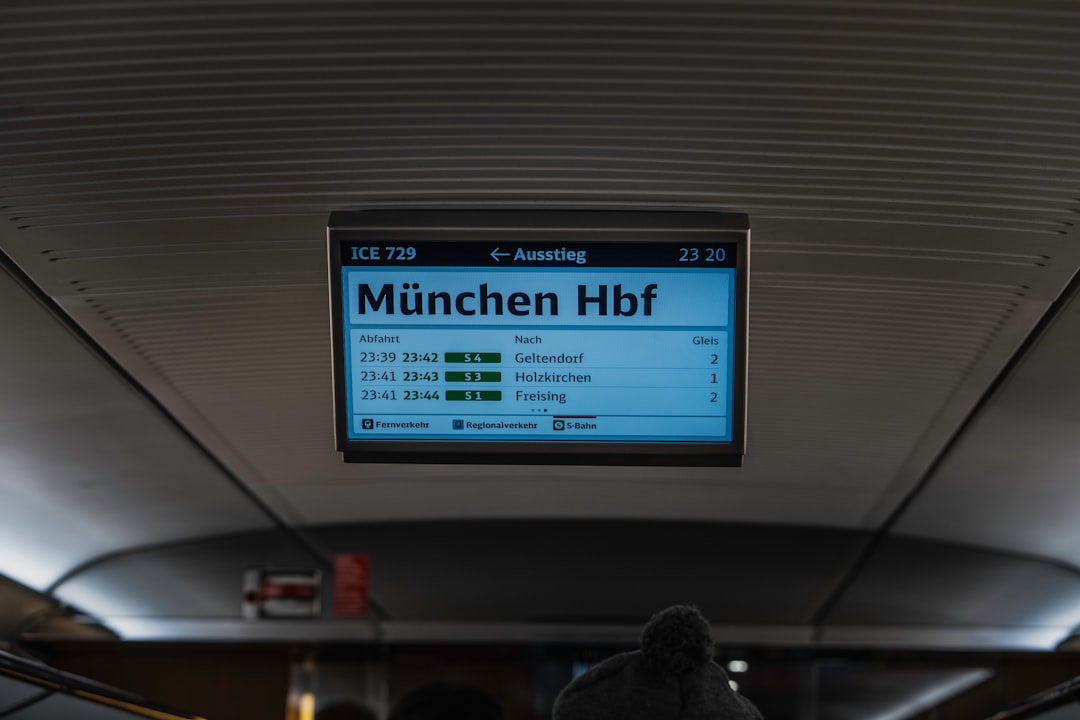
Der ICE (dare ee-tseh-AY) — InterCityExpress (fastest, most modern, expensive)
Der EC (dare ay-tseh) — EuroCity (fast international trains)
Der IC (dare ee-tseh) — InterCity (fast trains, fewer stops than EC)
Der RE (dare air-AY) — Regional Express (regional trains, more stops)
Der RB (dare air-BAY) — Regional Bahn (slower, local trains, many stops)
Der S-Bahn (dare ES-bahn) — Suburban railway (local city trains)
Der U-Bahn (dare OO-bahn) — Underground / Subway (metro system)
Der Nachtzug (dare NAHKT-tsoog) — Night train (sleeping cars available)
Reservations and Special Services
Ich möchte einen Sitzplatz reservieren (ikh MUKH-tuh eye-nen ZITS-plahts reh-zer-VEER-en) — I’d like to reserve a seat
Fensterplatz (FEN-ster-plahts) — Window seat
Gangplatz (GAHNG-plahts) — Aisle seat
Ein Abteil (ine AHP-tile) — A compartment
Hat der Zug einen Speisewagen? (haht dare TSOOG eye-nen SHPICE-uh-vah-gen) — Does the train have a dining car?
Hat der Zug einen Schlafwagen? (haht dare TSOOG eye-nen SHLAHF-vah-gen) — Does the train have sleeping cars?
Kann ich mein Fahrrad mitnahmen? (kahn ikh mine FAHR-raht MIT-nah-men) — Can I take my bike?
Gibt es eine Gepäckaufbewahrung? (gibt es eye-nuh guh-PEK-owf-buh-vah-roong) — Is there luggage storage?
On the Train
Entschuldigung, ist hier noch frei? (ent-SHOOL-dee-goong, ist heer nokh FRY) — Excuse me, is this seat still free?
Dieser Platz ist besetzt (DEE-zer PLAHTS ist buh-ZETST) — This seat is taken
Wo ist die Toilette? (vo ist dee toy-LET-uh) — Where’s the bathroom?
Wann kommen wir in Hamburg an? (vahn KOM-men veer in HAM-borg ahn) — When do we arrive in Hamburg?
Wie lange halten wir hier? (vee LAHNG-uh HAHL-ten veer heer) — How long do we stop here?
Hat der Zug Verspätung? (haht dare TSOOG fer-SHPAY-toong) — Is the train delayed?
U-Bahn and S-Bahn: City Transport
Most German cities have U-Bahn (underground/subway) and S-Bahn (suburban railway) systems. Berlin, Munich, Hamburg, and Frankfurt have extensive networks.
Getting Oriented
Die U-Bahn (dee OO-bahn) — Underground / Subway
Die S-Bahn (dee ES-bahn) — Suburban train
Die Haltestelle (dee HAHL-tuh-shtel-uh) — Stop / Station
Der Bahnhof (dare BAHN-hof) — Train station
Der Hauptbahnhof (dare HOWPT-bahn-hof) — Main train station
Die Fahrkarte (dee FAHR-kar-tuh) — Ticket
Ein Tageskarte (ine TAH-ges-kar-tuh) — Day pass
Eine Wochenkarte (eye-nuh VO-khen-kar-tuh) — Week pass
Eine Monatskarte (eye-nuh moh-NAHTS-kar-tuh) — Monthly pass
Asking for Directions in Stations
Wie komme ich zum Perron 5? (vee KOM-uh ikh tsoom peh-RON FOONF) — How do I get to platform 5?
Welche U-Bahn fährt nach Charlottenburg? (VEL-khuh OO-bahn FAHRT nahk shar-LOT-ten-burg) — Which U-Bahn goes to Charlottenburg?
Wo ist der Fahrkartenverkauf? (vo ist dare FAHR-kar-ten-fer-kowf) — Where’s the ticket office?
Kann ich einen Fahrkartenautomat benutzen? (kahn ikh eye-nen FAHR-kar-ten-ow-toh-maht buh-NOOT-sen) — Can I use a ticket machine?
Der Automat akzeptiert Kartenzahlung (dare ow-toh-MAHT ahk-tsep-TEERT KAHR-ten-tsah-loong) — The machine accepts card payment
Understanding Signs and Announcements
Bahnsteig 4 (BAHN-shtike fear) — Platform 4
Bitte einsteigen (BIT-tuh INE-shtye-gen) — Please board
Alle aussteigen (AHL-uh OWS-shtye-gen) — Everyone get off / All passengers exit
Nächste Haltestelle… (NEKH-stuh HAHL-tuh-shtel-uh) — Next stop is…
Türen schließen (TU-ren SHLEES-sen) — Doors closing
Vorsicht! (FOR-zikht) — Caution!
Berlin U-Bahn Lines
Berlin’s U-Bahn is extensive. Knowing line designations helps:
Die U1, U2, U3… (dee OO-eins, OO-tsvie, OO-drie) — U-lines 1, 2, 3, etc.
Die S1, S2, S3… (dee ES-eins, ES-tsvie, ES-drie) — S-lines 1, 2, 3, etc.
Asking for Directions
Getting lost is part of travel, but these phrases help you find your way:
General Direction Questions
Entschuldigung, wo ist die Straßenbahn haltestelle? (ent-SHOOL-dee-goong, vo ist dee STRAH-sen-bahn HAHL-tuh-shtel-uh) — Excuse me, where’s the tram stop?
Wie komme ich zur Kölner Kathedrale? (vee KOM-uh ikh tsoor KUL-ner kah-tay-DRAH-luh) — How do I get to Cologne Cathedral?
Ist der Weg weit? (ist dare VIKE VITE) — Is it far?
Kann ich zu Fuß gehen? (kahn ikh tsoo FOOS GAY-en) — Can I walk there?
Wie lange dauert es zu Fuß? (vee LAHNG-uh DOW-ert es tsoo FOOS) — How long does it take on foot?
Gibt es einen Bus dahin? (gibt es eye-nen BOOS dah-HIN) — Is there a bus there?
Welche Buslinie geht dahin? (VEL-khuh BOOS-lee-nee-uh GATE dah-HIN) — Which bus line goes there?
Können Sie mir einen Plan geben? (KUN-en zee meer eye-nen PLAHN GAY-ben) — Can you give me a map?
Right, Left, and Straight
Nach links (nahk LINKS) — Turn left
Nach rechts (nahk REKHTS) — Turn right
Geradeaus (guh-RAH-duh-OWS) — Straight ahead
An der Ecke (ahn dare EK-uh) — At the corner
An den Ampeln (ahn den AHM-peln) — At the traffic light
Nächste rechts (NEKH-stuh REKHTS) — Next right
Nächste links (NEKH-stuh LINKS) — Next left
Taxi and Ride-Sharing
While German public transport is excellent, sometimes you need a taxi:
Calling or Hailing a Taxi
Ein Taxi, bitte (ine TAHK-see, BIT-uh) — A taxi, please
Können Sie mir ein Taxi rufen? (KUN-en zee meer ine TAHK-see ROO-fen) — Can you call me a taxi?
Ich brauche ein Taxi (ikh BROW-khuh ine TAHK-see) — I need a taxi
Zum Bahnhof, bitte (tsoom BAHN-hof, BIT-uh) — To the train station, please
Was kostet die Fahrt zum Flughafen? (vahs KOS-tet dee FAHRT tsoom FLOO-hah-fen) — How much is the fare to the airport?
Können Sie den Kofferraum öffnen? (KUN-en zee den KOF-fer-rowm URF-nen) — Can you open the trunk?
Können Sie hier halten, bitte? (KUN-en zee heer HAHL-ten, BIT-uh) — Can you stop here, please?
Ride-Sharing (Uber, Bolt, etc.)
Ich bestelle einen Uber (ikh buh-SHTEL-uh eye-nen OO-ber) — I’m ordering an Uber
Wo ist mein Fahrer? (vo ist mine FAH-rer) — Where’s my driver?
Wie lange dauert es noch? (vee LAHNG-uh DOW-ert es nokh) — How long until arrival?
Können Sie schneller fahren? (KUN-en zee SHNELL-er FAH-ren) — Can you drive faster?
The Autobahn: Germany’s Famous Highway
The Autobahn is legendary, and driving it yourself requires specific knowledge:
Autobahn Basics
Die Autobahn (dee OW-toh-bahn) — Highway / Interstate (literally “automobile road”)
Der Tempolimit (dare TEM-poh-li-mit) — Speed limit
Es gibt keine Tempolimit (es gibt kine TEM-poh-li-mit) — There’s no speed limit (on some Autobahn sections)
Rechtsfahrgebot (REKHTS-fahr-guh-BOHT) — Keep right rule (stay in right lane except when passing)
Die Ausfahrt (dee OWS-fahrt) — Exit (freeway exit)
Die Raststätte (dee RAHST-stet-uh) — Rest stop / Service area
Die Tankstelle (dee TAHNK-shtel-uh) — Gas station
Common Autobahn Phrases
Wie schnell darf ich fahren? (vee SHNELL darf ikh FAH-ren) — How fast can I drive? (to understand speed limits)
Das Benzin ist teuer (dahs ben-TSEEN ist TOY-er) — Gasoline is expensive
Ich brauche Benzin (ikh BROW-khuh ben-TSEEN) — I need gas
Eine Tankstelle mit Toiletten, bitte (eye-nuh TAHNK-shtel-uh mit toy-LET-en, BIT-uh) — A gas station with bathrooms, please
Mein Auto ist kaputt (mine OW-toh ist kah-PUTT) — My car is broken
Traffic and Emergencies
Der Unfall (dare OON-fahl) — Accident
Ich habe einen Unfall (ikh HAH-buh eye-nen OON-fahl) — I’ve had an accident
Rufen Sie die Polizei (ROO-fen zee dee poh-lee-TSY) — Call the police
Gibt es einen Krankenwagen? (gibt es eye-nen KRAHN-ken-vah-gen) — Is there an ambulance?
Die Panne (dee PAHN-uh) — Breakdown
Mein Auto hat eine Panne (mine OW-toh haht eye-nuh PAHN-uh) — My car has broken down
Der Pannendienst (dare PAHN-en-deenst) — Roadside assistance
Road Signs You’ll See
Understanding key road signs helps you navigate safely:
Durchfahrt verboten (DOORKH-fahrt fer-BOH-ten) — No thoroughfare
Einbahnstraße (INE-bahn-strah-suh) — One-way street
Fußgänger (FOOS-gayn-ger) — Pedestrians
Geschwindigkeit begrenzt auf… (guh-SHVIN-dig-kite buh-GRENST owf) — Speed limited to…
Umleitung (OOM-ly-toong) — Detour
Parkplatz (PARK-plahts) — Parking lot
Airport and Flight Vocabulary
Getting to and from airports:
At the Airport
Der Flughafen (dare FLOO-hah-fen) — Airport
Das Abflug-Terminal (dahs AHP-floo-ter-mee-NAHL) — Departure terminal
Das Ankunft-Terminal (dahs AHN-koonft-ter-mee-NAHL) — Arrival terminal
Der Schalter (dare SHAHL-ter) — Check-in counter
Ich möchte mein Gepäck aufgeben (ikh MUKH-tuh mine guh-PEK OWF-gay-ben) — I’d like to check my luggage
Das Handgepäck (dahs HAHNT-guh-pek) — Carry-on luggage
Die Sicherheitskontrolle (dee ZIKH-er-hites-kon-TROHL-uh) — Security check
Das Boarding (dahs BOR-ding) — Boarding
Bus Travel and Local Transport
Beyond U-Bahn and S-Bahn, buses serve most German cities:
Bus Basics
Der Bus (dare BOOS) — Bus
Wohin fährt dieser Bus? (vo-HIN FAHRT DEE-zer BOOS) — Where does this bus go?
Welche Buslinie geht zum Flughafen? (VEL-khuh BOOS-lee-nee-uh GATE tsoom FLOO-hah-fen) — Which bus line goes to the airport?
Ein Fahrkarte bis zur Endstation (ine FAHR-kar-tuh bis tsoor ENT-shtah-tsee-OHN) — A ticket to the end of the line
Sagen Sie mir, wenn ich aussteigen muss (ZAH-gen zee meer, ven ikh OWS-shtye-gen MOOS) — Tell me when I need to get off
Die nächste Haltestelle, bitte (dee NEKH-stuh HAHL-tuh-shtel-uh, BIT-uh) — The next stop, please
Cycling in Germany
Germany is famous for cycling infrastructure. Understanding cycling vocabulary is helpful:
Cycling Basics
Das Fahrrad (dahs FAHR-raht) — Bicycle
Das Elektrofahrrad or Das E-Bike (dahs e-LEK-troh-FAHR-raht) — Electric bike
Der Fahrradweg (dare FAHR-raht-vek) — Bike lane / Bike path
Der Fahrradvermietung (dare FAHR-raht-fer-mee-toong) — Bike rental
Ich möchte ein Fahrrad mieten (ikh MUKH-tuh ine FAHR-raht MEET-en) — I’d like to rent a bike
Ein Helm (ine HELM) — A helmet
Der Schlüssel (dare SHLOO-sul) — Key / Lock key
Ein Schloss (ine SHLOS) — A lock
Der Fahrradständer (dare FAHR-raht-shtend-er) — Bike rack / Bike stand
Wo kann ich mein Fahrrad abstellen? (vo kahn ikh mine FAHR-raht AHP-shtel-en) — Where can I park my bike?
Common Transportation Problems
Knowing how to handle issues:
Der Zug hat Verspätung (dare TSOOG haht fer-SHPAY-toong) — The train is delayed
Der Bus kommt nicht (dare BOOS KOHMT nikht) — The bus isn’t coming
Ich habe meinen Fahrkarte verloren (ikh HAH-buh MY-nen FAHR-kar-tuh fer-LOH-ren) — I’ve lost my ticket
Mein Fahrrad ist kaputt (mine FAHR-raht ist kah-PUTT) — My bike is broken
Können Sie die Verkehrsinfo prüfen? (KUN-en zee dee fer-KAIRS-in-fo PROO-fen) — Can you check the traffic information?
Gibt es eine Alternative zur Bahn? (gibt es eye-nuh AHL-ter-nah-tee-vuh tsoor BAHN) — Is there an alternative to the train?
Final Transportation Tips
Germany’s transportation system is efficient and well-marked. The key advantages:
- Everything runs on time (mostly)
- Signs are clear and in German and English
- Ticket machines are found everywhere
- Staff are generally helpful if you ask politely
- Maps are usually free at stations
By mastering these transportation phrases, you can navigate Germany with confidence. Whether you’re catching the ICE to München, cycling through the Rhineland, or merging onto the Autobahn, you’ll have the language skills to handle whatever journey awaits. Safe travels!




Leave a Reply