If you’re an American visiting Ireland, you’ve probably already heard the stories. The genius writers, the melodious language, the way Irish authors seem to have an almost supernatural ability to weave magic into words. It’s not just reputation—Ireland genuinely punches above its weight when it comes to literature, and walking through Dublin or the countryside, you’ll feel this literary current running beneath everything. Four Irish authors have won the Nobel Prize in Literature. Four. For a country of roughly 5 million people, that’s staggering. To understand Ireland is to understand its literature, and to understand Irish literature is to fall a little bit in love with the country itself.
The Nobel Laureates: Ireland’s Literary Olympians
Let’s start with the main event. William Butler Yeats won the Nobel Prize in 1923, just as the Irish Free State was being born. He was 57 years old, already a legend, and the Swedish Academy recognized what the world had long suspected: here was a poet of exceptional power. Yeats wasn’t just writing pretty verses—he was trying to reclaim Irish culture from centuries of suppression, weaving mythology and politics into his work with an artistry that still astonishes readers today.
Then came George Bernard Shaw in 1925. Shaw was a playwright and social critic who wrote with ferocious wit and unapologetic iconoclasm. He wasn’t sentimental about Ireland or anything else; his plays were weapons of satire, and he used them brilliantly.
Samuel Beckett won in 1969 for works like “Waiting for Godot,” a play that fundamentally changed how we think about theater and human existence. And finally, Seamus Heaney claimed the prize in 1995, a poet so beloved that his funeral in Dublin drew hundreds of thousands of people to the streets.
Oscar Wilde: Dublin’s Dazzling Rebel
Before we even get to the 20th century, there’s Oscar Wilde, and honestly, no discussion of Irish literature is complete without him. Wilde was born in Dublin in 1854 to two prominent (and remarkably talented) parents—his mother was a poet and journalist, his father a surgeon and folklorist. Dublin at that time was a literary powerhouse, and young Oscar absorbed it all like a sponge.
Walking through Dublin today, you’ll see plaques marking Wilde’s birthplace on Westland Row and reminders of his presence throughout the city. But Wilde’s Dublin was a different place from what you’ll see now—a Victorian Dublin of gaslit streets and rigid social hierarchies that he spent his entire career trying to scanalize. His plays, particularly “The Importance of Being Earnest,” are still performed constantly, and his wit remains razor-sharp across the centuries. What’s remarkable is that Wilde’s Dublin experiences—the social pretension, the class dynamics, the desperate need to maintain appearances—all fed into his savage social commentary.
The tragic arc of Wilde’s life (imprisoned for his sexuality, dying in exile in Paris in 1900) adds another layer to understanding Ireland’s literary genius. A country that produced such brilliant minds often seemed determined to drive them away.
James Joyce and Bloomsday: Dublin Immortalized
If Dublin is the main character in Irish literature, then James Joyce is the author who best captured its essence. Joyce was born in Dublin in 1882 and spent his early years there before leaving Ireland—first for self-imposed exile and eventually for permanent departure. Yet Dublin never left him. His masterpiece, “Ulysses,” is a 750-page symphony of Dublin life, following Leopold Bloom through a single day—June 16, 1904—as he navigates the city’s streets, pubs, and interior monologues.
Today, Dubliners celebrate “Bloomsday” every June 16th. The city becomes a living museum of the novel. Thousands of people dressed in Edwardian clothes retrace Bloom’s route through the city, stopping at the pubs and locations mentioned in the book. The Brazen Head pub, the oldest pub in Dublin (established 1668), claims a connection to Joyce. The Bailey restaurant marks the location of Davy Byrne’s, where Bloom eats his famous gorgonzola sandwich. Even if you’re not a Joyce scholar, Bloomsday captures something magical about how literature and place can merge into something unforgettable.
The Dublin Writers Museum on Parnell Square is the place to get deeper into Joyce and his contemporaries. You’ll see first editions, manuscripts, and memorabilia that bring the literary world of early 20th-century Dublin to vivid life.
W.B. Yeats and the Soul of Ireland
William Butler Yeats spent crucial years in Sligo, in Ireland’s northwest, and the landscape of that region seeped into his bones. When you visit Sligo today, you understand Yeats in a different way. Ben Bulben looms over the landscape—the mountain appears again and again in his poetry. Lough Gill and its “Lake Isle of Innisfree” are real places that shaped his imagination. Yeats was trying to access something ancient and mythic in Irish culture, and the wild, magical landscape of Sligo provided the perfect crucible.
Yeats didn’t just write about Ireland; he tried to shape it. He was involved in theater (the Abbey Theatre), he served in the Irish Senate, he was political and ambitious. His nationalism was complicated—never as straightforward as some might have hoped—but it was genuine. When you read Yeats with the knowledge that he was grappling with the Irish independence movement, watching the Easter Rising, living through the Civil War, his work takes on new resonance.
Samuel Beckett: Minimalism and the Void
Samuel Beckett represents something different in Irish literature. Where Yeats was maximalist and political, Beckett was minimalist and existential. “Waiting for Godot” has two men waiting for someone who never arrives. It’s profound, it’s funny, it’s completely original. Beckett spent much of his life in Paris, but his Irish sensibility—that particular Irish mix of dark humor and philosophical despair—runs through everything he wrote.
Beckett’s sparse, economical prose style influenced an entire generation of writers. He won the Nobel Prize at age 65, and his acceptance speech was typical of the man: brief, humble, and profound. “One cannot but notice that… the attempt seems to have been to avoid representation, to avoid form and content together.”
The Modern Landmarks: Experiencing Literary Dublin
Today, visitors can experience Irish literary culture in several crucial ways:
The Museum of Literature Ireland (MoLI) on St. Stephen’s Green is essential. It’s an interactive, beautifully designed space dedicated to Irish writing, featuring the stories and works of hundreds of Irish authors across centuries.
The Dublin Writers Museum focuses specifically on the giants: Joyce, Beckett, Wilde, Shaw, and others. The collection includes letters, manuscripts, and personal items that make these larger-than-life figures feel suddenly very human.
The Literary Pub Crawl offers an entertaining evening where actors perform scenes from Irish literature while guiding you through Dublin’s pubs. It sounds gimmicky, but it’s actually quite good, and you’ll end the night in one of Dublin’s oldest bars.
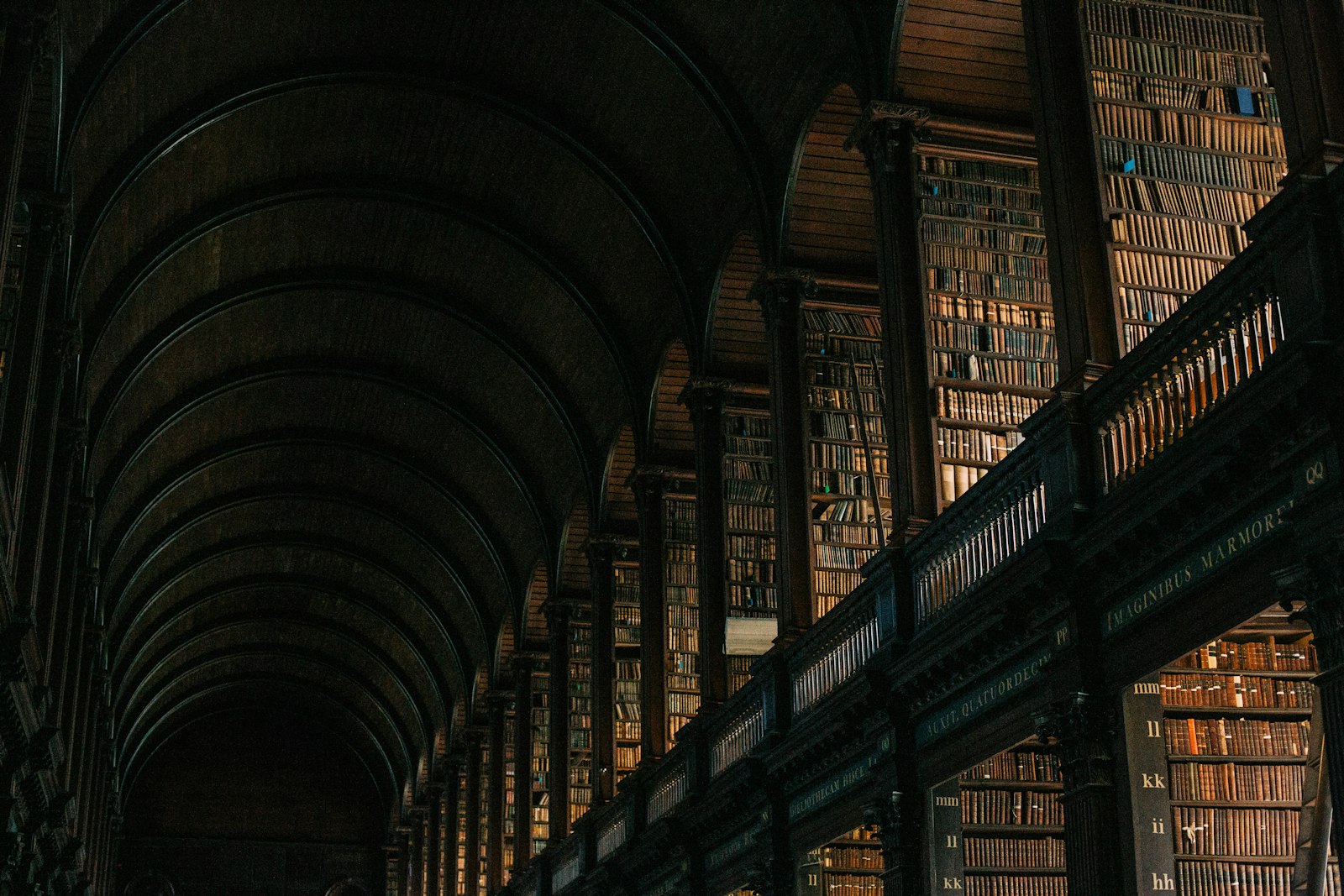
Trinity College is where Joyce, Beckett, and many others studied. The library there houses the Book of Kells, that magnificent illuminated medieval manuscript that represents Irish literary tradition stretching back over a thousand years.
The Abbey Theatre, founded by Yeats, still produces groundbreaking Irish drama. Seeing a play there connects you to over a century of theatrical tradition.
The Broader Literary Landscape
Beyond the giants, Ireland produced Sheridan Le Fanu (the inventor of vampire fiction), Flann O’Brien, Edna O’Brien, Colm Tóibín, Sally Rooney, and dozens of other writers of genuine genius. There’s something about Ireland—the landscape, the history, the linguistic richness of the Irish language influence on English—that seems to produce exceptional writers in unusual numbers.
When you visit Ireland as an American, you’re visiting the homeland of countless ancestors for some of you, but more fundamentally, you’re visiting the place that shaped the English language’s greatest literary voices. The Irish have suffered tremendously throughout their history, and literature became one of the ways they processed that suffering, found joy, and asserted their unique identity. Walking through Dublin’s Georgian streets or Sligo’s wild countryside, you’re walking through landscapes that inspired immortal words.
The literary magic of Ireland isn’t just in old books—it’s alive in the pubs, in conversations, in the way people here still value the spoken word and the power of a well-told story. That’s the real inheritance of Yeats and Joyce and Beckett: the belief that language matters, that beauty is worth pursuing, that literature can transform how we see the world.




Leave a Reply