Ireland is famous for castles. Roll through the Irish countryside and you’ll see them: perched on cliffs, rising from islands in lakes, dominating valleys from strategic hilltops. Some are perfectly preserved museums. Others are romantic ruins. Many still function as hotels, offering visitors the peculiar experience of spending a night in a real castle. Each castle has its own story, often a story of power, conflict, betrayal, romance, and sometimes genuine haunting. Understanding Irish castles is understanding Irish history itself.
Blarney Castle and the Stone of Eloquence
Blarney Castle, near Cork, is one of Ireland’s most visited castles, and the main attraction is its famous stone. Thousands of visitors come annually to kiss the Blarney Stone, supposedly granting the kisser the gift of eloquence. The stone is located on the castle’s roof, and kissing it requires you to lean backward (with assistance) in a somewhat undignified position. Tourists queue for hours for this brief moment of contact.
The reality is that the Blarney Stone is almost certainly not ancient or magical. The stone was probably added to the castle in the 1600s, centuries after the castle was built. But the legend that kissing it grants eloquence became attached to it, and the legend is what makes it famous.
The actual castle is worth exploring beyond the stone. Blarney Castle was built in the 15th century and was a stronghold of the McCarthy Clan. It was heavily damaged during Cromwell’s invasion in the 1650s, then reconstructed. The castle’s history involves typical Irish themes: clan politics, English conquest, siege warfare, and the gradual subjugation of Irish power by English forces.
The grounds surrounding the castle are beautiful, with gardens and walking paths. If you visit, spend more time exploring the castle itself than waiting in line for the stone.
Bunratty Castle and Medieval Banquets
Bunratty Castle in County Clare is a 15th-century fortress built by the MacNamara clan. What makes Bunratty notable today is its role as a tourist attraction offering “medieval banquets”—evening experiences where visitors dress up, eat period-style food, and watch entertainment that’s supposedly authentically medieval.
The banquets are historically dubious and probably have more to do with 20th-century tourist imagination than actual medieval reality. But they’re undeniably fun. The food is good, the atmosphere is festive, and if you approach it as entertainment rather than historical education, it’s a worthwhile experience.
The castle itself is impressive—a square keep surrounded by fortifications. The interior has been restored and furnished to give an impression of what medieval castle living might have been like, though obviously stylized and comfortable by medieval standards. You can visit during the day without attending a banquet.
Rock of Cashel: Seat of Kings
Rock of Cashel, also in County Tipperary, is one of Ireland’s most photographically striking sites. A massive limestone rock rises abruptly from the plain, and atop it sits a cluster of medieval buildings: a round tower, cathedral, chapel, and other structures. From a distance, it looks like a medieval fortress city compressed onto a stone outcrop.
Rock of Cashel was historically the seat of the Kings of Munster, one of Ireland’s most powerful provincial kingdoms. The site was occupied from at least the 5th century, and the surviving buildings date from the 12th-14th centuries. The round tower, typical of Irish architecture, would have served as both a bell tower and a refuge during raids.
Walking around the rock, you feel the weight of history. Centuries of Irish kings ruled from this strategic location. Saint Patrick supposedly visited the site. The carvings on the Romanesque cathedral show sophisticated medieval craftsmanship. The round tower tapers as it rises, a design both aesthetically pleasing and structurally sound.
Rock of Cashel is completely open to visitors, with no admission fee. You can walk around the buildings, go inside some of them, and climb the round tower if you’re not afraid of heights. The views from the top encompass much of Tipperary.
Dunluce Castle: Cliffside Drama
Dunluce Castle, on the north coast of County Antrim, is visually dramatic. The castle sits on a cliffside overlooking the Atlantic, its walls rising from rocky outcrops that plunge into the sea below. The castle is partially ruined, but substantial portions remain, giving you a sense of its medieval magnificence.
Dunluce was built in the 13th century and was controlled by the McQuillan family, then later by the MacDonnells. The location is extraordinarily defensive—enemies would have to assault from the sea or across a narrow land approach. The castle repeatedly survived sieges and attacks.
What makes Dunluce fascinating is the combination of architectural sophistication and dramatic setting. The castle incorporates multiple defensive features: a gatehouse, high walls, a central keep, and strategic positioning that exploits the natural cliffside terrain. You can imagine the castle in its heyday, flags flying, soldiers patrolling the walls, the Irish Sea crashing against the rocks below.
The ruins also tell stories of abandonment and decay. One entire section of the castle fell into the sea in the 1600s, taking servants’ quarters and kitchens with it. The accident supposedly prompted the remaining inhabitants to abandon the castle. Today, you can see the cliff edge where the building ended before it fell.
Malahide Castle: From Medieval Fortress to Stately Home
Malahide Castle, near Dublin, represents a different sort of castle story. Originally built as a fortress in the 12th century, Malahide was the seat of the Talbot family for nearly 800 years. Over the centuries, the castle was updated and modified, transitioning from a purely military fortress into an increasingly domestic residence.
The castle combines medieval fortification (the original towers and walls) with additions from every subsequent era—Georgian rooms, Victorian additions, modern conveniences. Walking through Malahide, you see the evolution of Irish architecture and domestic life across eight centuries.
The castle is now a museum with well-preserved interiors, period furnishings, and a collection of Irish paintings and decorative arts. The grounds include a botanical garden, making Malahide a more complete experience than just the castle itself.
Kilkenny Castle: Engineering and Elegance
Kilkenny Castle dominates the medieval city of Kilkenny. The castle was built by Strongbow, the Norman knight who conquered Ireland, and was the seat of the powerful Butler family for centuries. The Normans transformed Irish architecture with their stone castles—far more substantial and defensible than the raths and earthen fortifications of earlier periods.
Kilkenny Castle shows the evolution from simple fortress to elegant residence. The original Norman keep is supplemented by later additions, including a long gallery that’s a masterpiece of Victorian architecture. The interior has been carefully restored and furnished to show how the castle was inhabited in different periods.
The castle’s setting is beautiful, overlooking the Nore River with the medieval city of Kilkenny spreading out around it. The city itself is worth exploring—it has medieval walls, narrow streets, and is one of Ireland’s best-preserved medieval towns.
Ashford Castle: From Castle to Luxury Hotel
Ashford Castle, in County Mayo, represents a modern take on castle living. The castle was built in the 1600s and has been extensively rebuilt and remodeled since. Today, it operates as a luxury hotel and resort.
Staying at Ashford Castle is an opportunity to experience castle living in comfort. You get the romanticism of staying in a castle with the amenities of a modern luxury hotel. It’s expensive, but it’s a unique experience. Even if you don’t stay overnight, the grounds are beautiful and worth visiting.
Ross Castle: Island Fortress
Ross Castle, in County Kerry near Killarney, is built on a peninsula jutting into the Lower Lake of Killarney. The castle is surrounded by water on three sides, making it extremely defensible. The castle was built in the 15th century as a stronghold of the O’Donoghue clan.
Ross Castle is particularly notable because it was one of the last Irish strongholds to resist English conquest. The castle wasn’t taken until 1652 during Cromwell’s invasion, when an English gunboat demonstrated to the Irish that their fortress couldn’t protect them against modern naval power.
The castle has been restored and is now open to visitors. A boat tour around the castle gives you a sense of how the water defense worked. The scenic setting, with Killarney’s mountains in the background, makes Ross Castle one of Ireland’s most photogenic castles.
Dunguaire Castle: Elegance on Galway Bay
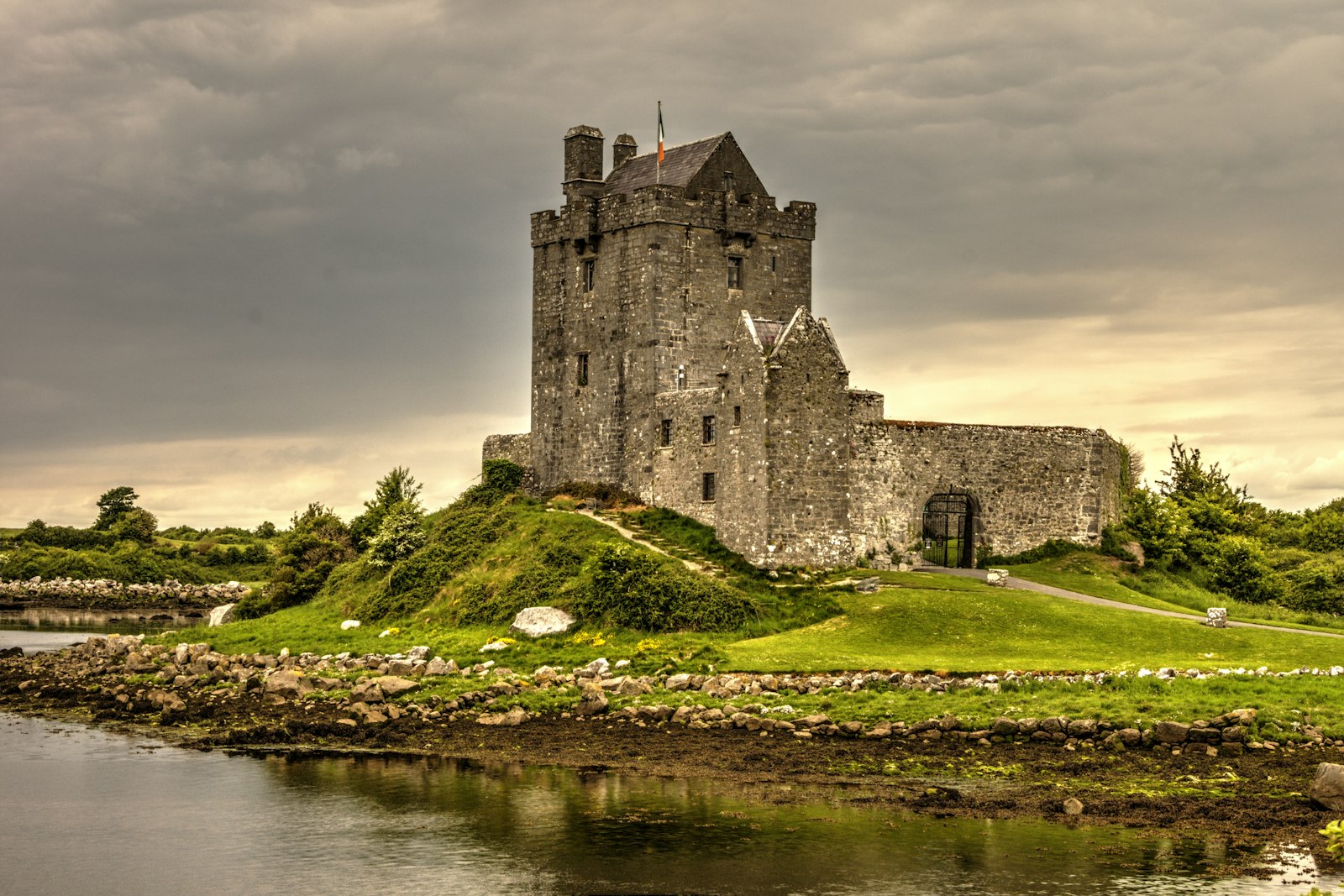
Dunguaire Castle, in County Galway, is a perfectly square tower house from the 16th century, perched on the shore of Galway Bay. The castle’s compact elegance is striking—it’s not a massive fortress but a functional fortified residence.
The castle is now open as a museum and occasionally hosts events like medieval banquets (similar to Bunratty’s offerings). But the real appeal is the setting and the view across Galway Bay toward the Aran Islands.
The Stories Within the Stones
Every Irish castle has stories: of sieges and battles, of family feuds and betrayals, of loves and losses. Ghost stories are attached to many castles—the woman in white at this castle, the phantom horseman at that one. Whether you believe in ghosts, the stories reveal something about how Irish people engage with their history. The castles aren’t just architectural monuments but vessels for stories and meaning.
Some castles have genuine historical traumas attached. Dungeons where prisoners were held. Battlements where soldiers died defending against invaders. Chambers where families huddled during sieges. These human experiences are embedded in the stones.
Visiting Irish Castles
When visiting Irish castles, try to go beyond the tourist experience. Yes, see the famous stones and take the photos. But also pay attention to the architecture, the defensive features, the views from the walls. Think about who lived here, how they lived, what they feared and hoped for.
Many castles are now hotels, restaurants, or museums. Some are ruins open to the sky. Each tells a different story about Irish history, about the transition from medieval to modern times, about the English conquest and Irish resilience.
Irish castles aren’t just tourist attractions—they’re physical records of centuries of Irish history, written in stone and preserved across generations. Walking through them, you walk through Ireland’s past.




Leave a Reply