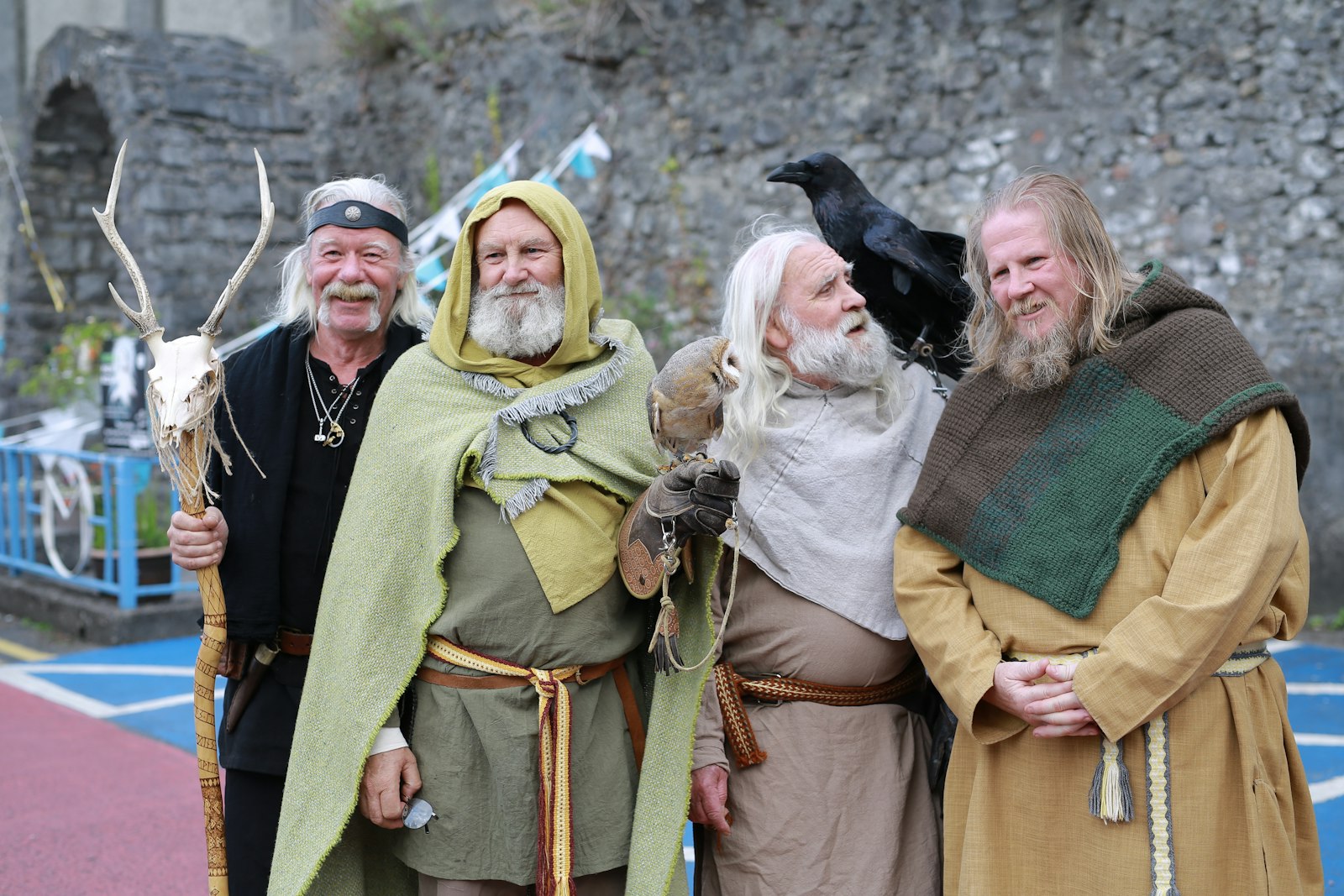
If you want to understand the Irish spirit, you have to understand Irish mythology. Not in an academic sense—though Irish mythology is fascinating from a scholarly perspective—but in the way these ancient stories embed themselves in the Irish imagination and continue to shape how Irish people see themselves and their land. Ireland’s mythology is unique among European cultures. While the Greeks had Homer and the Norse had the Eddas, Ireland had the great cycle of tales: the Mythological Cycle, the Ulster Cycle, the Fenian Cycle. These stories are wild, violent, magical, and profound. They speak to something elemental in the Irish character.
The Mythological Cycles
Irish mythology is organized into several major cycles, each covering different periods and themes. The Mythological Cycle covers the pre-Christian inhabitants of Ireland, including the Tuatha Dé Danann—the People of the Goddess Danu—who were supernatural beings with magical powers. These weren’t gods exactly, but they occupied a space between the human and divine.
The Ulster Cycle is centered on the kingdom of Ulster in the north of Ireland and features the greatest hero of Irish mythology: Cú Chulainn. This cycle involves intense rivalries, magical interventions, and the great war of the Táin Bó Cúailnge (The Cattle Raid of Cooley).
The Fenian Cycle concerns Fionn Mac Cumhaill (pronounced “Finn MacCool” in English) and his band of warriors, the Fianna. These stories are more folkloric in tone, often featuring adventure, love, and loss.
The Historical Cycle supposedly deals with real historical figures, though it’s heavily mythologized.
Cú Chulainn: The Hound of Ulster
Cú Chulainn is the greatest hero of the Ulster Cycle and arguably the most famous figure in Irish mythology. He’s a figure of almost superhuman power, capable of feats that defy normal possibility. His name means “the Hound of Culann,” derived from a childhood incident where he accidentally killed the guard dog of a craftsman named Culann and offered himself as a replacement—hence the name.
The most famous story involving Cú Chulainn is the Táin Bó Cúailnge (The Cattle Raid of Cooley). In this epic tale, Queen Medb of Connacht leads an army to steal a famous brown bull from Ulster. The people of Ulster are mysteriously weakened (a curse that falls on them in the tales), and so the young warrior Cú Chulainn, though still a teenager, takes on the role of defending Ulster alone.
What follows is one of literature’s great combat narratives. Cú Chulainn challenges the invading army to single combat, fighting one warrior at a time. He’s invincible in these duels, killing enemy after enemy. His famous “riastrad” or “warp spasm”—a supernatural transformation where his body contorts and he becomes almost unrecognizable—is described in terms of transcendent, terrifying power. His eye bulges from his head, his hair stands on end, and he becomes nearly unstoppable.
Eventually, Cú Chulainn faces his best friend Lóeg mac Emonis in combat. Lóeg is conflicted—Cú Chulainn is his closest companion, but he’s fighting for the invading army. In some versions of the tale, Lóeg wounds Cú Chulainn mortally, and Cú Chulainn, dying, ties himself to a standing stone to remain upright in death, defiant even in defeat. The image of Cú Chulainn bound to a stone, dead but standing, has become iconic.
What’s remarkable about Cú Chulainn is that he’s not a straightforward hero. He’s capable of terrible violence and rash decisions. He has a weak point—a flaw that ultimately dooms him. He’s subject to passions and urges he can’t control. In many ways, he embodies the Irish heroic ideal: brave to the point of recklessness, capable of extraordinary feats, but ultimately tragic because his greatness and his flaws are inseparable.
Fionn Mac Cumhaill and the Fianna
Fionn Mac Cumhaill (Finn MacCool) is the hero of the Fenian Cycle, and his tales are different in tone from the more tragic Ulster Cycle stories. Fionn is a leader of a band of warriors called the Fianna—semi-legendary military companies that operated outside normal society. The Fianna were outsiders, adventurers, and heroes. Serving in the Fianna was a rite of passage for young warriors.
Fionn’s story begins in obscurity. His father was killed before he was born, and his mother raised him in hiding, not telling him his true identity or his destiny. When he grows up, he discovers who he is and seeks out the wise woman Bodhmall who teaches him the magical and martial arts he needs to become a great warrior. Eventually, he goes to study with a wise poet who teaches him ultimate wisdom through the consumption of the magical Salmon of Knowledge.
Fionn becomes the leader of the Fianna and goes on numerous adventures. He fights magical opponents, falls in love with Sadb (a woman who was transformed into a deer), fathers Oisín (who becomes a great poet), and travels throughout Ireland and beyond on quests and adventures. The Fenian tales have a lighter touch than the Ulster Cycle—more emphasis on adventure, romance, and quest-narrative than on the tragic inevitability of the Ulster tales.
Fionn’s relationship with the 3rd-century High King Cormac Mac Airt is an interesting theme in some versions. Fionn serves the High King, but the relationship is complex and sometimes tense. Eventually, Fionn dies in battle, either killed by the High King’s enemies or in a confrontation with the High King himself, depending on the version.
The Fenian tales remained popular in Irish oral tradition longer than some of the other cycles. They were told and retold for centuries, evolving and changing with each telling.
The Tuatha Dé Danann: Ireland’s Magical People
The Tuatha Dé Danann (The People of the Goddess Danu) are the supernatural inhabitants of Ireland according to the Mythological Cycle. They arrive in Ireland in magical fashion, sometimes arriving by ship, sometimes said to have come from the north in clouds. They possess magical knowledge and weapons.
In the mythological narrative, the Tuatha Dé Danann fight with the Fomorians—another supernatural race, generally portrayed as antagonistic and chaotic. The conflict between these two groups and their ultimate settlement defines the supernatural history of Ireland.
What’s interesting is that the Tuatha Dé Danann don’t just vanish or die out in the mythological narratives. Instead, they retreat underground and become the fairy folk, the Sídhe. This is the origin story for Irish fairies—not cute pixies, but the powerful, sometimes dangerous supernatural beings of Irish folklore. They live in fairy forts, ancient burial mounds that dot the Irish countryside.
Fairy Forts and Why Farmers Won’t Touch Them
This brings us to something remarkably practical: the fairy forts (raths and sidhe mounds) that dot the Irish countryside. Even today, Irish farmers are often reluctant to remove or significantly alter these ancient earthworks, and the reason goes back directly to the mythology. These are believed to be the dwellings of the Tuatha Dé Danann and the fairy folk.
The folklore holds that disturbing a fairy fort brings terrible bad luck. Livestock sicken. Family members fall ill. Accidents occur. There are numerous modern stories of builders or farmers who cleared a fairy fort despite warnings and suffered terrible consequences. Whether you believe in this literally or understand it as a cultural tradition, the practical effect is that many of Ireland’s ancient archaeological sites have been preserved because people were too afraid to destroy them.
In recent decades, archaeologists have worked with local communities to study these sites, respecting the cultural beliefs while gathering scientific knowledge. In some cases, construction projects have been rerouted to avoid fairy forts, not because the developers literally believe in fairies, but because of the cultural significance and the potential for local resistance.
The Otherworld: The Place Beyond
Central to Irish mythology is the concept of the Otherworld—a magical realm that exists alongside our own but is hidden from normal perception. It can be accessed through certain locations: mist-shrouded islands, underwater kingdoms, hidden valleys. The Otherworld is not exactly Heaven or Hell, but a place of magic, eternal youth, and supernatural time where a day might pass that is actually a century.
Many Irish heroes find themselves drawn into the Otherworld, either through enchantment or intention. Time works differently there. Oisín (Fionn’s son) supposedly spent what he thought was three years in the Otherworld with the magical woman Tír na nóg, but when he returned to Ireland, 300 years had passed and all his companions were dead.
Places Connected to Mythology
When you visit Ireland, you can connect with these mythological places:
Cooley Peninsula in County Louth is the setting for the Táin Bó Cúailnge. Walking these hills, you can imagine the great cattle raid and Cú Chulainn’s solitary defense.
Ben Bulben in County Sligo is associated with several mythological tales and is one of Ireland’s most famous mountains.
The Giant’s Causeway in County Antrim is a dramatic geological formation with numerous legends attached—supposedly built by the giant Finn mac Cumhaill to cross to Scotland.
Tír na nóg/Tír na nÓg in Limerick and surrounding areas is named directly after the Otherworld.
Newgrange in County Meath is a prehistoric monument often associated with the Tuatha Dé Danann in mythology, though it predates the mythological tales by thousands of years.
The Significance for Understanding Ireland
Irish mythology isn’t just historical artifact. It shapes how Irish people understand themselves, their land, and their values. The emphasis on heroic individual action, the tragic acceptance of inevitable doom, the respect for wisdom and magic, the connection to place—these themes from the mythology echo through Irish literature, art, and culture even today.
When you read James Joyce or Samuel Beckett or Seamus Heaney, you’re reading authors steeped in these mythological traditions. When you walk through the Irish countryside and locals mention fairy folklore with a mix of skepticism and genuine uncertainty, you’re witnessing the living presence of these ancient stories.
Irish mythology teaches that the land itself is sacred, populated with magic and meaning. It teaches that heroes are flawed and tragic, that great deeds often lead to downfall, and that there’s a mysterious Otherworld just beyond perception. These aren’t quaint tourist talking points—they’re genuinely woven into Irish consciousness. Understanding them helps you understand Ireland itself.




Leave a Reply