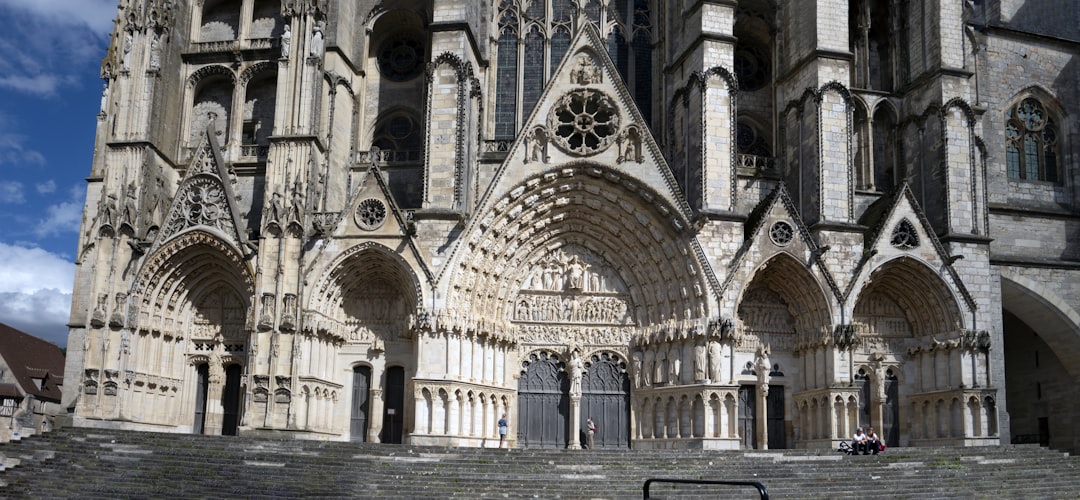
When you stand in front of Notre-Dame Cathedral in Paris, or walk the ramparts of Carcassonne, or climb the rocky path to Mont Saint-Michel, you’re looking at stones that were placed there 800 years ago. You’re experiencing the physical reality of medieval France—a world of faith, feudalism, warfare, and ambitious cathedral builders whose faith in God was as solid as the stone they assembled.
Medieval France (roughly the 5th century to the 15th century) wasn’t the France of the Revolution or Napoleon. It was a fragmented, feudal world where the king was powerful but not absolute, where the Catholic Church was arguably more important than any secular ruler, and where the idea of “France” itself didn’t really exist as a unified political entity. Yet it was medieval France that produced the architectural and artistic glories we associate with French culture, and it was medieval France that gradually transformed from a post-Roman fragmented society into something resembling a modern nation-state.
The Legacy of Rome and the Rise of the Franks
To understand medieval France, you need to go back to the end of the Roman Empire. After Rome’s collapse in the 5th century, the territory we call France was divided among various Germanic peoples—Franks, Visigoths, Burgundians. The Franks eventually became dominant, and their kingdom became Frankland (Francia), which is how France got its name.
The most important Frankish ruler was Charlemagne (768-814), who conquered vast territories and created the Carolingian Empire, which at its height encompassed most of what is now France, Germany, Italy, and other parts of Europe. Charlemagne was crowned Emperor by the Pope in 800, which seemed to suggest that Rome was being restored. But after Charlemagne’s death, his empire fragmented, partly by his own heirs’ decisions to divide power, and partly because the empire was too large to govern effectively.
By the 10th century, the Frankish realm that had become West Francia (and eventually France) was divided among feudal lords. The king ruled Paris and the surrounding Île-de-France region, but his authority was limited. Powerful dukes and counts, some of whom controlled territories larger than the king’s domain, were effectively independent. The king was theoretically the apex of feudalism, but practically his power was constrained.
Feudalism: A System of Obligations and Loyalties
Medieval France was organized around feudalism—a system where land was held in exchange for loyalty and military service. Kings granted land to nobles, who granted land to lesser nobles, who granted land to knights. Each level owed allegiance and military support to those above them. Peasants worked the land in exchange for protection and the right to use a portion of what they grew.
It’s tempting to romanticize feudalism—knights in shining armor, noble ideals of chivalry, and clear hierarchies that everyone understood. The reality was messier. Feudalism worked (when it worked) because it created networks of obligation and loyalty. If you were a lord and your vassal betrayed you, that was a violation of the most sacred relationship in medieval society. If you were a peasant, you owed your local lord labor and a portion of your crops, and in return, he was theoretically obligated to protect you.
In practice, medieval life for ordinary peasants was hard. They were tied to the land and couldn’t leave without their lord’s permission. They owed significant labor services—perhaps three days a week working the lord’s land. They had limited legal rights. If the lord was brutal, there was little recourse. Yet the system provided a kind of security—you weren’t free, but you weren’t entirely unprotected either.
The Power of the Church
Understanding medieval France requires understanding that the Catholic Church wasn’t just a religion—it was a political, economic, and cultural institution as powerful as any secular ruler. Monasteries and bishops controlled vast lands. The Church ran schools and maintained much of medieval literacy. The Pope, as head of the Church, claimed authority over all Christian rulers, including the King of France.
This created tensions. Kings wanted to control the Church within their territories. Popes wanted to maintain Church independence and authority. These conflicts simmered throughout the medieval period, occasionally erupting into open warfare between secular rulers and the Church.
The Church also provided the language of legitimacy. Kings were crowned by archbishops. They were understood to rule by divine right—God had chosen them. If a king was defeated militarily, it suggested that God had withdrawn his favor. Religious authority and political authority were intertwined in ways that sometimes supported each other and sometimes conflicted.
The Cathedral Age: Faith Made Stone
The most visible legacy of medieval France is its cathedrals. The 12th, 13th, and 14th centuries were a period of extraordinary cathedral construction. Across France, cities competed to build ever more magnificent cathedrals—taller, with more light, more elaborate decoration, more proof of the city’s wealth and faith.
Notre-Dame de Chartres, built mostly in the 12th and 13th centuries, is one of the most perfect examples of Gothic architecture. The soaring pointed arches, the ribbed vaults, the flying buttresses (architectural innovations that allowed walls to be thinner and taller), the intricate stained glass windows—all of it was designed to inspire awe and connect people to the divine. Building a cathedral was an act of faith and a form of civic pride. It employed hundreds of workers, attracted pilgrims, and demonstrated a city’s importance.
The construction of these cathedrals was staggering in scope. Notre-Dame de Reims took about 80 years to build. Notre-Dame d’Amiens took over a century. Hundreds of workers labored for their entire lives knowing they would never see the finished building. Parents and children and grandchildren worked on the same cathedral. It was a multi-generational commitment to an idea—the glory of God expressed in stone.
The stained glass windows served multiple purposes. They let light into the cathedral, creating an almost supernatural atmosphere. The light coming through the colored glass was meant to represent the presence of God. The scenes depicted in the windows told biblical stories to a population that was mostly illiterate. Images of Christ, saints, biblical scenes, and moral lessons were communicated through visual narrative. The cathedrals were, in effect, illustrated theology.
The Crusades: Medieval Warfare, Faith, and Disaster
In 1095, Pope Urban II called for a holy war to recapture Jerusalem from Muslim control. This was the beginning of the Crusades—a series of military campaigns that would continue for nearly two centuries. French nobles, including kings, participated in the Crusades in large numbers. Some went for genuine religious reasons. Some went for glory and wealth. Some went because they were obligated to their lords who were going. Most were probably motivated by some combination of all three.
The First Crusade (1096-1099) was remarkably successful in achieving its immediate goal. Crusaders fought their way to Jerusalem and established a Christian kingdom there, controlling it for nearly a century. Subsequent Crusades were less successful. The later Crusades often involved disaster—armies defeated, logistics collapsing, religious fervor not compensating for military inferiority.
The Crusades reveal medieval attitudes about faith, warfare, and the world. The idea that Christians had a religious obligation to wage war on Muslims, that violence in service of religious goals was righteous, that holy sites were worth dying for—these ideas seem alien to modern sensibilities, yet they drove medieval peoples to massive expenditure of resources, lives, and suffering.
The Crusades also created long-term consequences. They increased contact between Europe and the Islamic world and the Byzantine Empire, introducing new technologies, ideas, and goods. They created lasting resentment—Muslims remembered Crusaders and Christian violence; Christians remembered defeats and Islamic strength. The conflicts that began in the medieval Crusades still echo in modern geopolitics.
The Hundred Years’ War: Medieval Warfare at Scale
The great military conflict of late medieval France was the Hundred Years’ War (1337-1453), a conflict between the Kings of France and England over who should control French territories (particularly Aquitaine) and who should be the rightful King of France.
The war revealed the transition from medieval to early modern warfare. Early in the war, English forces, using longbows and other innovations, defeated much larger French armies. At the Battle of Crécy (1346), an English force of about 10,000 defeated a French force of perhaps 25,000. The French nobility, used to cavalry dominance, were devastated by the English archers. Hundreds of French knights were slaughtered.
The war lasted, on and off, for over a century. There were moments of English dominance and moments of French recovery. The conflict was devastating for the French countryside, where armies moved back and forth, foraging and destroying. Peasants suffered enormously. Warfare, combined with the Black Death (which killed about a third of Europe’s population in the 14th century), depopulated entire regions.
By the early 15th century, England controlled large parts of France, and it seemed possible that England would ultimately prevail. French morale was devastated. The king was weak. Rival noble families fought each other for power even while England threatened to conquer the realm.
Joan of Arc: The Warrior Who Changed Everything
In 1429, a peasant girl named Jeanne d’Arc (Joan of Arc) from the village of Domrémy experienced what she believed were divine visions commanding her to save France. Convinced that God was calling her to military leadership, she traveled to the French court and managed to convince the king and his advisors that she was genuinely chosen by God.
What followed was extraordinary. Joan was given command of a French military force. In a series of battles, she achieved stunning victories, lifting the English siege of Orléans and winning other crucial battles. She was captured, tried for heresy and witchcraft, and burned at the stake on May 30, 1431, in Rouen. She was 19 years old.
Joan’s story is complex. On one level, she was a religious fanatic who believed God spoke to her. On another level, she was a military commander who achieved remarkable results. On another level, she was a victim of a patriarchal society that put a young woman on trial and executed her. On another level, she was a symbol of French resistance and nationalism that inspired the French people to continue fighting the English.
After her death, the French slowly drove the English out of France. By 1453, the Hundred Years’ War was effectively over. France had survived and prevailed. Joan became a martyr and a national symbol. She was canonized as a saint in 1920. Her story represents something profound about medieval France—the mixture of faith and warfare, of individual heroism and collective struggle, of the possibility of transformation through commitment and sacrifice.
The Transition to Modern France
By the end of the medieval period (roughly 1453 or 1500, depending on how you mark it), France had changed significantly. The constant warfare had eliminated many of the independent feudal lords. The king’s power had grown. A sense of French national identity, weakly present in the early medieval period, had strengthened.
The Renaissance, starting in Italy and gradually spreading north, was beginning to transform European thought and culture. Printing was invented, making books abundant for the first time. The classical learning of Greece and Rome was being rediscovered and celebrated. The medieval world of faith, feudalism, and darkness was giving way to an early modern world of reason, nationalism, and humanism—at least in intellectual and elite circles.
Where to Experience Medieval France Today
For travelers interested in medieval France, there are numerous sites:
Notre-Dame de Chartres remains one of the most perfect Gothic cathedrals. The town of Chartres is easily visited from Paris, and the cathedral dominates the landscape just as it must have in medieval times.
Notre-Dame de Reims is the cathedral where French kings were crowned. It remains a stunning example of Gothic architecture, and visiting it while thinking about the importance of the coronation ceremony in medieval culture adds resonance.
Mont Saint-Michel is a medieval monastery built on a rocky island in Normandy. The dramatic setting, the medieval buildings, and the continuing pilgrimage tradition connecting it to medieval religious practice create an almost supernatural experience.
Carcassonne is a walled fortress city in southern France. Walking its ramparts and through its medieval streets, you get a sense of how medieval cities were organized and defended.
Rouen in Normandy is where Joan of Arc was executed. The city remains medieval in character, with narrow streets, half-timbered houses, and the cathedral where she was tried.
Avignon in southern France was the seat of the Papacy during the 14th century (when the Popes moved there from Rome). The Papal Palace remains one of Europe’s largest medieval buildings.
Understanding Medieval Consciousness
Walking through these medieval spaces, you encounter not just architecture but a different way of thinking about the world. Medieval people saw connections between the spiritual and material worlds that we’ve largely lost. A cathedral wasn’t just a building—it was a physical representation of heaven and divine order. A king’s power came not just from military strength but from divine sanction. A saint’s bones had power to heal and protect.
This worldview seems strange to modern people, but it made sense within medieval cosmology. Medieval people lived in a universe where God was constantly present and active, where miracles were possible, where the visible world was constantly penetrated by divine reality. This isn’t primitive superstition—it’s a coherent and deeply felt way of understanding existence.
Medieval France produced some of the greatest artistic and architectural achievements in European history. It also was filled with suffering, poverty, violence, and disease. Medieval life was often short, brutal, and painful. Yet from that world, people created works of beauty and meaning that still move us 800 years later. That combination—extraordinary achievement alongside ordinary suffering—is what makes medieval France worth understanding.




Leave a Reply