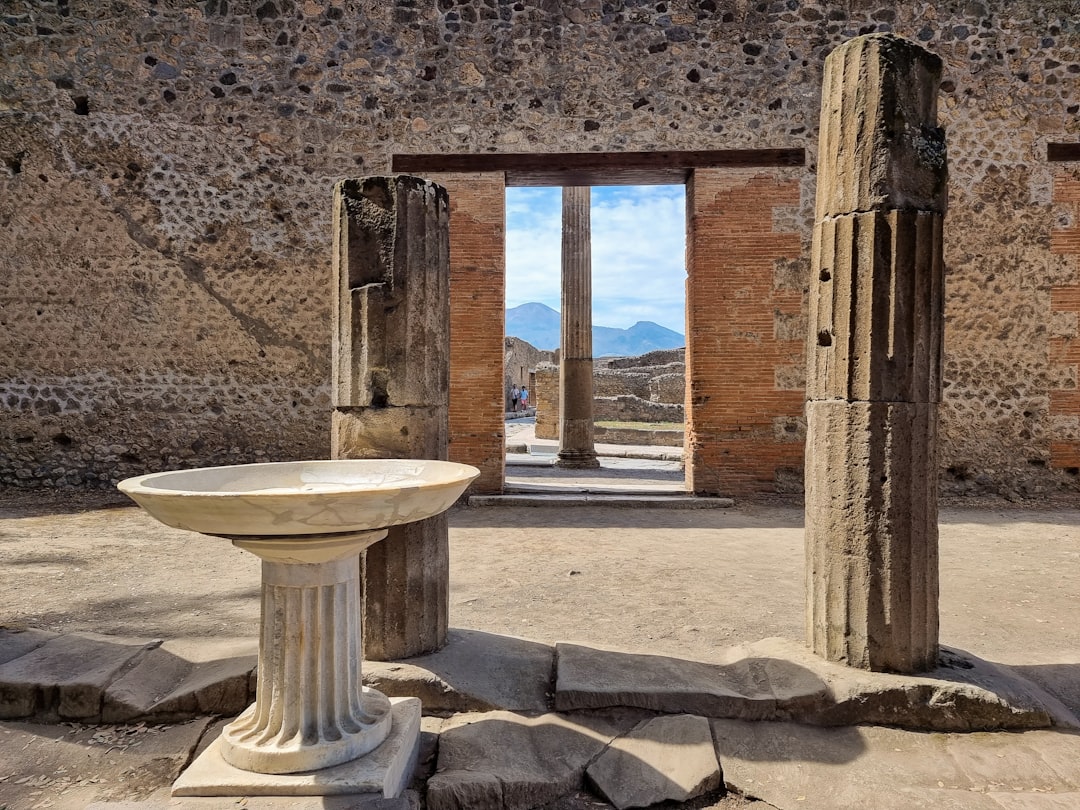
Imagine you’re living in a Roman city on the Bay of Naples in 79 AD. You’re going about your daily life—running a shop, attending the bathhouse, getting lunch from a street vendor. Then, over the course of a few hours, your entire city is buried under a toxic cloud of volcanic gas and ash. Everything—your business, your home, your possessions—is sealed under several meters of pumice and ash.
Then, 1,700 years later, archaeologists dig it all up, and your city is revealed in extraordinary detail. Your food is still in the bowls. Your graffiti is still on the walls. The skeleton of a person who tried to hide from the volcano is still in the basement where they took shelter.
This is Pompeii. And its sister city Herculaneum. These are the two best-preserved Roman cities ever discovered, and they offer an unparalleled window into what daily life in Rome was actually like.
August 24, 79 AD: The Eruption
Mount Vesuvius, which towers over the Bay of Naples, had been dormant for centuries. People living in Pompeii and the surrounding towns probably didn’t think much about it. It was just a mountain.
Then, around midday on August 24, Vesuvius erupted. Not a minor eruption—a catastrophic explosion. A column of ash and pumice rose 25 miles into the atmosphere in less than an hour. The sky turned dark. Hot ash rained down. Poisonous volcanic gases (mostly sulfurous compounds) filled the air.
Pompeii, about 6 miles from the volcano, was directly in the path. The city was buried under meters of light pumice ash. The temperature was hot but not hot enough to incinerate people. But the gases were lethal. Many people died from asphyxiation where they stood or took shelter.
Over the next day, additional pyroclastic flows—avalanches of hot gas and ash traveling at high speeds—covered the region further. Herculaneum, closer to the volcano, was buried under these flows, which preserved it differently than Pompeii.
By the time the eruption was over, Pompeii and Herculaneum were sealed under several meters of material. They were lost to history.
Pliny the Younger: Eyewitness Account
We know details about the eruption because Pliny the Younger wrote about it. Pliny was a Roman writer and politician living nearby, and he witnessed the eruption from a distance. He wrote two letters describing what he saw—they’re the most detailed eyewitness account of an ancient eruption we have.
Pliny describes the massive column of ash, the darkness at midday, the rain of pumice, the toxic air. His uncle, Pliny the Elder, was a military commander who tried to rescue friends near the volcano. Pliny the Elder died, probably from the toxic gases. Pliny the Younger’s account is matter-of-fact and observational—he’s writing as a witness to extraordinary events.
His letters are valuable not just for the historical record but because they allow us to connect the physical evidence we find (bodies in certain positions, buildings collapsed in particular ways) to what was actually happening in those final hours of the cities.
The Rediscovery: The 1700s and Archaeology
Pompeii and Herculaneum weren’t completely forgotten, but they were lost. The eruption buried them so completely that eventually the exact location of the cities was unknown. Buildings were built on top of the buried ruins. The areas were just known as places where odd pottery and artifacts sometimes turned up.
Then, in the 1710s, someone digging in the area found ancient walls. In 1748, systematic excavation of Pompeii began. What emerged was extraordinary: an intact Roman city. Not ruins like Rome, where buildings had been dismantled over centuries. An actual city, preserved in the moment of destruction.
Herculaneum proved even more interesting archaeologically. Where Pompeii was covered in lighter pumice and ash that was relatively easy to excavate, Herculaneum was buried under heavier pyroclastic flows that had hardened into a kind of concrete. It was much harder to excavate, so work proceeded more slowly. But because of the different preservation method, Herculaneum actually preserved more delicate materials—wood, fabric, food, papyri.
What the Cities Tell Us: Everyday Roman Life
When you walk through Pompeii, you’re not seeing a museum display or a reconstruction. You’re seeing an actual Roman city, frozen in the moment before catastrophe. This is precious because we know a lot about Rome from literature and from grand public buildings, but we know relatively little about everyday life.
Pompeii shows us how ordinary Romans actually lived.
The first thing that strikes you is the street layout. Streets are narrow—maybe 10-15 feet wide. Sidewalks are narrow too. The buildings open directly onto the streets. It’s dense and claustrophobic compared to modern cities.
The second thing is the graffiti. There’s graffiti everywhere—on the walls of houses, the sides of buildings, storefronts. Some of it is political (endorsements for candidates in local elections). Some is advertisements (“Gaius Sittius, cloth merchant, has good merchandise”). Some is personal (“Rufus loves Granius”). Some is just crude jokes. It’s graffiti, which means people carved or wrote on walls just like they do today. This makes Pompeii feel immediate and human in a way historical accounts don’t.
The third thing is the evidence of commerce. Pompeii wasn’t a wealthy city—it was a working city. There are bakeries with loaves of bread still in the ovens (preserved by the ash, though carbonized). There are thermopolia (essentially ancient fast food restaurants) with remnants of food in large amphorae—beans, chickpeas, meat. There are shops, workshops, laundries. People worked for a living.
The houses are also instructive. Wealthy houses are large and ornate, with multiple rooms, courtyards, and beautiful mosaics and frescoes. But most people lived in much smaller spaces—maybe a couple of rooms. Many Pompeians lived in apartment buildings called insulae, similar to modern apartment buildings, where multiple families lived in small spaces.
What They Ate
Remains of food give us precise information about what Roman diet was actually like. Pompeians ate bread (a lot of it), legumes (beans, lentils, chickpeas), nuts, and fresh and dried fruit. Fish was available—shells and fish bones are found throughout the site. Meat was less common for ordinary people, though available. Wine was universal, usually mixed with water. Olive oil was used extensively.
The carbonized remains of meals and the amphorae with food residue show a diet that was surprisingly varied and sophisticated. It wasn’t the monotonous diet we might expect. Of course, what you ate depended heavily on how much money you had. Wealthy people ate better. But even ordinary people in Pompeii had access to varied food.
What They Believed
The graffiti and inscriptions tell us about religious beliefs. There are references to the standard Roman gods—Jupiter, Juno, Mars, Venus, Minerva. There are also references to more exotic cults that had come to Pompeii through trade and contact. There are a few references to Christianity, though it’s not the dominant religion (Christianity was still a minority religion in 79 AD).
One of the most poignant elements of Pompeii is the evidence of personal relationships and daily concerns. Graffiti includes I love messages, insults directed at people, political endorsements where friends ask for votes for their favorites in elections. People cared about the same things—love, status, politics, gossip—that people care about today.
The Bodies
The most haunting aspect of Pompeii is what happened to people who were caught in the eruption. Some were killed instantly by the heat or by pyroclastic flows. Others died from the toxic gases—their lungs filled with poisonous air and they asphyxiated.
What happened to the bodies is remarkable. The ash and pumice were hot enough to decompose the bodies but cool enough that they didn’t incinerate. Over time, the bodies decomposed, leaving empty cavities in the hardened ash. In the late 1800s, archaeologists realized they could pour plaster into these cavities and create casts of the bodies—showing exactly how people were positioned when they died.
The casts are extremely powerful. You can see a mother shielding her children. A dog straining at its chain. A gladiator lying in a pose that suggests he died in pain. These aren’t abstract historical facts—they’re visible records of actual human deaths.
It’s overwhelming to see them, which is probably appropriate. These people died in a catastrophic event 2,000 years ago, and we can see exactly how it happened.
Herculaneum: Different Preservation, Different Insights
Herculaneum, Pompeii’s sister city, was buried differently. The pyroclastic flows created different conditions, and the city was buried deeper and more completely. This made excavation much harder—it’s still not completely excavated—but it meant better preservation of delicate materials.
In Herculaneum, wood survives. Furniture survives. Fabric survives. Papyri (ancient paper/parchment) survive. So we have more complete information about what people owned, how they decorated their homes, what they read.
The House of the Neptune and Amphitrite, for instance, preserves beautiful mosaics and interior decoration. The House of the Faun in Pompeii is similar, but Herculaneum versions of these houses preserve more detail about furniture, textiles, and objects.
The papyri found in Herculaneum are particularly valuable. Many are personal correspondence, business records, and literature. They give us direct access to what people wrote and thought about.
What This All Means
Pompeii and Herculaneum show us that ordinary Romans were not so different from us. They worked for a living. They had jokes and graffiti. They fell in love. They had favorite restaurants. They engaged in politics. They worried about the things people worry about.
At the same time, their world was very different. The social hierarchies were starker—slavery was universal and unquestioned. Women had fewer rights. The level of violence and disease was much higher. The technology was much simpler. The entertainment was different.
But the fundamental humanity is recognizable. You can read graffiti from a Pompeian and feel like you understand the person who wrote it. You can see a family’s dining setup and imagine them eating together. You can see a shop and imagine the shopkeeper greeting customers.
This is the power of Pompeii: it makes history immediate and human in a way that more distant sources don’t.
Visiting Pompeii and Herculaneum
When you visit these sites, try to slow down. There’s an enormous temptation to rush through—there’s so much to see, and it’s extremely crowded. But Pompeii is most powerful when you take time to imagine the lives that were lived here.
Walk down the streets. Look at the storefronts. Read the graffiti. Try to visualize what the city was like when it was full of people. Look at the casts of bodies—they’re disturbing, but they’re also a reminder of actual human tragedy.
In Herculaneum, which is smaller and less crowded than Pompeii, spend time in the houses. Look at the surviving furniture. Imagine families living in these spaces.
Both sites have museums with artifacts—cooking vessels, jewelry, tools, religious objects. These mundane objects, preserved for 2,000 years, are incredibly evocative.
Most importantly, remember that what you’re seeing is not a archaeological dig or a museum. It’s an actual city where actual people lived and died. That context makes it sacred in its own way.




Leave a Reply