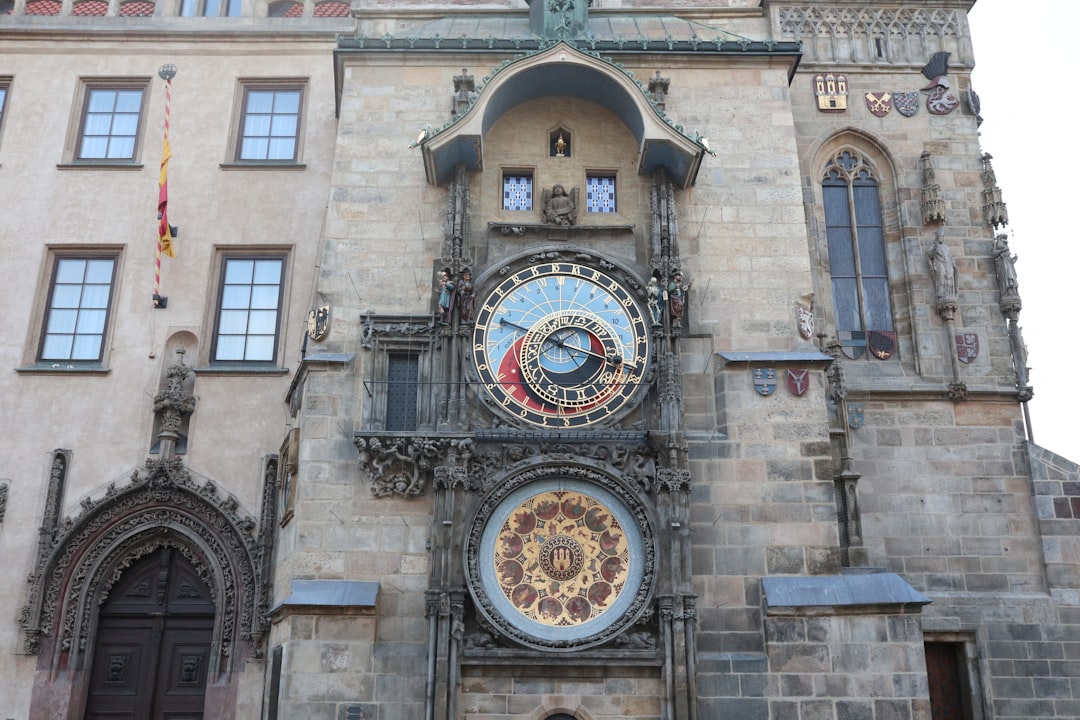
There’s a moment that happens every hour in Old Town Square, Prague—a moment that has repeated roughly 525,600 times since the clock was built. At precisely noon, or one o’clock, or three in the morning, the clock’s mechanical doors swing open and out walks the procession of the Apostles, each nodding solemnly at the crowds below. It’s a medieval show so perfectly preserved that when you stand watching it, you’re not just looking at a mechanical marvel—you’re witnessing the same spectacle that a merchant saw in 1410, or a Renaissance scholar in 1550, or a Baroque nobleman in 1700.
The Prague Astronomical Clock, known locally as the Orloj, is the oldest working clock of its kind in the world. But unlike Big Ben or other famous timepieces that announce themselves with bombastic chimes, the Orloj tells time as medieval minds imagined it should be told: as a cosmic dance of sun and moon and stars across the heavens, all governed by the mathematical laws that Renaissance intellectuals were only just beginning to understand.
The Clock That Mapped Heaven
When you step into Old Town Square for the first time, the astronomical clock doesn’t announce itself with grandeur. It sits modestly on the south wall of the Old Town Hall, a Gothic tower that would be unremarkable except for this one medieval contraption adorning its face. But look closely, and you realize you’re staring at the most sophisticated timepiece of the 15th century.
The clock face isn’t just one dial—it’s several overlapping them, each revealing different layers of cosmic information. The outer ring shows traditional Roman numerals and marks the hours. But within that sits the astronomical dial, a masterpiece of medieval science. This blue circle represents the sky of Prague at any given moment. The ecliptic—the sun’s apparent path through the heavens—is marked in gold. Moving within this dial are three hands: one tracking the hour, one the sun, and one the moon.
The second major dial below displays a calendar, decorated with scenes of medieval Prague life by a various artists. Every day at noon, you can see which saint’s day it is. The calendar changes throughout the year, its hand pointing to the appropriate date within the zodiac circle, reminding medieval pilgrims and modern tourists alike that the heavens and earthly life are bound together.
Then there’s the truly remarkable part: the Apostles. When the hour strikes, mechanical doors in the upper section of the clock open with a satisfying creak, and out step the twelve apostles—each carved in wood, each nodding with an almost Buddhist acceptance of the passage of time. Below them, a skeleton rings a bell and turns an hourglass. Death, that medieval obsession, literally punctuates the hours.
Building a Miracle
The clock was installed in 1410, though scholars debate exactly when construction began. What we know is that it emerged during Prague’s golden age—a period when the city rivaled Rome in its wealth and intellectual ambition. This was the Prague of Jan Hus, of the Bethlehem Chapel where reformist ideas were being preached, of a population approaching 50,000 (enormous for the 15th century). Prague in 1410 was a city exploding with possibility.
The original clockmaker is lost to history, though local legend credits a master named Hanuš. According to the most famous (and entirely unhistorical) legend, the city council had Hanuš blinded so that he could never build a clock as magnificent elsewhere. This story tells you more about Prague’s vanity than its history, but it’s a perfect illustration of how much pride this city took in its mechanical wonder.
The clock represented the cutting edge of medieval technology. At its heart lies a complex escapement mechanism—the same principle that governs mechanical clocks today. The movements of the heavenly bodies shown on the dial aren’t magical; they’re the result of hundreds of gears, weights, and levers, all working in precise mathematical harmony. A medieval viewer watching the sun’s hand trace across the sky wasn’t seeing superstition—they were seeing astronomy, physics, human engineering translated into mechanical motion.
What You’re Actually Looking At
Standing in Old Town Square, let’s decode what you’re seeing on that famous clock face, because understanding it transforms casual viewing into genuine wonder.
Start with the astronomical dial, the larger blue circle with gold markings. That blue represents the sky over Prague. The sun’s path (the ecliptic) is marked in gold around the edge. As the day progresses, you’re literally watching the sun’s position in the sky being tracked. The 24 hours marked around the edge aren’t conventional 1-24 hours—instead, they show medieval “Italian hours,” which began at sunset. It’s a reminder that this clock speaks a different language of time than we do.
The golden sun symbol moves across this dial continuously, showing not just the hour but also the sun’s position in the sky. This was genuinely useful information for people without watches, for travelers calculating when darkness would fall, for farmers knowing when to harvest. The moon dial, marked in silver, similarly tracks the moon’s phase and position.
Below, the calendar dial shows the months in the zodiac circle with beautiful illustrations. Each date sits within the sign of the zodiac, a medieval way of ordering the year that mingled astronomy with astrology (a distinction that didn’t matter much in 1410).
Then there’s the hourly spectacle. Bells ring—one for each hour. The skeleton on the left rings a bell in his bony hand. His companion on the right turns an hourglass. These aren’t just decorative; they’re philosophical. They’re Death and Time, reminders that every hour is borrowed, that the elaborate machinery of the cosmos grinds on regardless of human concerns.
The doors open. Out file the twelve apostles in a procession, each carrying symbols of their faith or their martyrdom. Saint Peter with his keys. Saint Paul with his sword. John with his chalice. For about forty seconds, they process across the opening while a rooster crows (or now, crows mechanically), and then—just as suddenly—the doors close. The show is over. Time marches on. Hundreds of people gather daily just to watch thirty seconds of medieval engineering and symbolism.
From Medieval Marvel to Modern Restoration
The Orloj has survived nearly 600 years of Prague’s turbulent history. It survived the Hussite Wars of the 1420s. It survived the Counter-Reformation and the Thirty Years’ War. It survived the fire of 1689. But what it couldn’t survive was April 1945 and Nazi occupation.
As Soviet forces closed in on Prague in the final days of World War II, German forces set the Old Town Hall ablaze. The astronomical clock was badly damaged. For decades, it was repaired temporarily, kept barely functional. But a medieval clock cannot be maintained halfway—either its mathematics work perfectly or they don’t. For years, the Orloj operated imperfectly, its Apostles jerking awkwardly, its dials not quite synced.
This is where modern Prague’s relationship with its own heritage becomes relevant to your visit. In 2018, after a full three-year restoration, the clock was reopened to the public. The restoration didn’t replace the medieval mechanism wholesale—instead, conservators painstakingly repaired each gear, cleaned each dial, and restored the original artwork with extraordinary care. The Apostles now walk as smoothly as they did 500 years ago. The calendar dial, covered in Renaissance paintings, gleams like new.
When you watch the clock now, you’re watching something genuinely medieval operating as the craftspeople originally intended. This isn’t a replica or a recreation. It’s the actual mechanism, the actual gears, the actual (albeit refurbished) wooden Apostles.
Prague’s Ambitions Written in Gears
The Orloj is worth your time not just as a tourist spectacle, but as a window into medieval Prague’s self-image. This was a city that had not just adopted the mechanical clock (that had spread throughout Europe by the 1400s), but had chosen to build the most complex, most cosmologically ambitious version of one.
Medieval Prague saw itself as the center of intellectual and spiritual authority. It was the capital of the Kingdom of Bohemia and seat of power within the Holy Roman Empire. The Orloj was a statement: We are sophisticated. We understand the cosmos. Our city operates according to the same mathematical principles that govern the heavens.
When you’re standing in Old Town Square at noon, waiting for the doors to open, you’re standing in one of Europe’s most perfect medieval spaces—surrounded by 15th-century buildings, watching a 15th-century astronomical instrument tick away the hours. The crowds press in around you. Tour guides in dozens of languages explain the story. And then the mechanism whirs, the doors open, and for a moment, you’re not in 21st-century Prague. You’re nowhere and everywhere at once—watching the cosmos turn, as Prague has watched it turn for 600 years.
Come for the spectacle. Stay for the science. Understand that this clock is a prayer in brass and oak, a medieval city’s way of saying: We have ordered the universe, and here is the proof.




Leave a Reply