The Ship That Carried Catastrophe
In 1349, a merchant vessel from England sailed toward the port of Bergen on Norway’s western coast. It was likely a routine trading voyage, the kind that happened regularly as northern European cities exchanged goods and merchants ventured across the North Sea. But this ship carried more than cargo and passengers. Hidden in the dark holds, traveling in the hair and fur of rats, came tiny fleas carrying a bacterium that would transform Norwegian history.
Yersinia pestis—the bacterium that causes plague—would arrive in Bergen as it had arrived throughout Europe in the preceding years. The consequence would be catastrophic. Within a generation, Norway would lose an estimated 60 to 65 percent of its population. This was likely the highest mortality rate of any European region affected by the Black Death—a pandemic that was already one of history’s most devastating events, now claiming an even higher percentage in this northern land.
The Black Death in Norway was not merely a tragedy—it was a civilizational collapse. Entire social structures would crumble. The feudal system that had organized Norwegian society would effectively end. The aristocracy would be nearly wiped out. Farms would be abandoned. The forests would reclaim the cleared land. The consequences would reshape Norwegian history for the next four centuries, pushing the country into a subordinate position from which it would take centuries to recover.
The Plague’s Arrival and Spread
The plague that arrived in Bergen in 1349 was already old news to Europe. It had originated in Central Asia in the 1340s and spread along trade routes westward. Italian merchants trading with the East had brought it to the Crimea. When the Mongols who ruled the region laid siege to a Christian trading post, they reportedly catapulted plague corpses over the walls, weaponizing disease. The disease followed merchant vessels back to the Mediterranean, reaching Genoa and Venice in 1347.
From the Mediterranean, plague spread northward into continental Europe. By 1348-49, it was ravaging Germany, France, and the Low Countries. By 1349, it had reached Scandinavia via merchant routes. Bergen, as the major northern port, was one of the first places the plague appeared. From there, traveling along trade routes and carried by infected goods and people, the disease spread to the rest of Norway.
The medieval Norwegians had no understanding of how plague was transmitted. They didn’t know about bacteria or fleas. Many attributed it to miasma—bad air—or to divine punishment for sin. Different communities attempted different responses. Some tried to isolate themselves from contact with the infected. Others attempted medical treatments that we now know were ineffective. Religious communities increased their prayers and processions. But there was nothing anyone could actually do to stop the disease. Once plague arrived in a community, it would kill until the susceptible population was exhausted or until enough people had fled that human density was too low for the disease to spread effectively.
The Death Toll
The statistics are almost incomprehensible. Norway’s population before the plague is estimated at around 350,000 to 400,000 people. Within the years following 1349, approximately 230,000 of those people died. In some regions, the death rate was even higher. In Iceland, which received the plague probably through contact with Norwegian merchants, the death rate may have exceeded 70 percent. In some rural parishes of Norway, virtually the entire population perished, leaving ghost villages where only the stone churches remained as evidence that people had once lived there.
The speed of the death was part of what made the plague so horrifying. A person could wake up healthy and be dead by evening. Entire families would fall ill within days of each other. Entire households would perish. There were insufficient people to bury the dead properly. Mass graves were dug. Bodies were sometimes stacked in churches or churchyards. The social fabric that holds communities together simply collapsed under the weight of so much death.
The psychological impact must have been almost unimaginable. Imagine a community where you know that perhaps one of every two people you see will be dead within months. Where the smell of decay is omnipresent. Where the normal functions of society—trade, governance, agriculture—are breaking down because there simply aren’t enough people alive to maintain them. Where you might see a child buried in the morning and be preparing for the funeral of an adult friend by afternoon.
The Collapse of the Aristocracy
Medieval Norwegian society was organized in a strict feudal hierarchy. At the top were the king and the great noble families—the jarls and their descendants—who controlled territory and wealth. Below them were lesser nobles and landowners. Below them were tenant farmers and serfs who worked the land and owed obligations to their lords. The church was a major landowner and power center, existing somewhat apart from the feudal hierarchy but integrated into it through church lands and ecclesiastical appointments.
The plague struck all social classes, but its impact on the aristocracy was particularly devastating. The great noble families, concentrated in the towns and major settlements where plague spread fastest, were especially hard hit. Many noble families were completely wiped out—the family line ended with the death of the last family member, and their lands reverted to the Crown or became vacant.
The king and royal authority were themselves undermined. The medieval Norwegian monarchy depended on the support of the great nobles and the church. When most of the major noble families died out, royal authority became harder to exercise. The surviving nobles and church leaders had new leverage against the king. The balance of power that had characterized medieval Norwegian politics was permanently shifted.
Moreover, the infrastructure of royal rule began to collapse. Local administrators, tax collectors, and royal agents died. Records were lost. The networks through which royal authority had been exercised disintegrated. It would take decades for any king to rebuild this administrative capacity.
The Abandoned Farms and Lost Land
Perhaps the most visible consequence of the plague in Norway was agricultural collapse. Farms that had been carved out of the Norwegian forest over centuries—representing enormous investment of labor to clear forest, establish pasture, and build dwellings—were suddenly abandoned. When an entire family died, there might be no one to inherit the farm. When survivors fled from plague zones to seek refuge elsewhere, the farms they left behind were left untended.
The forest reclaimed the land with remarkable speed. Norwegian forests are powerful and aggressive—within a few years, young trees will grow back in cleared areas. Within a generation, you couldn’t tell that the land had ever been farmed. The evidence of medieval Norwegian agrarian civilization was literally swallowed by the forest.
Archaeological evidence suggests that this process was particularly dramatic in marginal agricultural areas—places where farming had been difficult and required constant effort to maintain. In coastal and valley regions with better soil and easier farming, recovery was somewhat faster. But even in the best agricultural areas, it took decades to recover to pre-plague population levels and productivity.
The economic consequence was enormous. Norway’s wealth in the medieval period derived primarily from agriculture. With farms abandoned and agricultural production collapsed, the country’s economic output plummeted. This was exactly the moment when Norwegian independence and economic viability were being tested under the Kalmar Union with Denmark and Sweden.
The “Lost Centuries”
Historians often refer to the period after the Black Death as Norway’s “lost centuries.” This is not because nothing happened—the centuries that followed were full of events and developments. Rather, it’s because Norway’s position and prosperity declined so dramatically that the country became marginalized in northern European affairs.
Before the plague, Norway had been a significant power in northern Europe. Norwegian merchants traded internationally. Norwegian kings were respected. Norwegian sea power was formidable. But after the plague, recovery was slow. Population wouldn’t return to pre-plague levels for perhaps 200 years. The disruption of trade networks was severe. The economic foundation for maintaining a powerful state was undermined.
Into this void of Norwegian weakness stepped Denmark and Sweden. The Kalmar Union, established in 1397, was partly possible because Norway—devastated by plague, economically weakened, and with its aristocracy decimated—lacked the strength to resist. Had Norway maintained its pre-plague strength, union with Denmark and Sweden might have been structured differently, with Norway as a more co-equal partner rather than subordinate.
Instead, Denmark dominated the Kalmar Union, and Norway’s status in union with Denmark for 400 years can be directly traced to the demographic and economic collapse caused by the Black Death 50 years earlier.
Recovery and Adaptation
Yet Norway did eventually recover. The process was slow and painful, but by the 16th century, population growth had resumed. New generations of Norwegians, born after the plague, established new farms in areas that had been abandoned. The forests were partially cleared again. Trade networks were rebuilt. The country, while weakened relative to what it had been, was again functional.
What’s remarkable is that despite the catastrophe, many aspects of Norwegian culture and identity survived. The church, despite massive losses, remained and eventually recovered. The language survived. The traditions and folk culture persisted. When Norway would eventually regain independence in the early 20th century, it would do so as a nation with a continuous cultural identity stretching back to the medieval period and beyond.
The Plague’s Legacy in the Landscape
For travelers visiting Norway today, the legacy of the Black Death is often invisible but occasionally visible in the landscape and in surviving structures. The stave churches that survive from the medieval period—like Borgund, Heddal, and Urnes—are in some sense monuments to the pre-plague period. Many were built in the 12th and 13th centuries, before the plague. They survived the plague better than the communities around them, partly because of the durability of wooden construction and partly because the church maintained resources to maintain its buildings.
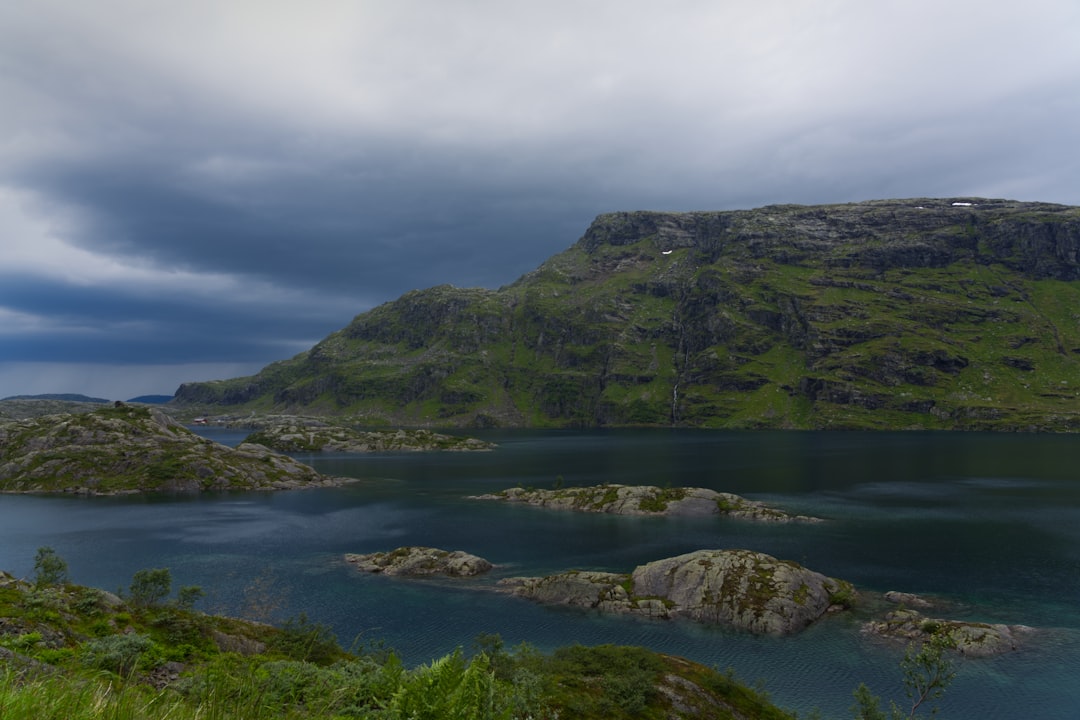
Some abandoned farms from the medieval period have been archaeologically excavated. In a few cases, the ruins remain visible—stone foundations of dwellings and barns, now surrounded by forest, haunting reminders of the communities that once thrived there before the forest reclaimed the land.
Bergen, where the plague first arrived, has maintained medieval buildings and streets dating to the pre-plague period, though the city has grown enormously since. Walking the medieval quarters of Bergen (particularly Bryggen, the Hanseatic wharf area), you’re walking through the city that was devastated by plague in 1349 and has been rebuilt and adapted ever since.
Understanding Collapse and Resilience
The Black Death in Norway represents a profound historical watershed. It marks the divide between the medieval period of Norway’s power and independence and the early modern period of subordination and recovery. It’s a reminder that civilizations are fragile, that disease can destroy social orders in ways that wars and politics cannot, and that recovery from catastrophe is slow and painful.
Yet it’s also a story of human resilience. A society that lost two-thirds of its population recovered. People moved back to abandoned villages. Farms were re-established. The demographic collapse was eventually reversed through natural population growth. The cultural continuity was maintained even through the catastrophe.
For modern travelers in Norway, understanding the Black Death provides crucial historical context for understanding the medieval landscape, the development of medieval structures, and the eventual trajectory that led to the union with Denmark, the independence movement, and modern Norway. The plague was not merely a historical event but a turning point that fundamentally redirected the course of Norwegian history.




Leave a Reply