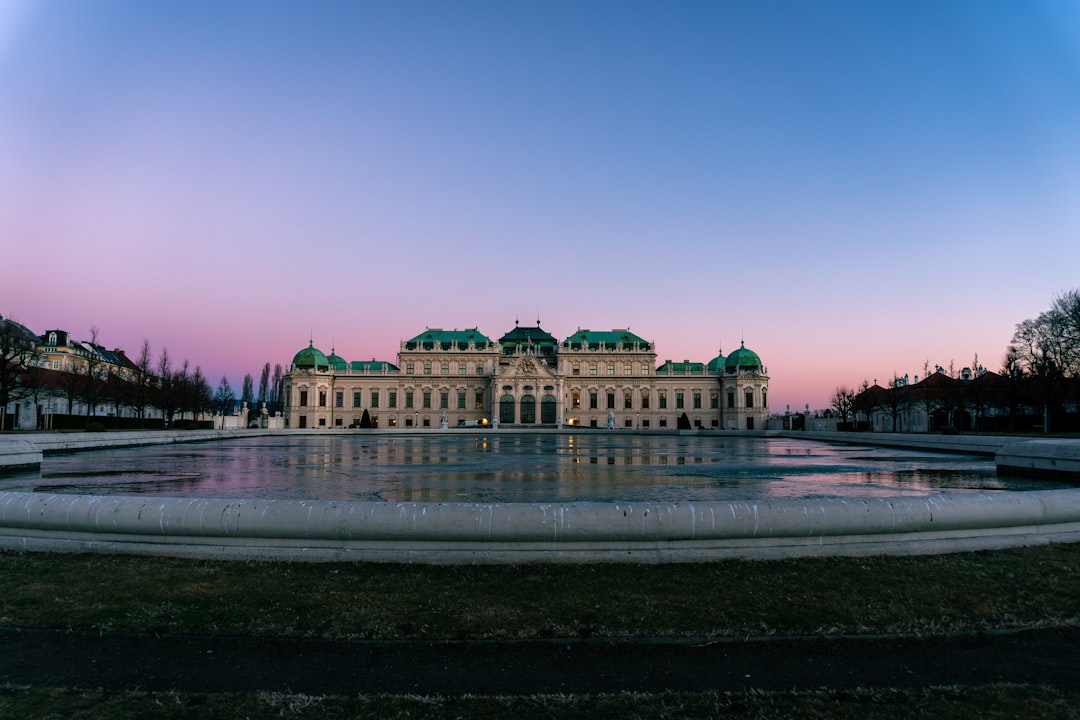
For over six centuries, the House of Habsburg ruled an empire that at various times encompassed Austria, Hungary, Bohemia, Croatia, parts of Italy, the Low Countries, and Spain. When the Austro-Hungarian Empire finally dissolved in 1918 after World War I, it left behind not only a complex political legacy but a remarkably cohesive architectural one. From Vienna to Zagreb, from Prague to Lviv, a distinctive visual vocabulary of Baroque palaces, Art Nouveau facades, grand boulevards, and ornate coffeehouses connects cities across national borders — a built reminder that these now-separate capitals were once part of a single, if fractious, imperial whole.
Vienna: The Imperial Center
Vienna was the empire’s heart, and its architecture reflects centuries of imperial ambition. Schönbrunn Palace, the Habsburgs’ summer residence, is a 1,441-room Baroque behemoth completed in the mid-eighteenth century under Maria Theresa. Its gardens, extending to a hilltop gloriette pavilion, were designed to rival Versailles — a comparison the Habsburgs would have welcomed. The Hofburg, the winter residence, is an even more sprawling complex that evolved over seven centuries, incorporating Gothic, Renaissance, Baroque, and Historicist elements into a palace city that includes the Spanish Riding School, the Imperial Treasury (home to the Holy Roman Empire’s crown jewels), and the Austrian National Library’s spectacular Prunksaal, often cited as the most beautiful library hall in the world.
The Ringstrasse, the grand boulevard that replaced Vienna’s medieval walls after Emperor Franz Joseph ordered their demolition in 1857, is a concentrated showcase of Historicist architecture — the Parliament in Greco-Roman style, the City Hall in Neo-Gothic, the Opera House in Neo-Renaissance, the Burgtheater in Baroque Revival. It was designed to project imperial grandeur and modernity simultaneously, and it succeeds magnificently.
Budapest: The Twin Capital
After the Compromise of 1867 created the dual monarchy of Austria-Hungary, Budapest became the empire’s co-capital and embarked on a building boom intended to prove that the Hungarian half was every bit Vienna’s equal. The Parliament Building, designed by Imre Steindl and completed in 1904, is a Neo-Gothic masterpiece sitting on the Danube’s Pest embankment — deliberately larger than the Austrian Parliament on the Ringstrasse. The Hungarian State Opera House, designed by Miklós Ybl, drips with gilded stucco, frescoes, and chandeliers. Andrássy Avenue, the grand boulevard connecting the city center to Heroes’ Square, was modeled on the Champs-Élysées and features a coherent row of Neo-Renaissance palaces that earned it UNESCO World Heritage status.
Prague: Baroque Over Gothic
Prague Castle, the largest ancient castle complex in the world according to the Guinness Book of Records, served as the seat of Bohemian kings and later Habsburg governors. Its architectural layers span Romanesque, Gothic, Renaissance, and Baroque periods. The city’s Baroque transformation in the seventeenth and eighteenth centuries — driven partly by the Catholic Habsburgs’ desire to stamp their authority on Protestant Bohemia after the Battle of White Mountain in 1620 — gave Prague much of its current character. The Baroque churches, palaces, and garden terraces of the Malá Strana district below the castle are among the finest in Central Europe, and the city’s Art Nouveau buildings, particularly the Municipal House with its Alfons Mucha decorations, represent the empire’s final creative flowering.
Zagreb, Trieste, and Lviv
Zagreb’s Upper Town (Gornji Grad) preserves its medieval street plan, but it is the Lower Town’s elegant nineteenth-century grid of parks, museums, and Secessionist buildings that most clearly reflects Habsburg influence. The Croatian National Theatre, a Neo-Baroque confection opened by Emperor Franz Joseph himself in 1895, anchors a sequence of park squares that feel unmistakably Austro-Hungarian in character.
Trieste, now in Italy’s northeastern corner, was the Habsburg Empire’s primary seaport. Its grand waterfront piazza, the Piazza Unità d’Italia, is one of Europe’s largest sea-facing squares, lined with imposing Austro-Hungarian government buildings. Above the city, Miramare Castle — built in the 1850s for Archduke Maximilian (who would later become the ill-fated Emperor of Mexico) — sits on a promontory overlooking the Adriatic in a romantic setting that belies its owner’s tragic fate.
Lviv, in western Ukraine, may be the most surprising Habsburg city. Known as Lemberg under Austrian rule, it was the capital of the province of Galicia and developed a magnificent city center of Baroque churches, Renaissance town houses, and Art Nouveau apartment buildings. Its Opera House, modeled on the Vienna State Opera, and its café culture — Lviv claims to have introduced coffee to the Habsburg Empire — are tangible connections to a shared Central European heritage that transcends current borders.
The Coffeehouse as Architecture
No discussion of Habsburg architectural legacy is complete without mentioning the café. The Viennese coffeehouse — with its marble-topped tables, bentwood chairs, newspaper racks, and unhurried atmosphere — was replicated across the empire and became a defining institution of Central European intellectual life. Café Central in Vienna, Café Gerbeaud in Budapest, Kavárna Slavia in Prague, and dozens of similar establishments across the former empire share a recognizable aesthetic and ethos. They are architecture in the broadest sense — designed spaces that shaped social behavior and cultural production. To sit in one with a melange and a Sachertorte is to inhabit, however briefly, the Habsburg world.




Leave a Reply