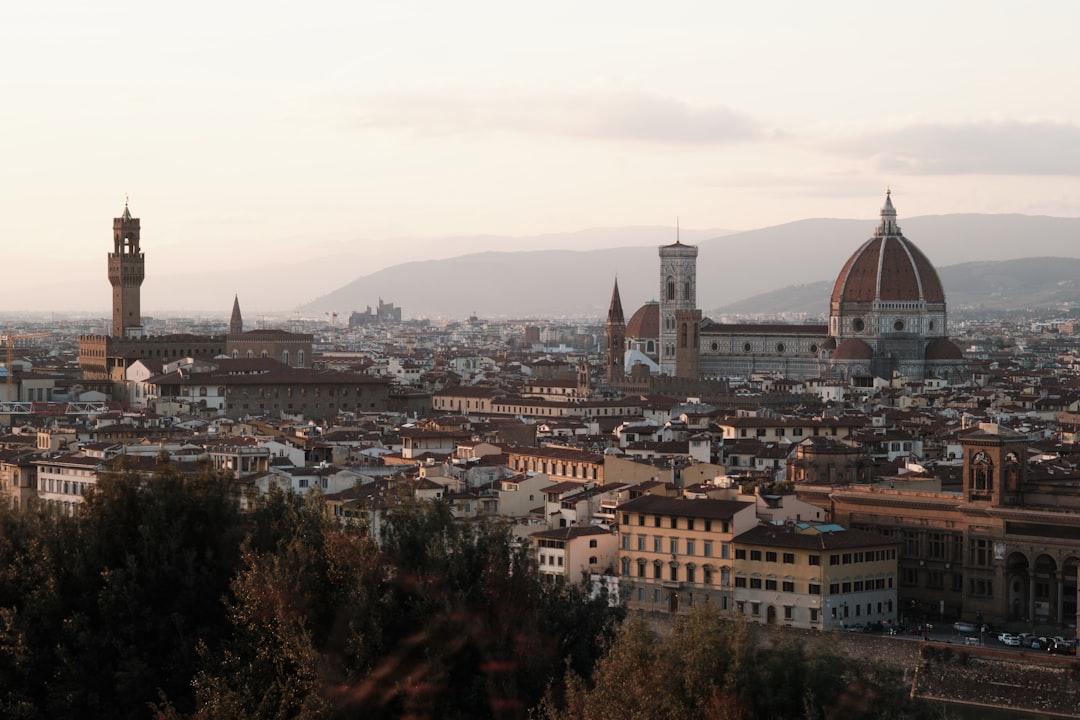
There’s a moment you’ll have in Florence—probably in front of the Duomo, probably when you’re tired and hot and questioning whether it was worth fighting through another crowd of tourists. You’ll look up at Brunelleschi’s dome, or you’ll turn a corner and see the Arno with the Ponte Vecchio and the hills beyond, or you’ll walk into the Uffizi and suddenly be surrounded by more genius per square foot than anywhere else on Earth. And you’ll understand: something genuinely revolutionary happened here. Something that changed human civilization.
The Renaissance—literally “rebirth”—wasn’t just an Italian phenomenon, but Florence was its epicenter. Between roughly 1400 and 1600, this city of maybe 60,000 people produced artists, thinkers, and scientists whose ideas we still live by today. Leonardo da Vinci. Michelangelo. Botticelli. Machiavelli. These weren’t just talented people—they were the architects of the modern world.
The Medici: From Bankers to Princes
None of this happens without the Medici family. Understanding the Medici is understanding how the Renaissance actually worked.
The Medici weren’t nobles in the medieval sense—they didn’t have ancient bloodlines or inherited kingdoms. They were merchants and bankers who got spectacularly rich. By the early 1400s, the Medici Bank was the most powerful financial institution in Europe. They loaned money to kings and popes. They essentially invented modern banking—double-entry bookkeeping, branches in multiple cities, sophisticated accounting. Money is power, and the Medici had money.
But the genius of the Medici wasn’t just that they were rich. It was that they understood that wealth could be converted into something more important: cultural dominance. They began systematically spending their money on art, architecture, and scholarship. They supported artists. They funded buildings. They collected ancient manuscripts. They created a climate where intellectual and artistic achievement was valued and rewarded.
Cosimo de’ Medici, who dominated Florence from the 1430s until the 1460s, essentially invented the Medici formula: use banking wealth to dominate the city politically and culturally, while maintaining the facade that Florence is still a republic (rather than admitting it’s run by one family). He was so effective that he was called “Pater Patriae”—the Father of the Homeland.
Then came Lorenzo de’ Medici, called “the Magnificent,” who ruled Florence from 1469 to 1492. Lorenzo inherited the family business and did something interesting: he actually reduced the amount of time he spent on banking and increased the amount he spent on politics, culture, and statecraft. He was a patron of Botticelli and Michelangelo. He wrote poetry. He was a political operator at the highest level, negotiating with the Pope and the King of Naples. He embodied the Renaissance ideal of the “Renaissance man”—someone skilled in multiple domains, who brought philosophy, art, and power together into a coherent vision of civilization.
The Platonic Academy: Ancient Ideas Reborn
Here’s something that seems boring until you understand what it means: in the 1430s, humanist scholars in Florence started seriously studying ancient Greek and Roman texts. Not just reading them, but really engaging with them—translating them, debating them, asking what the ancients could teach about how to live a good life.
This created the Platonic Academy, a gathering of intellectuals (not a formal institution, but a circle of friends and students) who met regularly to discuss Plato and other ancient philosophers. Why Plato? Because in medieval Christianity, Aristotle had been the dominant ancient philosopher, and his ideas had been integrated into Christian theology. Plato offered something different: he was a mystic, idealistic, interested in beauty and love and the transcendent. His ideas could be integrated into a kind of spiritual Christianity that was more aesthetic and less about obedience to church hierarchy.
This sounds abstract, but it was revolutionary. What the Platonic Academy did was create a framework where you could be deeply Christian AND deeply engaged with pagan ancient philosophy. You could study the human body as a beautiful creation worthy of art. You could explore the natural world. You could celebrate human potential and human achievement. You didn’t have to see the material world and human ambition as inherently sinful.
This is humanism—the intellectual movement that defines the Renaissance. Humanism says: human beings are capable of greatness. The study of the ancients teaches us about human potential. Literature, art, science, and philosophy aren’t distractions from religious devotion—they’re ways of understanding God’s creation and human dignity. It’s a shift in perspective so fundamental that it’s hard to overstate its importance.
Brunelleschi and the Dome: Engineering as Art
In 1419, Florence had a problem. The cathedral (the Duomo) had a giant hole in the roof. The plan was to put a dome on it, but no one had built a dome that size since the Roman Pantheon, 1,300 years earlier. And the Pantheon was solid—its dome was poured concrete. No one knew how to build a large dome with medieval brick and stone technology.
Filippo Brunelleschi solved it. He was an artist and an engineer—which is to say, a typical Renaissance man. He spent years studying Roman structures, understanding how they worked. He designed a double dome: a thicker outer shell and a thinner inner shell, with a gap between them. He invented scaffolding and hoisting equipment. He figured out how to build the dome in such a way that it could support its own weight as it went up, without needing a wooden framework underneath. It was an engineering triumph and a work of art—still one of the most beautiful architectural features in the world.
The dome was built between 1420 and 1436. When it was completed, it was the largest dome in the world since the Pantheon. It proved something crucial: that medieval and Renaissance technique and ingenuity could solve problems that seemed insurmountable. Brunelleschi became famous. Florence’s artistic reputation was sealed. The dome became a symbol of Florentine excellence and still is—it’s the heart of the city, visible from most vantage points, impossible to miss.
When you see the dome in person, its beauty is obvious. What’s less obvious is that it’s also a technological marvel—a problem solved through engineering genius combined with artistic sensibility. That combination is very Renaissance.
Michelangelo’s David: The Ultimate Human
In 1504, Michelangelo’s David was unveiled in Florence’s Piazza della Signoria. It’s 17 feet tall. It was carved from a single piece of marble that earlier sculptors had deemed unusable. It’s the most famous sculpture in the world, and it deserves to be.
What’s extraordinary about David is the combination of technical mastery and psychological insight. Technically, the anatomy is perfect—Michelangelo understood the human body at the level of a surgeon (he dissected cadavers to learn it). But it’s not a cold, clinical accuracy. The body is idealized—beautiful, powerful, tense. And the face and posture are psychologically complex. You can see the moment right before David fights Goliath—he’s calm, focused, maybe a bit wary. There’s intelligence in his face. This is a heroic figure, yes, but also a human being.
The David represents the Renaissance belief in human potential and human dignity. This is a regular guy—a shepherd—but he’s also heroic, strong, intelligent, beautiful. He’s worthy of being sculptured in marble. He’s worthy of attention and admiration. The medieval Christian tradition was often suspicious of the human body and human achievement. David says: the human form is beautiful. Human ambition is worthy. Human beings have potential for greatness.
When you see the David in the Accademia, you should spend time with it. Really look at it. Notice how the weight shifts onto one leg. Notice the muscles in the abdomen. Notice the expression on the face. You’re looking at technical mastery combined with a deep understanding of human psychology and human beauty. It’s one of those artistic works that genuinely lives up to its reputation.
Leonardo: The Obsessive Genius
Leonardo da Vinci is maybe the ultimate symbol of Renaissance achievement because he simply couldn’t be confined to one domain. He was a painter (the Mona Lisa, the Last Supper, both in Italy). He was an engineer who designed weapons, bridges, and flying machines centuries ahead of his time. He was a scientist who dissected bodies and studied anatomy. He was an architect. He wrote backwards in mirrored script in his notebooks (probably to save ink and keep his notes private). He was obsessed with understanding how everything worked.
The Last Supper, painted in a monastery in Milan, is one of the most influential paintings ever made. What makes it revolutionary is that Leonardo was interested in psychology. His earlier painters might have painted the Apostles as a static line of figures. Leonardo paints the moment after Jesus says “one of you will betray me.” Each Apostle reacts differently—some are shocked, some deny it, some are confused, some angry. The composition draws your eye to Jesus at the center, but the drama is in the reactions around him. It’s a painting about human emotion and human psychology, not just religious iconography.
Leonardo kept detailed notebooks—thousands of pages survive. He sketched ideas, observations, anatomical drawings, mechanical designs. Some of these designs (helicopters, tanks, flying machines) wouldn’t be actually built for centuries, but they show the Renaissance understanding that human ingenuity could solve problems, could understand nature, could innovate.
Leonardo represents the Renaissance ideal at its most ambitious: human intelligence can understand and improve upon nature. We have the capacity to see how the world works and to make things that were previously impossible. It’s a worldview that’s fundamentally optimistic about human potential.
Botticelli and the Birth of Venus: Pagan Beauty Returns
Sandro Botticelli painted the Primavera (Spring) and the Birth of Venus, which hang in the Uffizi. The Birth of Venus is maybe the most distinctly Renaissance painting you’ll see—it depicts the ancient Roman goddess of love emerging from the sea on a shell. It’s pagan subject matter, which would have been unthinkable in medieval Christian art.
What Botticelli does is paint Venus as a figure of profound beauty and grace—but also as a symbol of love and human connection. The attendants around her are dressed in elaborate Renaissance clothing. The landscape is idealized and beautiful. The painting celebrates sensuality and beauty as worthy of artistic attention. It’s not religious, but it’s also not debauched—it’s a sophisticated meditation on love, beauty, and human experience.
Botticelli was one of the first major Renaissance painters, and his work bridges medieval and Renaissance sensibilities. But the Birth of Venus is unmistakably Renaissance in its celebration of human beauty and classical themes.
Machiavelli: Power as It Actually Is
In 1513, Niccolò Machiavelli—a politician and military theorist—wrote The Prince, a book about how to acquire and maintain political power. It was genuinely shocking because Machiavelli was willing to describe politics as it actually is, not as it should be ideally.
His central insight: sometimes a leader has to do immoral things to maintain power. A prince should be willing to lie, to break promises, to use cruelty when necessary. He shouldn’t be cruel for pleasure, but he shouldn’t shy away from it either. The goal is to maintain power, and idealism can get in the way of that goal.
This was revolutionary because it was fundamentally honest. Earlier political theory was often written by clergy or philosophers who assumed that rulers should follow Christian or philosophical virtues. Machiavelli was saying: no, rulers do what they have to do to survive, and if you want to understand politics, you need to understand that.
The Prince became (and remains) one of the most influential political texts ever written. It’s been seen as immoral (hence “Machiavellian” becoming a synonym for cynical manipulation) and as a profound insight into how power actually works. You can read it either way.
Savonarola: The Backlash
Not everyone was thrilled with the Renaissance. In the 1490s, a Dominican friar named Girolamo Savonarola began preaching against the materialism, paganism, and immorality he saw in Florence. He gave passionate sermons about returning to religious purity. For a few years, he had enormous influence, and Florence briefly became a more religiously conservative place.
Savonarola orchestrated the famous “Bonfire of the Vanities” in 1497, where friars collected objects considered sinful—cosmetics, worldly books, paintings of secular subjects—and burned them. Some of these might have included works by Renaissance artists. Savonarola represented a kind of medieval religious conservatism pushing back against Renaissance humanism and celebration of earthly beauty.
But Savonarola overreached. He began claiming direct communication from God. He opposed the Pope. Eventually, he was arrested, tried for heresy, and executed by burning in 1498. His backlash against the Renaissance was ultimately unsuccessful, and Florence soon returned to its celebration of art, humanism, and the pursuit of beauty.
Savonarola’s brief ascendance reminds us that the Renaissance wasn’t universally loved. There was genuine anxiety about the celebration of paganism, the focus on human potential rather than God, the attention to earthly beauty rather than spiritual truth. But ultimately, the Renaissance vision won out—at least in the cities and among the educated elite.
Visiting the Heart of the Renaissance
When you visit Florence, you’re visiting the place where the modern world was invented. The key sites:
- The Duomo and Brunelleschi’s Dome: Stunning architecture, the symbol of Florence. Climb the dome if you’re up for it—the view is worth it.
- The Uffizi Gallery: One of the world’s greatest art museums. You’ll see Botticelli, Leonardo, Michelangelo, and dozens of other Renaissance masters. Go early or book ahead—it’s always packed.
- The Accademia: Home to Michelangelo’s David. Yes, seeing it in person is as impactful as you hope.
- The Palazzo Medici: The family home, with beautiful Renaissance architecture and decoration. More intimate than the big museums.
- San Marco Monastery: See the frescoes by Fra Angelico, and learn about Savonarola’s brief rule.
Florence is more than a museum of dead art. It’s a place where human beings once decided that beauty, art, science, and philosophy were worth devoting enormous resources to. Where a family of bankers decided to make their city a center of human achievement. Where artists and thinkers pushed the boundaries of what was possible. That ambition shaped the modern world, and you can still feel it in the streets.




Leave a Reply