Imagine stepping into Stockholm’s medieval city center, Gamla Stan, on a chilly November morning in 1520. The narrow, winding streets are filled with anticipation. King Christian II of Denmark has just conquered Sweden, ending a century of complicated union between the two countries. He has promised amnesty for Swedish nobles who opposed him. Now he will be crowned king of Sweden in a solemn coronation ceremony. The great and the good of Swedish nobility have gathered—more than 80 of them—for what they believe will be a celebration of the establishment of a new reign and the end of conflict. They are dignitaries, nobles, bishops, and military leaders. Many are dressed in their finest. They have brought their families. The city is decorated. There is a sense of occasion.
What happens next is one of the most shocking events in Scandinavian history. Within days, those same nobles would be executed in the main square. King Christian II would break his promise of amnesty and order a massacre of the Swedish nobility. The bloodletting would be so brutal and the betrayal so profound that it would trigger a national uprising, lead directly to Swedish independence, and establish a dynasty that would rule for centuries. The Stockholm Bloodbath of 1520 is not just a historical event; it is a foundational trauma in Swedish identity, the moment when Swedes united against foreign rule and established the nation-state that would become modern Sweden.
The Kalmar Union and Swedish Discontent
To understand the Bloodbath, you must understand the Kalmar Union. In 1397, the three Nordic kingdoms—Denmark, Norway, and Sweden—were united under one monarch through the Kalmar Union. In theory, it was a union of equals, three independent kingdoms sharing a single ruler. In practice, Denmark, the largest and most economically powerful kingdom, dominated the union. Swedish nobility found themselves subordinate to Danish authority. Trade was controlled to benefit Danish merchants. Swedish resources flowed to Denmark. Over more than a century, Swedish resentment of the union intensified.
By the early 16th century, Swedish opposition to Danish domination had become explicit. Swedish nobility and clergy sought greater autonomy, resisting Danish authority and sometimes rebelling against it. There was a genuine independence movement, not yet focused on total separation from the union, but demanding Swedish self-determination and freedom from Danish control. The situation was volatile and unstable.
Christian II of Denmark came to power in 1513, determined to reassert firm Danish control over the union and to crush the growing independence movement in Sweden. Swedish nobles who had opposed union had to be dealt with. Christian gathered his forces, invaded Sweden, and by 1520 had defeated Swedish opposition militarily. Now he needed to consolidate his victory. The coronation ceremony in Stockholm would be the occasion to establish his authority and, he hoped, to reconcile the Swedish nobility to Danish rule.
The Coronation and the Feast
The coronation of King Christian II as king of Sweden took place on November 4, 1520, in the great cathedral in Stockholm. The ceremony was grand and formal, carefully choreographed to demonstrate the legitimacy of Christian’s rule and the submission of Swedish nobility to the Danish king. Christian II was careful to be respectful, to honor Swedish traditions, and to present himself not as a conqueror but as the rightful king of Sweden.
Following the coronation, Christian invited the Swedish nobility to a banquet—a celebratory feast to mark the occasion and to demonstrate goodwill toward the Swedish elite. This was meant to be a moment of reconciliation, a chance for Christian to show magnanimity and for Swedish nobles to accept his rule graciously. More than 80 nobles accepted the invitation, gathering at the king’s residence for what they believed would be a festive occasion. They came in good faith, believing that Christian’s promise of amnesty was genuine.
What happened next is disputed by historians regarding the exact sequence of events and Christian’s intentions, but the broad outline is clear. As the feast progressed, Christian’s guards surrounded the building. Swedish nobles found themselves trapped. Christian accused them of heresy—a charge related to their support for Swedish independence and resistance to papal authority. He declared them traitors and heretics who had broken their oath of loyalty.
The Executions in Stortorget
Over the next few days, the arrested nobles were taken to Stortorget, the main square of Stockholm’s old city, and executed. The killings were brutal and methodical. They were not quick military executions but public killings designed to intimidate and to demonstrate Christian’s absolute power. The square ran with blood. Bodies were left on display. The city watched in horror as the Swedish elite were slaughtered. Estimates vary, but approximately 80 to 100 people were killed—nobles, bishops, merchants, family members. Some sources suggest the number may have been higher.
The execution of such a large number of the Swedish elite, in such a public and brutal manner, was unprecedented. It violated every principle of medieval chivalry and nobility. More important, it violated Christian’s explicit promise of amnesty. The nobles had come believing they were safe, believing the king had promised they would not be punished for past opposition. The betrayal was complete and shocking.
Why did Christian order the massacre? Historians debate the king’s motives. Some argue it was genuine fear of Swedish rebellion and a decision to eliminate the leadership of potential opposition. Others suggest Christian simply wanted to eliminate rivals and consolidate absolute power. Some point to Christian’s character—he had a reputation for ruthlessness and paranoia. Whatever the motivation, the effect was catastrophic for Christian’s rule in Sweden and for the Kalmar Union itself.
The Aftermath: Stortorget’s Red Buildings
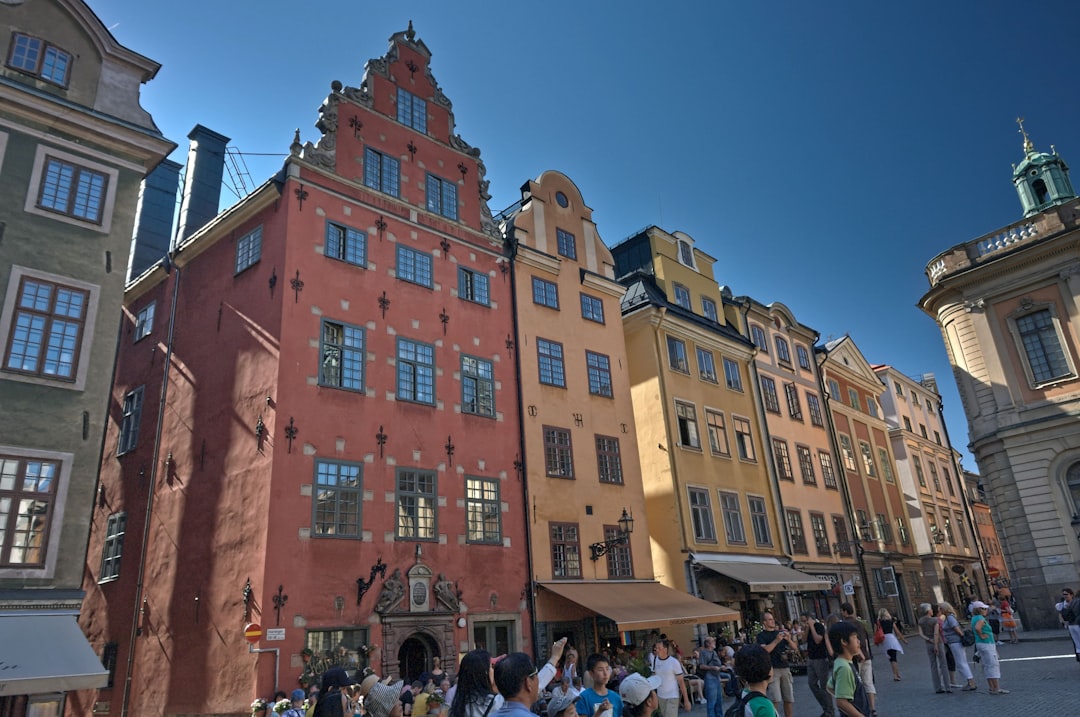
Today, Stortorget remains the heart of Stockholm’s Old Town. The square is beautiful and well-preserved, with colorful buildings surrounding it. But these buildings—painted in soft oranges, yellows, and reds—are connected directly to the Bloodbath. In the centuries following the massacre, the buildings around Stortorget were rebuilt and painted, and according to tradition, they were painted in shades of red and orange to commemorate the blood spilled in the square. Whether this is literally true or a romantic tradition, the red buildings of Stortorget have become the physical memorial to the Bloodbath.
For travelers standing in Stortorget today, the irony is striking. The square is peaceful, picturesque, filled with tourists taking photos and eating ice cream. Cafes and restaurants surround the square. It looks like a European postcard. Yet this is the place where one of the most shocking acts of medieval political violence occurred. The contrast between the beauty and peace of the square today and the horror that occurred there is part of what makes the Bloodbath so affecting when you stand in the actual location.
Gustav Vasa and the Swedish Uprising
The massacre backfired catastrophically for Christian II. Rather than frightening the Swedish elite into submission, it unified them in outrage and determination. The surviving relatives of the executed nobles, the lower nobility and gentry who had not been at the feast, and common people who were appalled by the violence, all joined in opposition to Christian’s rule.
A young noble named Gustav Eriksson, who later became known as Gustav Vasa, emerged as the leader of the Swedish resistance. Gustav had not been at the coronation feast; he survived the Bloodbath. He mobilized support for an uprising against Christian II and Danish rule. In a series of campaigns, Gustav’s forces defeated the Danish troops occupying Sweden. By 1523, Christian had been overthrown and driven from Sweden. Gustav Eriksson was elected king of Sweden, establishing the Vasa dynasty that would rule Sweden for centuries.
The Swedish independence movement, which had been growing throughout the 15th and early 16th centuries, was crystallized and accelerated by the Stockholm Bloodbath. The massacre made clear to Swedish nobles and common people alike that Danish union meant subordination and danger. Separation was necessary. The Bloodbath, in this sense, created modern Sweden by making Swedish independence not an abstract idea but an urgent necessity.
Gustav Vasa and the Establishment of Sweden
Gustav Vasa (1496-1560) became one of Sweden’s greatest kings. He established the Vasa dynasty and laid the foundation for Swedish greatness. He reformed the church, aligning Swedish Protestantism with royal authority. He strengthened the military and consolidated royal power. He expanded trade and economic development. By the time of his death, Sweden was an independent, centralized nation-state with a strong monarchy and growing power.
The Vasa dynasty that Gustav established would rule Sweden for a century. His descendants included Gustavus Adolphus, the “Lion of the North,” who made Sweden a great European power during the Thirty Years’ War. The Vasa line established Sweden’s position as an independent nation and a significant player in European politics.
Historical Interpretation and Legend
Over the centuries, the Stockholm Bloodbath became increasingly mythologized in Swedish popular consciousness. The event was presented as a founding trauma—the moment when Swedes united against foreign tyranny and established their independence. The narrative of the Bloodbath became central to Swedish national identity. Swedish schoolchildren learned the story. Swedish artists painted the scene. Historians debated and analyzed it.
Modern historians have questioned some elements of the traditional narrative. Some scholars suggest that the execution of heretics, while brutal, was not unprecedented for the time period. Others note that Christian’s motives may have been more complex than simple tyranny. Some question whether the death toll was actually as high as tradition suggests. These revisionist accounts don’t deny that a massacre occurred or that it was shocking and unjustified, but they suggest that the traditional Swedish narrative may have romanticized and exaggerated elements of the event.
Yet even accounting for historical reinterpretation, the Stockholm Bloodbath was undeniably a major event with major consequences. The execution of a large number of Swedish nobles, in violation of a promise of amnesty, did trigger a national uprising. It did lead directly to the establishment of Swedish independence and the Vasa dynasty. Whether the exact details match the traditional narrative or not, the broad outlines are clear: the Bloodbath was a watershed moment in Swedish history.
Visiting Stortorget: The Physical Site
For travelers to Stockholm, Stortorget is essential. It’s not a major tourist attraction in the way that the Vasa Museum or the Royal Palace is. It’s quiet, peaceful, and easy to miss if you’re rushing through Gamla Stan. But it’s the location of one of the most significant events in Scandinavian history. Standing in the square, reading the plaques that commemorate the Bloodbath, you’re standing in the actual location where history turned. The juxtaposition of the peaceful, beautiful square today with the horror that occurred there five centuries ago is powerful and affecting.
The Stockholm Museum and the Medieval Museum both address the Bloodbath and the medieval history of Stockholm. If you want a deeper understanding of the context and consequences of the event, these museums provide excellent information and artifacts.
Conclusion: Violence and Foundation
The Stockholm Bloodbath is not a comfortable historical narrative. It’s not a story of great civilizations or heroic deeds. It’s a story of betrayal, violence, and the shattering of trust. Yet it is also a story of resilience—of a people who, faced with treachery and violence, united to establish their independence and create a nation.
The Bloodbath reminds us that modern nations, for all their peace and order, often emerged from violence and trauma. Sweden, now one of the world’s most peaceful and law-governed societies, was founded as a nation through rebellion against foreign rule. The irony is not lost on modern Swedes. Swedish national identity is shaped by a founding moment of violence and betrayal, yet modern Sweden is a nation that explicitly rejects violence and values peace.
For travelers seeking to understand Sweden, the Stockholm Bloodbath offers a window into the past and into how national identity is formed. It’s a reminder that history is not always simple or comfortable, and that even the most peaceful modern nations have violent and complicated origins. Standing in Stortorget, surrounded by red buildings and peaceful crowds, you’re encountering Swedish history at its most profound level—the moment when a people decided they would be free.




Leave a Reply